Showing posts with label peace. Show all posts

Tuesday, 20 June 2017

Three Horses

Unlike Alex Colville's Horse and Train (1954) or Church and Horse (1964), which evoke a sense of urgency and unease, Three Horses (1946), evokes a feeling of peace and tranquility.  Three horses, one brown, one rust-coloured and one grey, gather in a field of hay.  A barn sits in the background.  White clouds fill the sky.  It seems like all is well with the world.

Three Horses comes on the tail end of the Second World War.  Perhaps Alex Colville, after coming off the battlefield where he sketched scenes of horror and devastation, is content to just sit in a farmer's field and sketch horses.  He surrounded himself with animals all of his life, a source of companionship.  "Colville viewed animals as essentially innocent -- incapable of malice unless conditioned so by humans." (http://www.welcometocolville.ca/animals)


Tuesday, 13 June 2017

Church and Horse

"More than any other artist in Canada, Colville's images permeate both our psyche and our everyday life." (Toronto Star)


Alex Colville's Church and Horse contrasts a peaceful white-clapboard church with a spooked black horse.  The sanctuary of the church is contrasted with the dangers of the outside world.  A foreboding sky hovers over the church and horse.  The gate remains open, ready for the horse to bolt right through it.

Painted in 1964, "JFK's funeral is the subtext for Church and Horse, a painting that I never understood until this encounter.  We watch that big black riderless horse in the funeral procession...then meet him again, galloping madly through Colville's painting." (https://barczablog.com/2014/08/29/alex-colville-love-and-menace/)

No one will forget the image of little John F. Kennedy Jr. saluting his father's coffin; of the veiled widow Jacqueline, clasping each of her child's hands; of Caroline Kennedy sneaking a hand under the American flag, as if to touch her father one last time; of the riderless horse clip clopping behind the slain President's coffin as it made its way to Arlington Cemetery.  Colville's horse conveys some of the public's unease felt in the turbulent months after JFK's assassination (http://alinefromlinda.blogspot.ca/2013/11/one-brief-shining-moment-interrupted.html).


Sunday, 13 December 2015

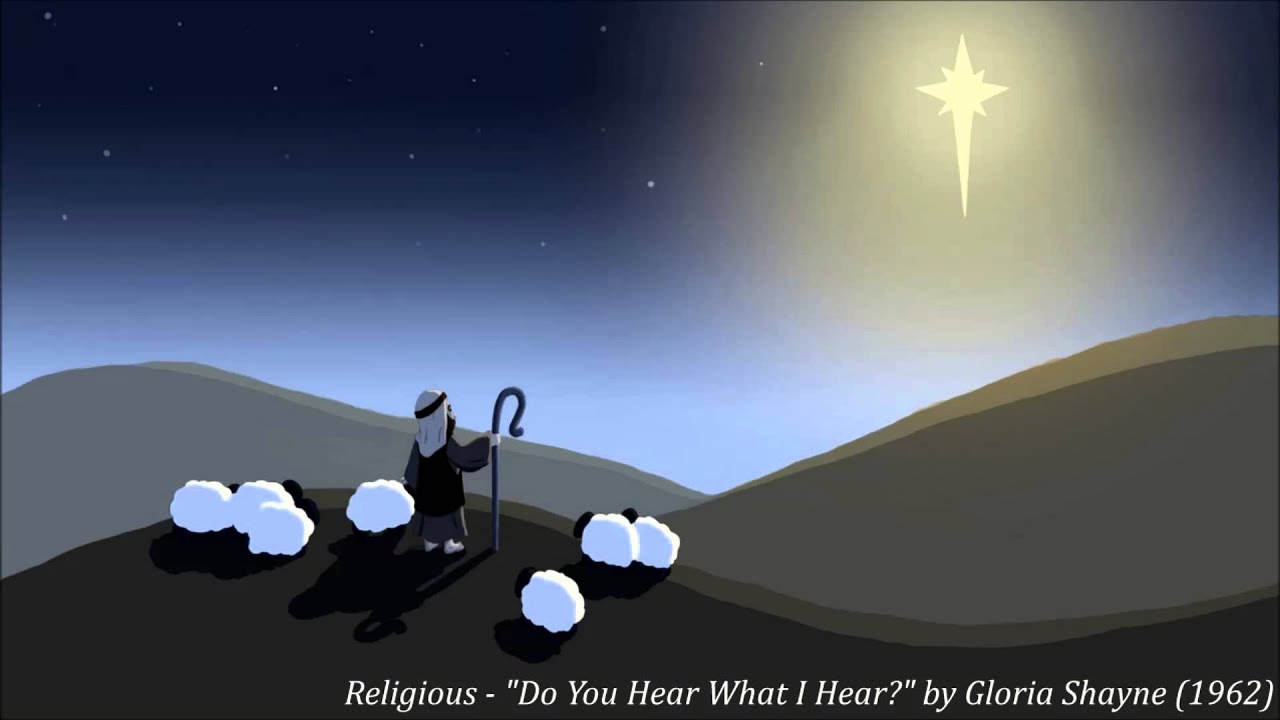
Noel Regney & Gloria Shayne's "Do You Hear What I Hear?"

Said the night wind to the little lamb,
Do you see what I see
Way up in the sky, little lamb,
Do you see what I see
A star, a star, dancing in the night
With a tail as big as a kite
With a tail as big as a kite.


In October of 1962, Noel Regney walked down the street in Manhattan, discouraged and disillusioned.  The world was on the brink of war:  America and the U.S.S.R. were arguing over missiles recently built in Cuba, aimed at the United States.  Rather than enjoying the autumn colours in their backgrounds, people were building bomb shelters.  The tension was so real, they could feel it.

Noel Regney was no stranger to war.  Born and raised in France, he had been drafted by the Germany Army during the Second World War.  Unbeknownst to the Germans, he went underground as part of the French Resistance.  Wounded during the war, some suspect he was hit by the French, to protect his identity from the Germans.

Noel Regney survived the war and in 1952, he immigrated to the United States.  The composer was smitten by a young singer named Gloria Shayne.  After a whirlwind courtship, the couple married.  Shayne was a talented lyricist, Noel a talented composer, so the two teamed up to write songs.  "Rain, Rain Go Away" was one of their trademark tunes.

However, in October of 1962, their arrangement changed.  As Noel walked down the Manhattan streets with a heavy heart, he looked up and spotted two babies in carriages.  He was struck by their joy and innocence.  They gave him hope.  Back at his apartment, he started to compose a Christmas song about the hope that the two babies brought, despite the world being on the brink of war.  Noel's wife, Gloria, wrote the music.  Do You Hear What I Hear? was the result.

"Pray for peace, people everywhere" became Noel's plea.  The two babies became the "little lamb".  "A star in the night" brought hope.  A "child sleeping in the night", the baby Jesus, brought "goodness and light".  Noel and Gloria struggled to perform the song at first, explaining:  "Our little song broke us up.  You must realize there was a threat of nuclear war."

The carol was first recorded on Thanksgiving of 1962 by the Harry Simeone Chorale.  However, it was Bing Crosby who made it a hit with his recording of October 1963 (https://www.youtube.com/watch?v=XuE_DXrt2Js)  The carol was by far the biggest hit for Noel and Gloria Regney.   

The Cuban Missile Crisis was resolved after a few weeks, in large part thanks to President John F. Kennedy's levelheadedness and diplomacy (see http://alinefromlinda.blogspot.ca/2012/10/october-14.html and http://alinefromlinda.blogspot.ca/2015/09/the-cuban-missile-crisis-kennedys.html).  Sadly, the President didn't get to enjoy the peace that resulted as he was assassinated only a year later in November of 1963.




Sunday, 18 October 2015

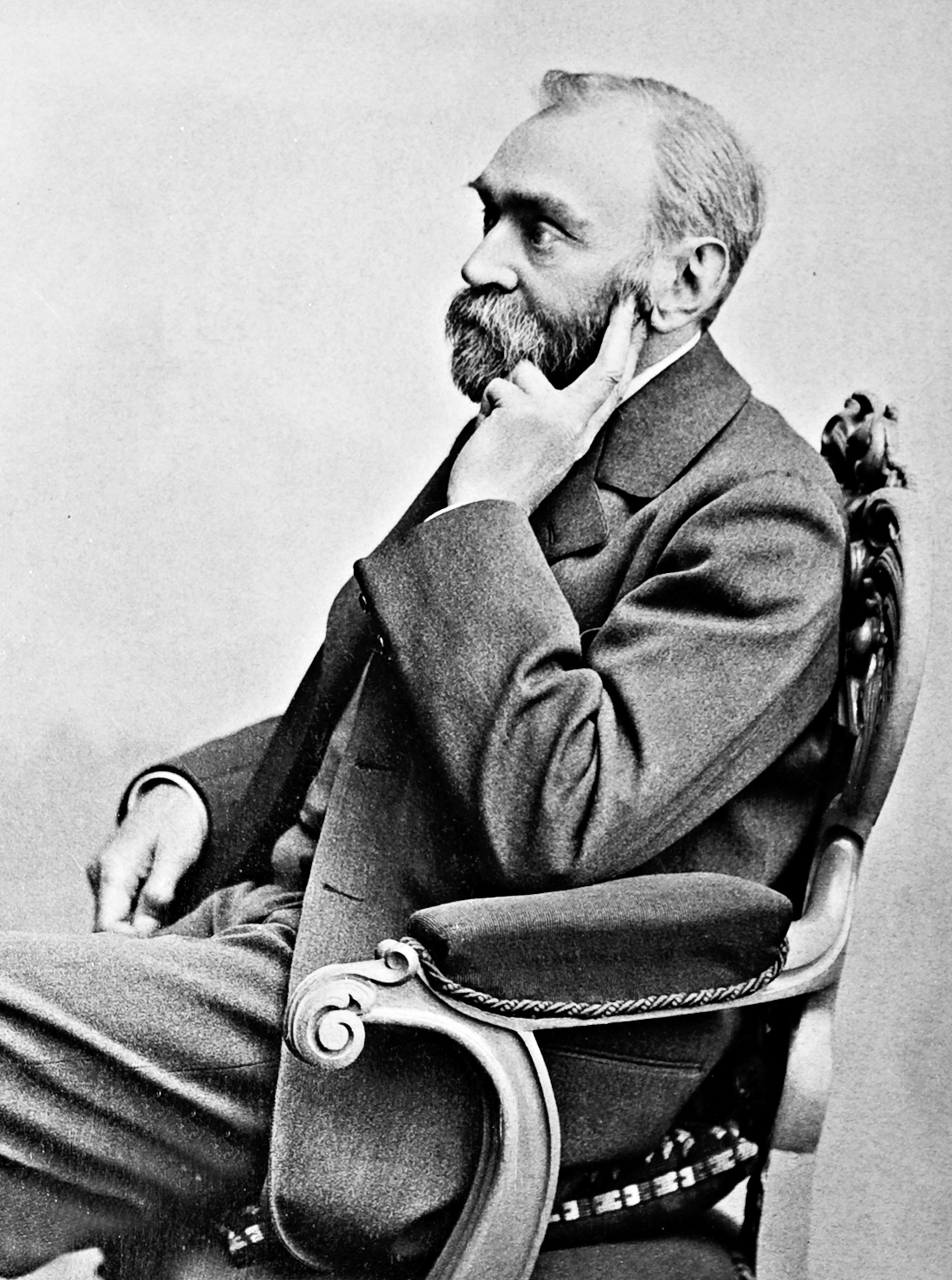
Alfred Nobel: Merchant of Death Became Champion of Peace

"The Merchant of Death is dead." (French newspaper, 1888)


"The Merchant of Death is dead," reported a French newspaper in 1888, mistaking Emil Nobel for his brother, Alfred.  Alfred Nobel, the inventor of dynamite, did not want to go down in history with such a moniker.  Childless and single, he decided to leave his fortune to a prize championing the cause of peace.  

Alfred Nobel was born into poverty in Stockholm, Sweden.  His father, an engineer, later built a decent career building bridges and buildings.  However, the economy suffered and downswing and Mr. Nobel declared bankruptcy.  Later, he moved to St. Petersburg, Russia where he finally enjoyed some financial success.

From a young age, Alfred demonstrated a passion for knowledge.  He particularly loved poetry and dabbled in it as a youth.  However, his father, wanting him to be an engineer, discouraged his study of literature.  Alfred also showed a passion for languages, becoming fluent in Swedish, German, French and Russian, English, which would serve him well in his world travels.  Alfred's knowledge of the latter was vast enough to write poetry in it.

Mr. Nobel sent his son to Paris, France to study science.  Later, Alfred moved to America to study under the engineer John Ericsson, who built the Civil War ship the USS Monitor.  While in Russia, Alfred studied under chemist Nikolai Zinin.  

Alfred fell in love with chemistry and devoted the rest of his life to studying it.  He was particularly interested in inventing a substance that would detonate nitroglycerin safely.  His patent for dynamite followed in 1867.  While he lost his brother Ludwig to a chemical experiment in 1888, he continued to work in the field.  Eventually he filed 355 patents and opened a worldwide network of almost 100 factories.  Alfred amassed a fortune of $9 million, which he donated to the Nobel Prize upon his death.

For more information, visit http://www.mensxp.com/special-features/today/10506-historys-best-inventors-alfred-nobel.html.


Sunday, 16 November 2014

Advent: The Season of Anticipation

Today at church Jacqueline and I helped the Junior and Senior Kindergarten Sunday School students put together advent wreaths (http://en.wikipedia.org/wiki/Advent_wreath).  We gave each student a green wreath cut out of styrofoam-like material. Then, we gave them candle #1, HOPE, which they had to colour purple.  Next was candle #2 PEACE which they had to colour purple as well.  Candle #3 was JOY which they coloured pink.  Candle #4 was LOVE which they coloured purple and Candle #5 was JESUS which they left white.  Some of the students were already had their candles coloured and glued on.  Some needed help with the colouring and gluing.  Some needed help reading the five words.  But all were immersed in the activity, their little fingers working busily to finish the task.

The season of advent brings back great memories for me.  The anticipation of the coming of Christmas, the coming of Jesus, makes it so exciting.  I remember the Christmas wreath at our home church.  I always looked forward to the lighting of one candle, followed the next week by two, and so on, building up to the Jesus or Christ candle on Christmas Eve.  One of the Advent Sundays was also a white gift Sunday where we would wrap a canned good in white tissue paper, twist it at the ends and put it under the Christmas tree at the front of the sanctuary.

As an adult, we celebrate Advent at home as well, following Rob's German Lutheran tradition.  My mom gave us her old wreath which she used to hang on our front door.  I bought a holder which fits four candles which sits inside the wreath.  We sit it on our dining room table.  For each of the Sundays of Advent, once it gets dark, we light a candle on the wreath, and sing Christmas carols (English and German).  At the end, we take turns saying a prayer and blowing out a candle.  As toddlers, our children cried when they had to sit still for Advent.  As preschoolers, they suggested we sing Happy Birthday (the only song they knew by heart).  As older children, they loved the tradition.

In two weeks, we will light the Candle of PEACE.  I can already feel the anticipation.  Maybe some of my Kindergarten students will post their wreaths on their fridge doors.  Likely some will have an Advent wreath at home.  Maybe they'll even sing. I'm sure Jesus will smile when he hears their little voices.