The canoe is an integral part of Canadian history. Derived from the Carib word "kenu" or dugout, the canoe was used by the Natives in North America. The French fur traders who arrived in Canada in the 1600's used the canoe to cross streams and rivers as they portaged the country. There are two types of canoes, the K-boat or kayak, intended for one passenger, and the C-boat or Canadian, intended for two passengers. The C-boat is about 17 feet long and each passenger uses a paddle with a single blade to move the canoe.
"History is a gallery of pictures in which there are few originals and many copies." (Alexis de Tocqueville)
Showing posts with label beach. Show all posts
Saturday, 17 June 2017
Woman Carrying Canoe
A woman rests a canoe casually on her shoulders. The ankle deep water is calm and serene. A narrow beach sits to the right and a cliff fills the background. The woman is likely Alex Colville's wife and the beach is likely one in Nova Scotia where they lived.
The canoe is an integral part of Canadian history. Derived from the Carib word "kenu" or dugout, the canoe was used by the Natives in North America. The French fur traders who arrived in Canada in the 1600's used the canoe to cross streams and rivers as they portaged the country. There are two types of canoes, the K-boat or kayak, intended for one passenger, and the C-boat or Canadian, intended for two passengers. The C-boat is about 17 feet long and each passenger uses a paddle with a single blade to move the canoe.
Labels:
Alex Colville,
beach,
C-boat,
canoe,
kenu,
Native Canadians,
portage,
voyageurs
Friday, 9 June 2017
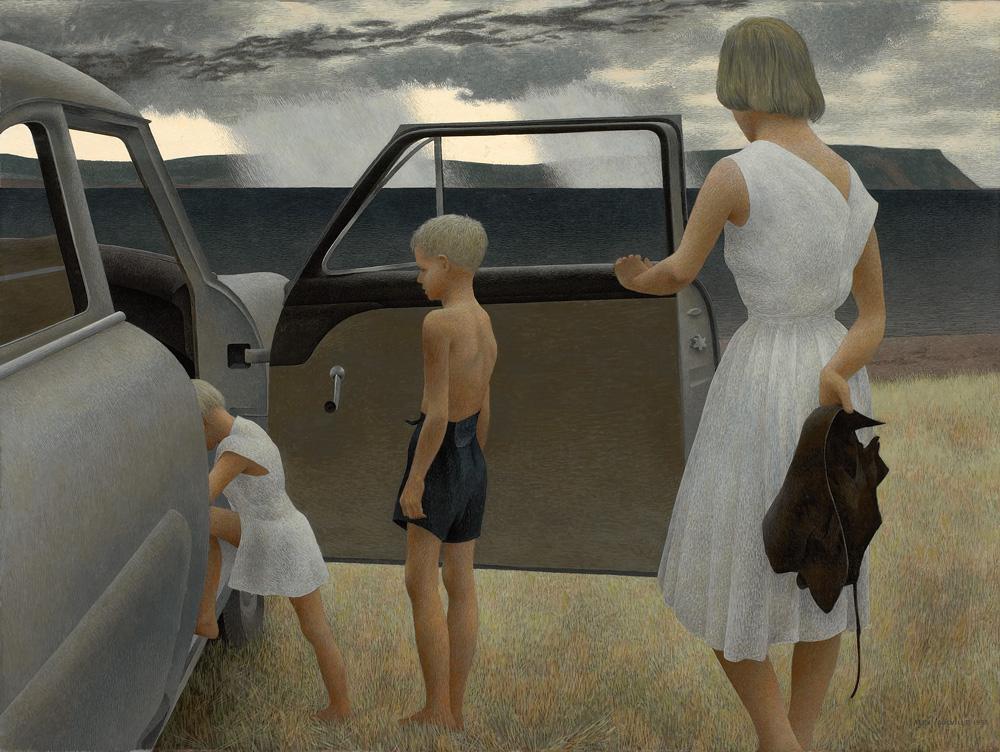
Family and Rainstorm
I'll never forget the summers of my childhood in Grand Bend, Ontario. My Mom, my sisters (and later my brother) and I would spend the day at the beach. Sometimes, in late afternoon, dark clouds would blow in and before we knew it, a thunderstorm would hit. We would pack up our towels and head for cover. We would sit in our mobile home and watch the fireworks display. There's nothing like a thunderstorm on the lake. It was more magnificent than anything you would witness on land.
Alex Colville's Family and Rainstorm reminds me of those thunderstorms, only this time set in Nova Scotia rather than Southern Ontario. Dark clouds hovering over the water threaten to burst open at any moment. A mother holds the car door open for her son and daughter as they climb inside. The children, likely drained from a day of sun and sand, are ready to collapse. The mother is likely dreaming of a warm bath to clean off the sand that clings to her body. I see visions of the car, only minutes later, driving down the road, its wipers working full speed, its occupants relieved to be inside.
Subscribe to:
Posts (Atom)