Showing posts with label President John F. Kennedy. Show all posts

Wednesday, 21 June 2017

Moon and Cow

Hey diddle, diddle
The cat and fiddle
The cow jumped over the moon.
The little dog laughed 
To see such sport.
And the dish ran away with the spoon.
(The Cow Jumped over the Moon)


Moon and Cow — painting by Alex Colville


Moon and Cow, with the moonlit night and the resting cow, evokes a feeling of peacefulness.  I think of the nursery rhyme, The Cow Jumped Over the Moon.  I think of the steady rhythm of the poem and the innocence of a young child.

On the other hand, in 1963, when Alex Colville completed the painting, the world was in the throes of the Cold War.  Children hovered under their desks during atomic bomb drills.  The hands of the superpower leaders hovered over the nuclear "button".  Mercifully, President John F. Kennedy had recently averted disaster with the diplomacy he displayed during the Cuban Missile Crisis.

Only two years before however, President Kennedy had promised to put a man on the moon by the end of the decade.  And while the world sat on the precipice of World War III, which would have put us back into the stone age, the two superpowers were working feverishly behind the scenes to forge ahead and put a man on the moon.  The Space Race refocussed their attention.  It would be only six years later that 600 million spectators would watch in hushed silence as Neil Armstrong placed his boot on the moon's dusty surface and declared:  "One small step for man, one giant leap for mankind."


Sunday, 13 December 2015

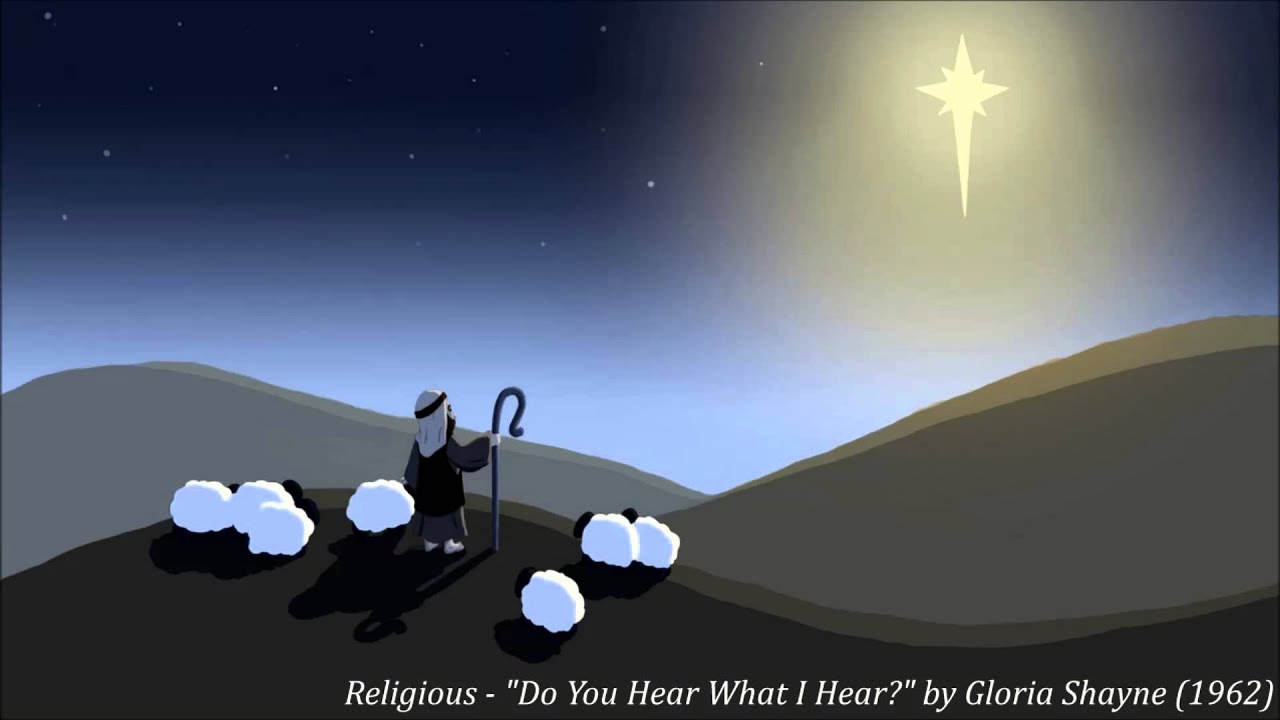
Noel Regney & Gloria Shayne's "Do You Hear What I Hear?"

Said the night wind to the little lamb,
Do you see what I see
Way up in the sky, little lamb,
Do you see what I see
A star, a star, dancing in the night
With a tail as big as a kite
With a tail as big as a kite.


In October of 1962, Noel Regney walked down the street in Manhattan, discouraged and disillusioned.  The world was on the brink of war:  America and the U.S.S.R. were arguing over missiles recently built in Cuba, aimed at the United States.  Rather than enjoying the autumn colours in their backgrounds, people were building bomb shelters.  The tension was so real, they could feel it.

Noel Regney was no stranger to war.  Born and raised in France, he had been drafted by the Germany Army during the Second World War.  Unbeknownst to the Germans, he went underground as part of the French Resistance.  Wounded during the war, some suspect he was hit by the French, to protect his identity from the Germans.

Noel Regney survived the war and in 1952, he immigrated to the United States.  The composer was smitten by a young singer named Gloria Shayne.  After a whirlwind courtship, the couple married.  Shayne was a talented lyricist, Noel a talented composer, so the two teamed up to write songs.  "Rain, Rain Go Away" was one of their trademark tunes.

However, in October of 1962, their arrangement changed.  As Noel walked down the Manhattan streets with a heavy heart, he looked up and spotted two babies in carriages.  He was struck by their joy and innocence.  They gave him hope.  Back at his apartment, he started to compose a Christmas song about the hope that the two babies brought, despite the world being on the brink of war.  Noel's wife, Gloria, wrote the music.  Do You Hear What I Hear? was the result.

"Pray for peace, people everywhere" became Noel's plea.  The two babies became the "little lamb".  "A star in the night" brought hope.  A "child sleeping in the night", the baby Jesus, brought "goodness and light".  Noel and Gloria struggled to perform the song at first, explaining:  "Our little song broke us up.  You must realize there was a threat of nuclear war."

The carol was first recorded on Thanksgiving of 1962 by the Harry Simeone Chorale.  However, it was Bing Crosby who made it a hit with his recording of October 1963 (https://www.youtube.com/watch?v=XuE_DXrt2Js)  The carol was by far the biggest hit for Noel and Gloria Regney.   

The Cuban Missile Crisis was resolved after a few weeks, in large part thanks to President John F. Kennedy's levelheadedness and diplomacy (see http://alinefromlinda.blogspot.ca/2012/10/october-14.html and http://alinefromlinda.blogspot.ca/2015/09/the-cuban-missile-crisis-kennedys.html).  Sadly, the President didn't get to enjoy the peace that resulted as he was assassinated only a year later in November of 1963.




Friday, 18 September 2015

Jacqueline Kennedy's Letter to Khrushchev

"So now, in one of the last nights I will spend in the White House, in one of the last letters I will write on this paper at the White House, I would like to write you my message."  
(Jacqueline Kennedy)


On December 1, 1963, the tears had barely dried on her cheeks when Jacqueline Kennedy sat down and drafted a letter to Premier Krushchev, thanking him for sending a representative to her husband's funeral.  Although hundreds of thousands had lined up to view President Kennedy's coffin while it lay in the Capitol, although hundreds of thousands more had lined the route of the President's caisson, and millions had watched the funeral procession on television, this mourner stood out (http://www.nydailynews.com/news/national/jfk-funeral-article-1.1514720).  Only a year before, Kennedy and Krushchev had faced off at the brink of World War III.  

In a delicate hand, Jacqueline wrote:

"I send it [the letter] only because my husband cared so much about peace and how the relation between you and him was central to this care in mind.  He used to quote your words in some of his speeches:  'In the next war, the survivors will envy the dead.' (https://history.state.gov/historicaldocuments/frus1961-63v06/d120)


It had only been a little over a year since President Kennedy had looked out his Oval Office window, his arms folded, worry etched on his face, agonizing over how to react during the Cuban Missile Crisis.  For thirteen days, the world stood at the brink of war.  Kennedy and Krushchev drafted and exchanged several letters, carefully measuring each word (see "Building Missiles Like Sausages" at http://alinefromlinda.blogspot.ca/2012/10/october-14.html).  The exchanges brought new meaning to the term Cold War.

The former First Lady continued:

"The danger which troubled my husband was that war might be started not so much by the big men but by the little ones.  While big men know the needs for control and self-restraint  -- little men are sometimes moved by fear and pride.  If only in the future the big men can continue to make the little men sit down and talk, before they start to fight."

Just over a week before, Jacqueline Kennedy had been living in the White House, the wife of a president, raising their son and daughter.  But on November 22, 1963, all that changed.  Jacqueline sat beside her husband as he was gunned down in a Dallas motorcade by an assassin.  She watched the priest stand over the President's bullet-ridden body and administer the last rites at Parkland Hospital. She laid her husband to rest on a hill at Arlington overlooking Washington D.C. (http://alinefromlinda.blogspot.ca/2013/11/one-brief-shining-moment-interrupted.html).

And now she was drafting an eloquent letter to a Soviet leader, even offering political advice, challenging him to be the "bigger man", all on the heels of the personal tragedy.  Jacqueline ended her letter with a nod to Kruschev's wife:  

"I read that she had tears in her eyes when she left the American Embassy in Moscow, after signing the book of mourning.  Please thank her for that."  

Eloquence, grace, class:  that sums up Jacqueline Kennedy.


Three-year-old John F. Kennedy Jr., salutes his father's casket in Washington three days after the president was assassinated in Dallas. Widow Jacqueline Kennedy (center) and daughter Caroline Kennedy are accompanied by the late president's brothers Sen. Edward Kennedy, left, and Attorney General Robert Kennedy.

A veiled Jacqueline Kennedy waits for the Presidential caisson, her daughter Caroline on her right, and John Jr. on her left, saluting his father's coffin as it heads to Arlington Cemetery on November 26, 1963 courtesy http://www.nydailynews.com/news/national/jfk-funeral-article-1.1514720.