Showing posts with label President Johnson. Show all posts

Friday, 22 July 2016

For a More Beautiful America

"Where flowers bloom so does hope." (Lady Bird Johnson)


Description: LB Johnson beautiful highways25

Yellow & blue wildflowers along a highway courtesy
http://about.usps.com/news/national-releases/2012/pr12_117.htm.


It was just over 50 years ago that the Lady Bird Bill was signed.  President Eisenhower had overseen the building of the Interstate Highway System.  Now, President Johnson, with his wife leading the effort, would oversee the beautification of those highways.

The Highway Beautification Act of 1965 called for the control of outdoor advertising, for the removal of junkyards along the highways and for "scenic enhancement and roadside development" (https://www.fhwa.dot.gov/infrastructure/beauty.cfm).
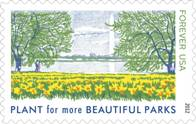

Description: LB Johnson beautiful parks25

Daffodils along the Potomac River courtesy 


Lady Bird concentrated not only on beautifying the nation's highways, but also cities.  Focusing on the Washington DC, which in the 1960's was in a dilapidated state, she hoped to set an example for other cities in the United States.  She believed that the state of America's cities was reflected in the state of the nation's minds.  In January 1965, Lady Bird wrote in her diary:

"Getting on the subject of beautification is like picking up a tangled skein of wool. All the threads are interwoven -- recreation and pollution and mental health, and the crime rate and rapid transit and highway beautification, and the war on poverty and parks -- national, state and local.  It is hard to stitch the conversation into one straight line, because everything leads to something else." (http://www.pbs.org/ladybird/shattereddreams/shattereddreams_report.html)


Description: LB Johnson more beautiful cities25

Pink & red azaleas and white tulips in front of the Capitol courtesy http://about.usps.com/news/national-releases/2012/pr12_117.htm.


The Beautification Act faced fierce opposition:  the billboard industry, which had sprung up under Eisenhower, would have no part of it.  The President and the First Lady, who made frequent road trips from their Texas ranch to Washington DC, had tired of the endless advertisements along America's highways.  

Lady Bird Johnson would not not give up the fight.  The First Lady was so involved in the beautification effort that Kansas Representative Robert Dole, who is still alive today, suggested an amendment to the bill which would replace the title "Secretary of Commerce" with Lady Bird, but lost by a voice vote.
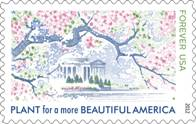

Description: LB Johnson more beautiful america25

Cherry trees in blossom by the Jefferson Memorial courtesy
https://about.usps.com/news/national-releases/2012/pr12_141.htm


Robert Dole may have lost the battle, but Lady Bird won the war.  Her husband, who had just gotten out of the hospital for gall bladder surgery, signed the bill on October 22, 1965.  Commenting on his drive from Bethesda Naval Hospital to the White House along George Washington Memorial Parkway, he said:  

"I saw Nature at its purest.  The dogwoods had turned red.  The maple leaves were scarlet and gold.  And not one foot of it was marred by a single unsightly man-made obstruction -- no advertising signs, no junkyards.  Well, doctors could prescribe no better medicine for me."(http://www.pbs.org/ladybird/shattereddreams/shattereddreams_report.html)


Description: LB Johnson beautiful streets25

Rows of crab apple trees along a suburban road courtesy
http://about.usps.com/news/national-releases/2012/pr12_117.htm.


For more information, read A White House Diary by Lady Bird Johnson at https://www.amazon.ca/White-House-Diary-Lady-Johnson/dp/0292717490.


Lady Bird Johnson circq 1963 courtesy http://tti.tamu.edu/about/hall-of-honor/inductees/yr2012/


Sunday, 29 May 2016

Vietnam

"Television brought the brutality of war into the comfort of the living room.  Vietnam was lost in the living rooms of America -- not on the battlefields of Vietnam." (Marshall McLuhan)


Anti Vietnam War Rally at National Mall in Washington DC circa 1971 courtesy https://www.pinterest.com/pin/24980972904463946/.


It started with John F. Kennedy sending some troops into Southeast Asia.  It killed President Johnson's bid for a second term in office.  It led to a massacre at Kent State University.  It ended with President Ford's order to evacuate people via helicopter from the American Embassy roof at the Fall of Saigon.  The Vietnam War polarized the nation of America.  Some were deeply committed to the war, even laid down their lives for the cause. Others vehemently protested on college campuses.  Still others dodged the draft, even moving to Canada to avoid serving.  

Unlike the First World War and Second World War, the Vietnam War was televised (http://alinefromlinda.blogspot.ca/2012/04/girl-in-picture.html).  For the first time, the carnage was brought into people's living rooms via the evening news.  "Television brought the brutality of war into the comfort of the living room.  Vietnam was lost in the living rooms of America -- not on the battlefields of Vietnam," explained Marshall McLuhan.  Young American men were coming home from Southeast Asia in body bags at an alarming rate.  It became increasingly hard for American leaders to justify the death toll.

As Ken Burns explains:  "The Vietnam War...took the lives of 58,000 Americans and as many as 3 million Vietnamese, polarized American society as nothing has since the Civil War [and] fundamentally challenged America's faith in our leaders, our government and our most respected institutions..."  Ken Burns series, due out next year, attempts to explain why the war happened and why it polarized America.


Sunday, 21 February 2016

Violence over Forced Busing in Boston

A decade after President Johnson signed the Civil Rights Bill, violence broke out in South Boston over forced desegregation of the city's schools on this day in 1974.  Whites pelted rocks and eggs at buses carrying black students to South Boston High.  Police on motorcycles were asked to escort the buses along their route.  The National Guard was called in to line the bus routes.  However, violence continued for three years and the problem was not completely resolved until 1988.


Police escort a caravan of 20 buses carrying black students to South Boston High courtesy www.pbs.org.


Segregated neighbourhoods in Boston naturally led to segregated schools.  Roxbury, formerly a Jewish neighbourhood, was predominantly black by the 1970's.  South Boston was a predominantly white (Irish Catholic) neighbourhood.  Blacks complained that Roxbury School lacked teachers, furniture and books, all of the things the white schools had.  School Board head Louise Day Hicks claimed that "a racially imbalanced school is not educationally harmful".  Rather than putting money in the predominantly black schools, the Board of Education did nothing.


Valerie Banks was the only student to show up for her geography class at South Boston High School on the first day of court-ordered busing, Sept. 12, 1974. (AP)

Valerie Banks was the only student to show up for her geography class at South Boston High on
 Sept. 12, 1974 courtesy www.wbur.org.


However, in the case of Morgan vs. Hennigan, a U.S. judge ruled that the Massachusetts State Board of Education must have a balanced racial mix in its schools.  At the beginning of the school year in 1974, the Board of Education was ordered to mix up the school population in the 80 of 200 schools that were less than 50% black.  Roxbury High, a predominantly black school, would have its students bused to South Boston High, an all-white school;  Conversely, South Boston students would go to the Roxbury.  A predominantly Italian-American neighbourhood in North Boston would also be affected. In fact, eighteen thousand students would be bused all over Boston to different schools.


Black students arriving at South Boston School courtesy wordpress.com.


Violence erupted on the streets of South Boston on the first day of the forced integration of the schools.  Later, Boston Police, riding motorcycles, accompanied many of the buses on their routes. But still, many whites (and blacks) protested by pulling their children out of school.  Senator Edward Kennedy was attacked by a mob protesting the decision outside a federal building.  Board of Education head Louise Day Hicks led protests.  Protesters wore pins with lions on them stating R.O.A.R. (Restore Our Alienated Rights).


Louise Day Hicks (at right) lead protest of forced busing in Boston circa 1974 courtesy weebly.com.


Finally, in 1977, Ms. Hicks resigned from the Board and a black member was elected.  It was not until 1988, however, that the desegregation issue was fully resolved in Boston.

*First published in 2014.