Showing posts with label Gettysburg. Show all posts

Wednesday, 24 February 2016

Coach Boone Battles Racism on the Football Field

"I can't make you like each other, but I will demand that you respect each other." 
(Coach Herman Boone)


When Coach Herman Boone walked into the dining hall at his football camp in 1971, he saw whites sitting at white tables, blacks at black tables.  He marched his team onto the bus and took a field trip    -- to Gettysburg.  In the early morning hours, the boys' eyes still half closed, Coach Boone told them about the young men who, over a hundred years before, had fought about the same thing that they were fighting about.  Only now they were wearing tombstones for hats.  The following morning, Coach Boone saw "a noticeable change in the dining hall".

In the 1950's and 1960's, schools were integrated across the United States.  The city of Alexandria, Virginia was no exception.  Parker-Gray, a black school, and George Washington and Hammond, both white high schools, were integrated into one school called T. C. Williams in the fall of 1971.  Resistance came from both blacks and whites.  Suddenly, children could not graduate from the same school as their parents or grandparents.  Alexandria students had to be bussed from one end of town to the other, often bypassing their "home school" on the way.  Blacks and whites would share the same classrooms for the first time in Alexandria.

With the integration of the schools came the integration of the sports teams.  T. C. Williams football team was in a shambles.  It was crying out for leadership.  And that came in the form of head coach, Herman Boone, a black who grew up in North Carolina.  A controversial decision, Boone was hired by the city of Alexandria instead of the more experienced white coach, Bill Yoast.  

Like baseball's Jackie Robinson, Herman Boone knew that if he were to be accepted by whites, he would have to deliver a top notch performance.  From the moment he set foot on the T. C. Williams field, he was a disciplinarian.  For the first time, white football players were facing off against blacks. And these were blacks who were originally on opposing teams.  But that didn't matter to Boone who reminded them:  "I can't make you like each other, but I will demand that you respect each other."

As Boone explained:  "Nobody wanted me to succeed but me."  But the T. C. Williams coach started to deliver immediately.  President Nixon heard about the fuss and sent his aide, Dr. Browne, to check out the Titans shortly after they returned from Gettysburg.  The interaction among the players likely accounts for some of the growing respect between blacks and whites.  However, as one former player points out:  "Boone's gradual acceptance by fans, neighbours and colleagues might have more to do with winning than enlightenment."  Like Jackie Robinson, Herman Boone knew how to win.  

With a no loss record, the Titans went on to win the Virginia State Championship that year and were ranked second in the United States.  Not just an inspiration at T. C. Williams, they inspired their entire community.  Richard Nixon called them "the team that saved Alexandria".  Coach Boone had a large part to play in that transformation.


Coach Boone with Titans players courtesy http://deadspin.com/remember-the-titans-is-a-lie-and-this-man-wants-you-to-1609473834.


*First published in 2015.


Wednesday, 25 November 2015

Coach Herman Boone's Remember the Titans Speech

"This green field right here was painted red, bubblin' with the blood of young boys, smoke and hot lead pourin' right through their bodies." (Herman Boone) 


The hour was early.  The sun was had just peaked above the horizon.  The young football players, both black and white, ran behind their coach, unaware of where they were headed.  As they arrived at a cemetery, fog lingered above the headstones.  Why were they here?

The coach broke the silence:

"Anybody know what place this is?  This is Gettysburg.  This is where they fought the Battle of Gettysburg.  Fifty thousand men died right here on this field, fightin' the same fight that we're still fightin' amongst ourselves today.

This green field right here was painted red, bubblin' with the blood of young boys, smoke and hot lead pourin' right through their bodies.  Listen to their souls, men:  'I killed my brother with malice in my heart.  Hatred destroyed my family.'

You listen.  And you take a lesson from the dead.  If we don't come together right now, on this hallowed ground, we too will be destroyed -- just like they were.  I don't care if you like each other or not.  But you will respect each other.  And maybe -- I don't know -- maybe we'll learn to play this game like men."(http://www.americanrhetoric.com/MovieSpeeches/moviespeechrememberthetitans.html)

The football players, led by Coach Herman Boone, attended T. C. Williams High, a newly integrated Virginia school.  Despite their differences, the football team went on to win a state title.  The football team served as a uniting force for the school.  Their story is portrayed in the movie Remember the Titans, starring Denzel Washington.


Tuesday, 22 September 2015

Coach Boone Battles Racism on the Football Field

"I can't make you like each other, but I will demand that you respect each other." 
(Coach Herman Boone)


When Coach Herman Boone walked into the dining hall at his football camp in 1971, he saw whites sitting at white tables, blacks at black tables.  He marched his team onto the bus and took a field trip    -- to Gettysburg.  In the early morning hours, the boys' eyes still half closed, Coach Boone told them about the young men who, over a hundred years before, had fought about the same thing that they were fighting about.  Only now they were wearing tombstones for hats.  The following morning, Coach Boone saw "a noticeable change in the dining hall".

In the 1950's and 1960's, schools were integrated across the United States.  The city of Alexandria, Virginia was no exception.  Parker-Gray, a black school, and George Washington and Hammond, both white high schools, were integrated into one school called T. C. Williams in the fall of 1971.  Resistance came from both blacks and whites.  Suddenly, children could not graduate from the same school as their parents or grandparents.  Alexandria students had to be bussed from one end of town to the other, often bypassing their "home school" on the way.  Blacks and whites would share the same classrooms for the first time in Alexandria.

With the integration of the schools came the integration of the sports teams.  T. C. Williams football team was in a shambles.  It was crying out for leadership.  And that came in the form of head coach, Herman Boone, a black who grew up in North Carolina.  A controversial decision, Boone was hired by the city of Alexandria instead of the more experienced white coach, Bill Yoast.  

Like baseball's Jackie Robinson, Herman Boone knew that if he were to be accepted by whites, he would have to deliver a top notch performance.  From the moment he set foot on the T. C. Williams field, he was a disciplinarian.  For the first time, white football players were facing off against blacks. And these were blacks who were originally on opposing teams.  But that didn't matter to Boone who reminded them:  "I can't make you like each other, but I will demand that you respect each other."

As Boone explained:  "Nobody wanted me to succeed but me."  But the T. C. Williams coach started to deliver immediately.  President Nixon heard about the fuss and sent his aide, Dr. Browne, to check out the Titans shortly after they returned from Gettysburg.  The interaction among the players likely accounts for some of the growing respect between blacks and whites.  However, as one former player points out:  "Boone's gradual acceptance by fans, neighbours and colleagues might have more to do with winning than enlightenment."  Like Jackie Robinson, Herman Boone knew how to win.  

With a no loss record, the Titans went on to win the Virginia State Championship that year and were ranked second in the United States.  Not just an inspiration at T. C. Williams, they inspired their entire community.  Richard Nixon called them "the team that saved Alexandria".  Coach Boone had a large part to play in that transformation.


Thursday, 16 July 2015

Philip Van Doren Stern's & Elmer Harris' "The Man Who Killed Lincoln"

"Wilkes was a good friend and faithful brother, and popular with all who knew him.  Too popular, some said:  too much of the convivial dram drinker, too much the pursuer of pretty ladies..." (Chicago Tribune)


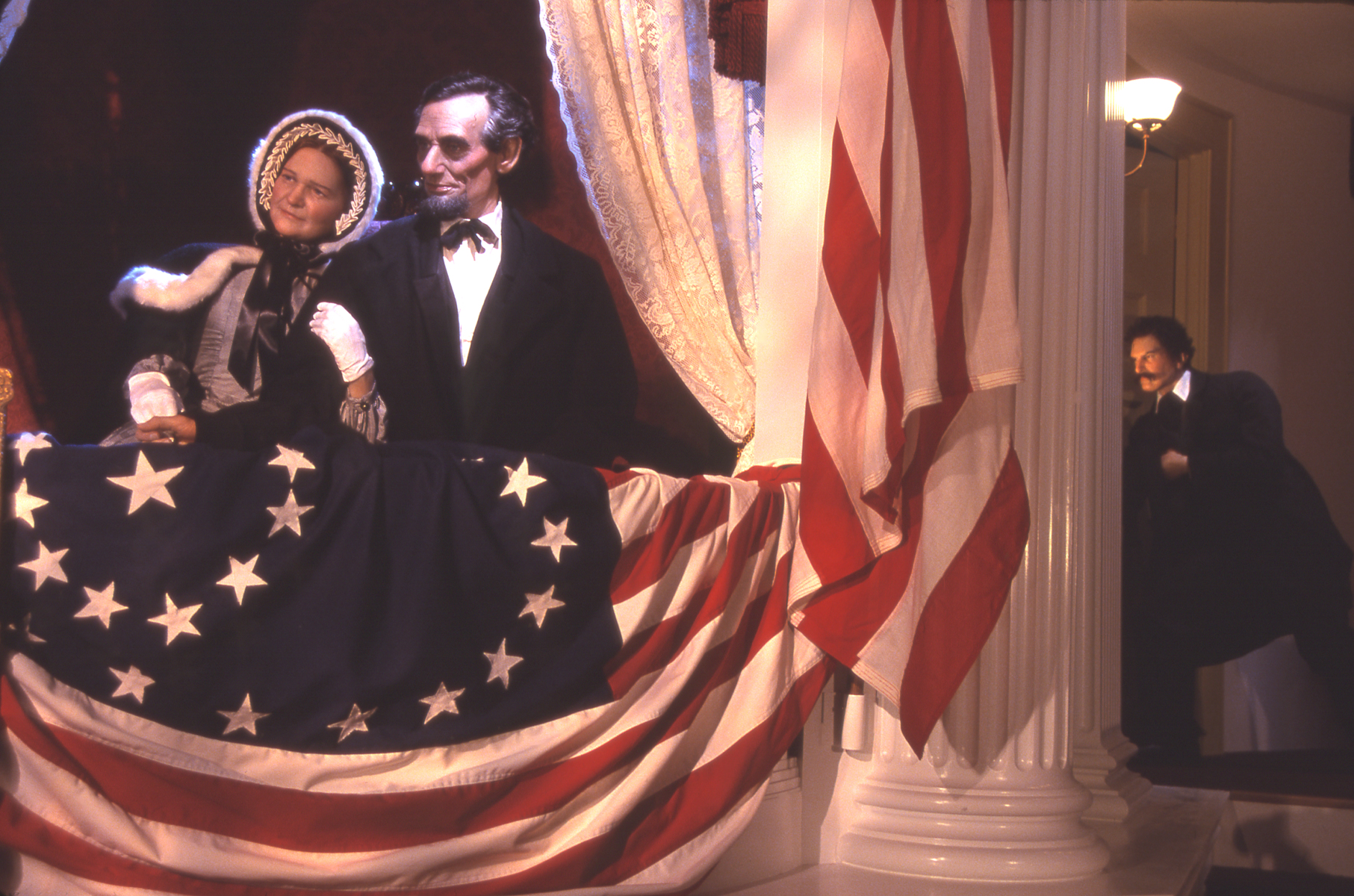
Abraham Lincoln attended the play Our American Cousin at Ford's Theatre that night.  He sat in a red velvet rocker, his wife Mary Todd Lincoln beside him.  All of a sudden, an assassin appeared from behind the curtain, pulled out a revolver, and shot the president; he leaped over the side of the balcony, fracturing his leg, and exited the theatre, leaving Lincoln for dead.  

John Wilkes Booth was a young fanatic.  "Most of his friends were Southern and all of his beliefs..." (http://archives.chicagotribune.com/1940/01/28/page/93/article/the-man-who-killed-lincoln-called-bad-showmanship).  He was disturbed to hear that President Lincoln called for the vote for the "freed Negro" only days after the Civil War ended.  He plotted to kill him, along with Vice President Johnson, General Grant and General Seward.  He thought General Lee would then withdraw his surrender, reassemble his army and save the Confederate's cause.  

But his fractured leg got in the way.  A doctor named Mudd treated Booth that day for his injury.  When the public found out, they were unamused.  Hence, the saying when you are in trouble: "Your name will be Mudd".  Booth escaped to Confederate territory where he took his final stand in a tobacco shed.  He was holding his revolver to his head when he was shot by a sentry and killed.

Lincoln passed away the following morning.  He was given a hero's farewell, complete with a caisson, a 21-gun salute, and a funeral train which crossed the United States from Washington D.C. to his home state of Illinois (en.wikipedia.org/wiki/Funeral_and_burial_of_Abraham_Lincoln).  No American would ever forget how he held the country together through the Civil War, how he took a stand on slavery, no matter how unpopular he would appear. 

On January 17, 1940, seventy five years after the assassination, The Man Who Killed Lincoln premiered at the Longacre Theatre on Broadway.  Charles Keane starred as Lincoln, Mary Dorne as Mrs. Lincoln, and Richard Waring as John Wilkes Booth.  According to the Chicago Tribune, however, it was Whitford Kane, as Samuel Fox, who stole the show.  

A century and a half later, Lincoln is still remembered fondly.  Millions visit Gettysburg National Park each year where the president delivered his infamous Gettysburg Address.  And the red velvet chair that Lincoln sat in at Ford's theatre sits in the Henry Ford Museum in Dearborn, Michigan.  John Wilkes Booth is buried in a small grave in Baltimore, Maryland.


commons.wikimedia.org/wiki/File:Fords_Theater_Scene_in_the_Abraham_Lincoln_Museum.jpg