Showing posts with label President Eisenhower. Show all posts

Friday, 22 July 2016

For a More Beautiful America

"Where flowers bloom so does hope." (Lady Bird Johnson)


Description: LB Johnson beautiful highways25

Yellow & blue wildflowers along a highway courtesy
http://about.usps.com/news/national-releases/2012/pr12_117.htm.


It was just over 50 years ago that the Lady Bird Bill was signed.  President Eisenhower had overseen the building of the Interstate Highway System.  Now, President Johnson, with his wife leading the effort, would oversee the beautification of those highways.

The Highway Beautification Act of 1965 called for the control of outdoor advertising, for the removal of junkyards along the highways and for "scenic enhancement and roadside development" (https://www.fhwa.dot.gov/infrastructure/beauty.cfm).


Description: LB Johnson beautiful parks25

Daffodils along the Potomac River courtesy 


Lady Bird concentrated not only on beautifying the nation's highways, but also cities.  Focusing on the Washington DC, which in the 1960's was in a dilapidated state, she hoped to set an example for other cities in the United States.  She believed that the state of America's cities was reflected in the state of the nation's minds.  In January 1965, Lady Bird wrote in her diary:

"Getting on the subject of beautification is like picking up a tangled skein of wool. All the threads are interwoven -- recreation and pollution and mental health, and the crime rate and rapid transit and highway beautification, and the war on poverty and parks -- national, state and local.  It is hard to stitch the conversation into one straight line, because everything leads to something else." (http://www.pbs.org/ladybird/shattereddreams/shattereddreams_report.html)


Description: LB Johnson more beautiful cities25

Pink & red azaleas and white tulips in front of the Capitol courtesy http://about.usps.com/news/national-releases/2012/pr12_117.htm.


The Beautification Act faced fierce opposition:  the billboard industry, which had sprung up under Eisenhower, would have no part of it.  The President and the First Lady, who made frequent road trips from their Texas ranch to Washington DC, had tired of the endless advertisements along America's highways.  

Lady Bird Johnson would not not give up the fight.  The First Lady was so involved in the beautification effort that Kansas Representative Robert Dole, who is still alive today, suggested an amendment to the bill which would replace the title "Secretary of Commerce" with Lady Bird, but lost by a voice vote.
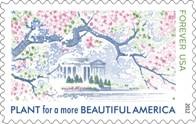

Description: LB Johnson more beautiful america25

Cherry trees in blossom by the Jefferson Memorial courtesy
https://about.usps.com/news/national-releases/2012/pr12_141.htm/ 


Robert Dole may have lost the battle, but Lady Bird won the war.  Her husband, who had just gotten out of the hospital for gall bladder surgery, signed the bill on October 22, 1965.  Commenting on his drive from Bethesda Naval Hospital to the White House along George Washington Memorial Parkway, he said:  

"I saw Nature at its purest.  The dogwoods had turned red.  The maple leaves were scarlet and gold.  And not one foot of it was marred by a single unsightly man-made obstruction -- no advertising signs, no junkyards.  Well, doctors could prescribe no better medicine for me."(http://www.pbs.org/ladybird/shattereddreams/shattereddreams_report.html)


Description: LB Johnson beautiful streets25

Rows of crab apple trees along a suburban road courtesy
http://about.usps.com/news/national-releases/2012/pr12_117.htm.


For more information, read A White House Diary by Lady Bird Johnson at https://www.amazon.ca/White-House-Diary-Lady-Johnson/dp/0292717490.


Lady Bird Johnson circq 1963 courtesy http://tti.tamu.edu/about/hall-of-honor/inductees/yr2012/


Thursday, 11 February 2016

Little Rock Nine


Photo of 101st U.S. Airborne Division courtesy http://upload.wikimedia.org.


My son Thomas started high school today at Hamilton District Christian High.  He had the normal first day of school jitters.  He wondered if he would know anyone in his classes.  He wondered what his first bus ride would be like.  He complained about the acne on his face.  But the one thing he didn't need to worry about was the colour of his skin.  He entered the school of his own accord rather than with armed troops at his side.  He entered the school without an angry mob yelling epithets and threats against him.  He entered the school without his fellow students spitting on him.  He entered the school without a line of reporters snapping his photo and posting it on the front page of the Hamilton Spectator.

Such was not the case when the Little Rock Nine (Elizabeth Eckford, Ernest green, Jefferson Thomas, Terrence Roberts, Arlotta Walls LeNier, Minnijean Brown Gloria Ray Karlmark, Thelma Mothershed and Melba Patillo Beals) entered high school on this day in 1957.  Daisy Bates, the head of the local NAACP chapter, arranged to have nine Black students enroll at Central High School in Little Rock, Arkansas that year.  After the landmark case of Brown vs. The Board of Education of Topeka, the court had ruled that segregation was unconstitutional and that all schools should be desegregated, but putting the theory into practice was a different story.  Governor Orval Faubus arranged to have the State National Guard meet the nine Black students with guns and gas masks ready to prevent their entry into the school.  White students called the Blacks "Communists" and other names; they spit in their faces; they threw bricks at them; and they blocked their entry into the school.  Reporters were beaten up by the angry mob. 

Little Rock soon became not only national but international news at a time when the Cold War was at its peak:  how could America justify treating its own citizens so poorly when it was supposed to be the land of democracy?  President Eisenhower realized something needed to be done so he pleaded with the Arkansas governor to call off the National Guard and allow the nine students to enter the school.  However, Mr. Faubus would not budge.  In the meantime, President Eisenhower sent federal troops to Arkansas to officially integrate the school. 

On September 25, the Little Rock Nine entered the school, each with a patroller by his or her side.  While the show of solidarity was impressive, White students continued to harass the Black students at any given opportunity.  Melba Patillo Beals was stabbed at one point and had acid thrown in her face; fortunately her patroller immediately threw water in her eyes to prevent her from being blinded.  Minnijean, taunted by Whites in the cafeteria, poured a bowl of chili on one of them only to be suspended for six days while no punishment was doled out to the instigators.  One of the students had his or her home bombed in the Fall of 1959.

In the meantime, Governor Faubus tried to stop integration by closing down all four Little Rock high schools.  The board even fired 44 high school teachers who were later re-instated.  But the damage was done:  all of the Little Rock high school students could not attend school during "The Lost Year".  Some of the Little Rock Nine transferred to other schools due to the harassment, but three remained to graduate.  Melba Patillo Beals ended up becoming a teacher at Central High which is 60% Black today. 

So as my son heads back to high school tomorrow, I can breathe a sigh of relief knowing that he can do so freely without harassment.  We take education for granted, but it came with a high price for the Little Rock Nine. 


Photo of one of the Little Rock Nine courtesy www.nps.gov.


*First published in 2012.

Monday, 16 November 2015

Dwight D. Eisenhower's Atoms for Peace

President Dwight D. Eisenhower stood before the United Nations Assembly on December 8, 1953 to deliver an important message:  the atomic bomb, which had first been detonated by the United States in 1945, was no longer an American secret.  Canada and the United Kingdom both knew the secret.  Even the Soviet Union now knew the secret.  In fact, the United States and the Soviet Union were starting to stockpile their atomic weapons at an alarming rate.  In the space of only eight years, atomic energy had gone from a limited to an unlimited quantity.  The two countries had the capability of wiping each other off the face of the earth.  President Eisenhower pleaded with the nations represented at the United Nations to think about ways to cut back on their atomic weapons; to think about constructive ways to use atomic energy.  President Eisenhower goes on to mention the problems the world faces:  a divided Germany and a divided Korea.  He calls for a "free intermingling" between East and West in Europe.  He calls also for a rapprochement between the United States and the Soviet Union.  Here is an excerpt from President Eisenhower's speech:

"On July 16, 1945, the united States set off the world's first atomic explosion.  Since that date in 1945, the United States of America has conducted forty two test explosions.  Atomic bombs today are more than twenty five times as powerful as the weapons with which the atomic age dawned, while hydrogen weapons are in the ranges of millions of tons of TNT equivalent.  Today, the United States stockpile of atomic weapons, which of course increases daily, exceeds by many times the total equivalent of the total of all bombs and all shells that came from every plane in every theatre of war in the all the years of World War II.

The United States would be more than willing -- it would be proud to take up with others principally involved the development of plans whereby such peaceful use of atomic energy would be expedited.

The coming months will be fraught with fateful decisions.  In this Assembly, in the capitals and military headquarters of the world, in the hearts of men everywhere, be they governed or governors, may they be the decisions which will lead this world out of fear and into peace." (http://www.americanrhetoric.com/speeches/dwightdeisenhoweratomsforpeace.html)


Sunday, 6 September 2015

Jackie Robinson Pens Protest Letter to Eisenhower

"I was sitting in the audience at the Summit Meeting of Negro leaders yesterday when you said we must have patience.  On hearing you say this, I felt like standing up and saying:  'Oh no!  Not again.'
I respectfully remind you sir that we have been the most patient of all people." (Jackie Robinson)


It was 1958 -- eleven years since the first black man officially played in the National Baseball League; four years since the ruling in Brown vs. Board of Education; three years since Rosa Parks refused to give up her seat on an Alabama bus; and one year since the National Guard escorted nine students to Little Rock High.  

Yet, America was still a long way from fulling integrating blacks into white society.  Jackie Robinson, who had integrated professional baseball, had just hung up his number 42 jersey.  He penned a letter to President Eisenhower indicating his frustration with the civil rights movement, which, after making giant strides, had seemed to stall.  

"I was sitting in the audience at the Summit meeting of negro leaders yesterday when you said we must have patience.  On hearing you say this, I felt like standing up and saying:  'Oh no!  Not again.' (www.archives.gov/exhibits/featured_documents/jackie_robinson_letter/).  I respectfully remind you sir that we have been the most patient of all people."  He pointed out that Negroes were striving to attain goals that Whites had already been granted over 150 years before.

"17 million Negroes cannot do as you suggest and wait for the hearts of men to change," implored Robinson.  In 1958, Negroes represented about 10 percent of the American population, a significant amount.  Robinson wanted actions, not words, for the Civil Rights Movement to move forward.  

Robinson saw President Eisenhower's attitude of forbearance as encouraging, not discouraging, the segregationists.  He reminded the President about Governor Faubus, who, the previous year, had blocked the school entry of the Little Rock Nine.  

The baseball legend drove his point home by stating:  "would let it be known that America is determined to provide -- in the near future -- for Negroes -- the freedoms we are entitled to under the Constitution."

Note:  For more information about Jackie Robinson, read "You Give Me the Number, I'll Give You the Guts!" at http://alinefromlinda.blogspot.ca/2013/04/april-15.html.


Jackie Robinson (right) meets Martin Luther King Jr. and other civil rights leaders circa 1950's courtesy http://iipdigital.usembassy.gov/st/english/publication/2009/01/20090106142542jmnamdeirf0.8552515.html#axzz3l0Ucr18M.