Showing posts with label deadline. Show all posts

Saturday, 29 October 2016

Norman Rockwell Visits a Country Editor

"At a time in which the noble tradition of community based journalism is being challenged by societal and technological transformation, Norman Rockwell's charming and realistic portrayal of a country editor and team of journalists diligently working to share the news of the day with their community readers, epitomizes the attributes of American journalism and its contribution to the life of America." (Barbara Cochran, National Press Club Journalism Institute)


Norman Rockwell Visits a Country Editor appeared on the cover of The Saturday Evening Post in 1946, when the painter was at the height of his career.  The picture depicts a scene from the Monroe County Appeal, a small town newspaper located in Paris, Missouri.  The bustling office contains nine characters all working towards the publication of the day's paper.  With the typewriters on the desks, one can imagine the clinging of the bell every time a journalist reaches the end of a line.  The picture of a serviceman on the wall indicates that it is wartime or shortly after the war's end.  Rockwell himself is in this painting at the far right with a portfolio of artwork under his arm.  A man in overalls indicates it is a rural rather than urban newspaper.  A man wearing an apron and sailor hat appears to be running, indicating that the paper is working towards a deadline.  The man in the chair reading the newspaper seems to be oblivious to everyone else.

Norman Rockwell Visits a Country Editor hung in the office of the National Press Club for decades, a gift from the artist.  The piece was sold at Christy's Auction House on November 19, 2015 to the tune of $10.2 million.  Proceeds from the sale went to the National Press Club Journalism Institute to support its programs.  As Barbara Cochran explained:  "At a time in which the noble tradition of community based journalism is being challenged by societal and technological transformation, Norman Rockwell's charming and realistic portrayal of a country editor and team of journalists diligently working to share the news of the day with their community readers, epitomizes the attributes of American journalism and its contribution to the life of America."(http://www.christies.com/about/press-center/releases/pressrelease.aspx?pressreleaseid=8079


"Norman Rockwell Visits A Country Editor," by Norman Rockwell. (Photo credit: National Press Club.)


Sunday, 21 June 2015

Tom Wolfe's "The Kandy-Kolored Tangerine-Flake Streamlined Baby"

Tom Wolfe had a serious case of writer's block.  And he had a deadline to keep.  Finally, he decided to simply type up his notes and send them to the editor of Esquire who would give the assignment to another writer.  Tom sat down at his typewriter and, several coffee cups later, he typed his last word. He delivered his 49 pages of notes to Esquire.  The editor simply stroked out "Dear Byron" and published the essay as is.  The result was "The Kandy-Kolored Tangerine-Flake Streamlined Baby".

In the 1960's, the car culture was alive and well in California.  Whereas in previous decades, the automobile had been a vehicle to get its occupants from Point A to Point B, by the middle of the decade, it had become much more than that.  It was a symbol of success, of which there was much in Los Angeles.  It also fulfilled the need for speed:  drag racing was all the rage.

Wolfe travelled to Los Angeles -- to the city of the "scorched boulevards", boutiques, bowling alleys, skating rinks and taco drive-ins -- to experience the culture.  What he found was a culture that, rather than worshipping giant heads as the Easter Islanders did, they worshipped cars.  Los Angeles youth would meet at something new called the Teen Fair.  They would arrive in their custom cars at what resembled amusement parks.  A hully gully band blasted music, all electrified, from a high platform. Young women, wearing tight slacks and bouffant hairdoes, danced the bird, the hully gully and the shampoo.

What stood out about these teenagers was their uniformity, as Wolfe explained:

"[If] you watched anything at this fair very long, you kept noticing the same thing.  These kids are absolutely maniacal about form.  They are practically maniacal about it.  For example, the dancers: none of them ever smiled.  They stared at each other's legs and feet, concentrating to do them exactly right.  And all the bouffant kids all had form, wild form, but form with rigid standards, one gathers. Even the boys.  Their dress was prosaic -- Levi's, Slim Jims, sport shirts, T shirts, polo shirts, but the form was consistent -- a stovepipe silhouette.  And they all had the same hairstyle...They were all wonderful slaves to form." (http://isites.harvard.edu/fs/docs/icb.topic1292219.files/Week%208/Kandy%20Kolored%20by%20Tom%20Wolfe.pdf)

Booths lined the perimeter of the grounds of the Teen Fair, hocking items like shoes, guitars, and of course, cars.  Wolfe talked to reps from the Ford Motor Company.  Ford was attempting to corner the market on this new "teenage lifestyle".  As Wolfe maintained:  "If Ford can get them hooked on Fords now, after the kids are married they'll buy new Fords."

These weren't just any Fords, though.  They were part of the Ford Custom Car Caravan.  Customizing was the new trend in California.  An autobody man took the original body of a car and chopped and channeled it.  He jacked up the back end.  He streamlined it.  He added lots of chrome.  And he likely repainted it.  Gone were the days of Henry Ford who said that you could order your Ford in any colour, as long as it was black.

That is where the custom car designers came in.  Wolfe talked to the owner of Kustom City.  He showed the writer around his shop.  At Kustom City, the owner didn't create cars, he created "objets d'arts".  He mixed "krazy kolors" which represented the rebelliousness of the new teen culture:  orange, purple, yellow and violet.   His cars made a statement.  And he didn't just make cars for teens.  His famous customers included Jayne Mansfield, Elvis Presley and Liberace.  In 1957, the custom car owner started hearing from the Detroit auto companies.  They wanted to know what teenagers were going for.  However, he admitted they were limited:  they had to "design a car for the farmer in Kansas and the hotdog in Hollywood".

Cars are no longer the status symbols they once were.  We have said goodbye to the streamlined cars, to the muscle cars, to the custom cars, to the gas guzzlers.  Cars have become, once again, vehicles to get us from Point A to Point B.


Wednesday, 22 April 2015

How to Write a Novel the Nano Way

Yesterday I blogged about how to write a novel using the Snowflake Method, a ten-step plan to follow to assemble your story.  Today, I'm writing about how to write a novel without an outline. There's something to be said about sitting down at a keyboard, staring at a blank page, and letting your fingertips take you away.  It's called "Nanowrimo:  30 days and nights of literary abandon".


I am a four time Nanowrimo (National Novel Writing Month) participant http://nanowrimo.org/ ). Set aside 30 days in November (or any month).  You need at least two hours per day.  That's 60 hours in a month.  Your quota is just under 1700 words per day.  In total you will write 30,000 words, the size of a small novel (although it doesn't have to be fiction; I wrote non-fiction).  At the end of the month, you have your first draft.


Southwestern Pottery by John Hritz

The quantity vs quality argument at http://thewritepractice.com/quantity-v-quality/.


The focus of Nanowrimo is quantity not quality.  The problem with an outline is you are constantly editing your thoughts.  The beauty of Nanowrimo is that you turn off that internal edit.  You are constantly writing, pushing forward, building the momentum of your story. As Snoopy found out the hard way, one of the Ten Commandments of Writing is "Thou shalt not edit when thou writes." (See http://killzoneblog.com/2011/06/10-commandments-for-writers.html).  But at the same time, Nanowrimo is not complete abandon:  you do have a deadline.  


Snoopy is breaking one of the Ten Commandments of Writing "Thou shalt not edit when thou writes" courtesy https://www.pinterest.com/proofeditwrite/writer-humour/.


There's something to be said for leaving your writing and letting it sit.  It's difficult to spot your errors when the ink has barely dried on the page, so to speak.  Let a couple of months pass and come at it with a new set of eyes (and maybe a new set of ideas).  Which begs the question:  When do you edit? Your opportunity to edit arrives in March, when Nanoedmo (National Novel Editing Month) arrives. If Nanowrimo is 30 days and nights of literary abandon, Nanoedmo is 50 hours of literary editing. That's one and a half hours per day.  Roll up your sleeves and get ready:  it's time to get your hands dirty.  This is where the real writing begins.  It's time to revise, rewrite, rework, remove, expand and proofread that first draft.


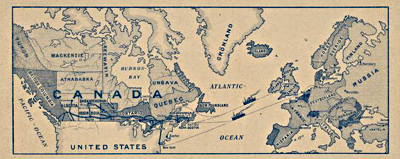
Now is your chance to check for the essential ingredients of a solid story.  Reread your story and listen for the rhythm of your words.  Just as a musician has an "ear for music", a writer has an "ear for words" says blogger Roni Loren (http://nanoedmo.com/2013/03/17/5-steps-roni-loren/).  Check for pacing of your plot.  Is there enough conflict?  Check for context.  When I wrote my great-grandmother's story, set in the early 1900's, I had to research details:  How many compartments did a cast iron stove have?  Was mail delivered to your door in small town Canada?  What did a Canadian map look like in 1903?  Examine your characters.  Are they three dimensional or flat?  Look for your dominant theme.  Does your main idea permeate every chapter of your book?  As author Larry Brooks points out in Story Engineering, "Theme can get you published".  For more, visit the site http://www.amazon.ca/Story-Engineering-Larry-Brooks/dp/1582979987.


A Canada map circa early 1900's, quite different from current day, courtesy 


Are you ready to put down your pen at this point?  While you have a solid second draft, my recommendation is that you let your manuscript sit for a few weeks, and look at it yet again.  Or better yet, let a fellow writer look at it and point out any errors, omissions or inconsistencies.  Scour it for those smaller details.  Look for "le mot juste" (see link "Ten Tips for Finding the Right Words" below).  Look for words that you have overused.  Vary your sentence length.  Make sure your verb tense is consistent.  Check for a consistent point of view. Your third draft will be much more polished than your second.  Your novel is complete.


But it's not over.  Submit your novel for publication.  You might join the long list of Nanowrimo participants who have become published authors.  Sara Gruen's Water for Elephants, published in 2007 by Harper Collins, even hit number one on the New York Times bestseller list. Visit http://nanowrimo.org/published-wrimos for a complete list.


Note:  For more information about Nanowrimo, read "Nanowrimo Rules!" at http://alinefromlinda.blogspot.ca/2014/11/nanowrimo-rules.html.


Friday, 6 February 2015

Developping Good Blog Content

"For a blog to be successful, your content needs to be useful and unique to readers." (Darren Rowse)

You have found a blog niche, name, platform and design.  Now it's time to start developping your blog content.

Define Your Voice

According to Professional Blogging for Dummies (http://www.amazon.ca/Professional-Blogging-Dummies-Susan-Getgood/dp/0470601795) the first consideration you need to focus on is defining your voice.  What is your writing style?  How do you present your material?  Do you let your personality shine through in your writing?  Do you use the correct grammar and spelling?  Does your writing look professional?  How much do you want to share with your readers?  Do you want to include information about your spouse and children, or keep them out of your writing?  Do you want to invite guest bloggers to post?  If so, how will you keep their voice consistent with your own? These are questions you must consider in the early weeks of blogging.

Keep an Editorial Calendar

The second consideration is an editorial calendar.  Just as a magazine editor has a calendar to plan each upcoming issue, you need a plan for your blog, a "roadmap for your content" (Professional Blogging for Dummies).  Without a calendar, you have to start from scratch each day.  Even though I have had a successful blog for four and a half years, there were many days where I didn't know what to blog about.  I wasted a lot of time choosing a topic, often more time than I did writing.  Last year, I started grouping blog topics into days or even a week.  This year I am experimenting with a monthly topic.  I find myself looking forward to writing that much more because I already know what I'm writing about.

Professional Blogging for Dummies recommends filling in the following details in your editorial calendar for each post:

1.  date:  daily, weekly, biweekly, bimonthly, etc.

2.  type ex. narrative, essay, review (book, restaurant), opinion, podcast, promotion, news, recipe, roundup (top ten)

3.  topic:  divide blog into sections with tabs; my blog has three categories, history, home & writing

4.  author:  if you have guest bloggers

5.  art:  always include a picture or photograph; it catches the reader's eye ex. www.istockphoto.com or www.flickr.com

6.  media:  include a Youtube (https://www.youtube.com/?gl=CA) link or podcast

7.  deadline:  if you have guest bloggers

Don't forget to include a catchy title or headline.  You have only three seconds to catch the reader's attention before they move on to something else.  Also, include tags in your post to attract reader's who happen to google keywords from your post.

Invite Comments

The third consideration is comments for your blog, something recommended by experts.  If you don't have comments, your blog is simply a website.  You may choose to set up a system where you approve or disapprove the comments before they are officially posted.  You can restrict comments to stop profanity, negativity or HTML hyperlinks.  Some people aren't interested in engaging in dialogue but just want to promote their own blogs.  Some software programs allow you to pre-approve the first comment and then automatically approve any subsequent comments from that same blogger.  Post your policy somewhere on your blog so that readers know what your rules are regarding comments.

Add a Blogroll

Lastly, consider starting a blogroll to accompany your blog in a sidebar.  It is a good way to become part of the blogosphere community.  It also gives readers a sense of your taste and friends.  You may get discovered through a Google Alert.  Start with your favourite blogs, then influential blogs in your niche, then associations and affinity groups and then blogs dealing with complementary topics.  My blogroll includes a few history blogs, a few writing blogs and a few Christian blogs, a true reflection of my interests and values.

For more information, visit
http://www.problogger.net/archives/2006/02/18/writing-good-content/.