Showing posts with label Sir Winston Churchill. Show all posts

Monday, 11 April 2016

Royal Albert Hall Legacy of the Great Exhibition

"This hall was erected for the advancement of the arts and sciences and works of industry for all nations in fulfillment with the intention of Prince Albert Consort." (http://www.freetoursbyfoot.com/royal-albert-hall-tours/)


First performance at the Royal Albert Hall circa 1871 courtesy https://en.wikipedia.org/wiki/Royal_Albert_Hall#2014.

The Great Exhibition, or Crystal Palace Exhibition, of 1851 was such a success that Prince Albert proposed "Albertopolis", the construction of a series of buildings in Hyde Park to promote the advancement of the arts and sciences.  Queen Victoria laid the granite foundation stone in 1867 in front of a crowd of over 7,000 spectators.  "Invocation to Harmony", a composition by Prince Albert, was played followed by a 21 gun salute in Hyde Park.

A glazed iron dome, the world's largest unsupported dome at the time at 135 feet, covered the Royal Albert Hall. Inside were over 5000 seats facing a large stage in the middle.  A pipe organ, consisting of thousands of pipes, was built in the space of 14 months for the price of 8,000 pounds.

During the First World War, the dome was used as a point of reference for pilots flying over London. During the Second World War, the dome was painted black to block out the light when a performance was going on.


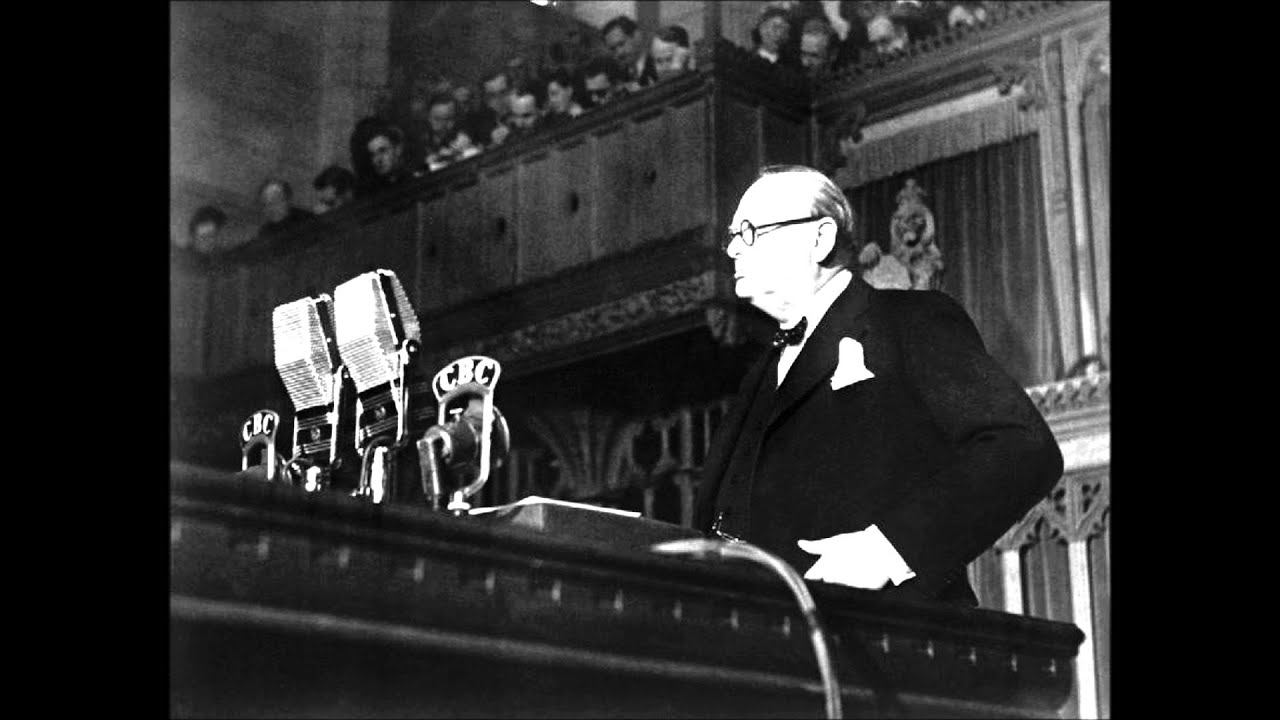
Sir Winston Churchill speaks about Lincoln at Royal Albert Hall circa 1944 courtesy http://www.gettyimages.ca/detail/news-photo/photograph-of-winston-churchill-speaking-at-the-albert-hall-news-photo/513666045.


The first performance, Sullivan's On Shore and Sea cantata, was performed on May 1, 1871.  Since then Royal Albert Hall has attracted the finest musicians, scientists, athletes and politicians.  Richard Wagner played there.  Sir Winston Churchill delivered speeches.  Albert Einstein shared his scientific theories.  Alfred Hitchcock directed his movie The Man Who Knew Too Much at the Hall.  Luciano Pavarotti sang there.

Surprisingly, the Hall did not have the best reputation for acoustics.  It was said that it was "the only place that a British composer could be sure of hearing his work twice".  In the late 1960's, fibreglass "mushrooms" were suspended from the Hall's ceiling as acoustic diffusers, a move that seemed to make a difference.

Today, the Hall hosts up to 350 events a year.  The former conservatory is now the location of the Queen Jubilee steps.
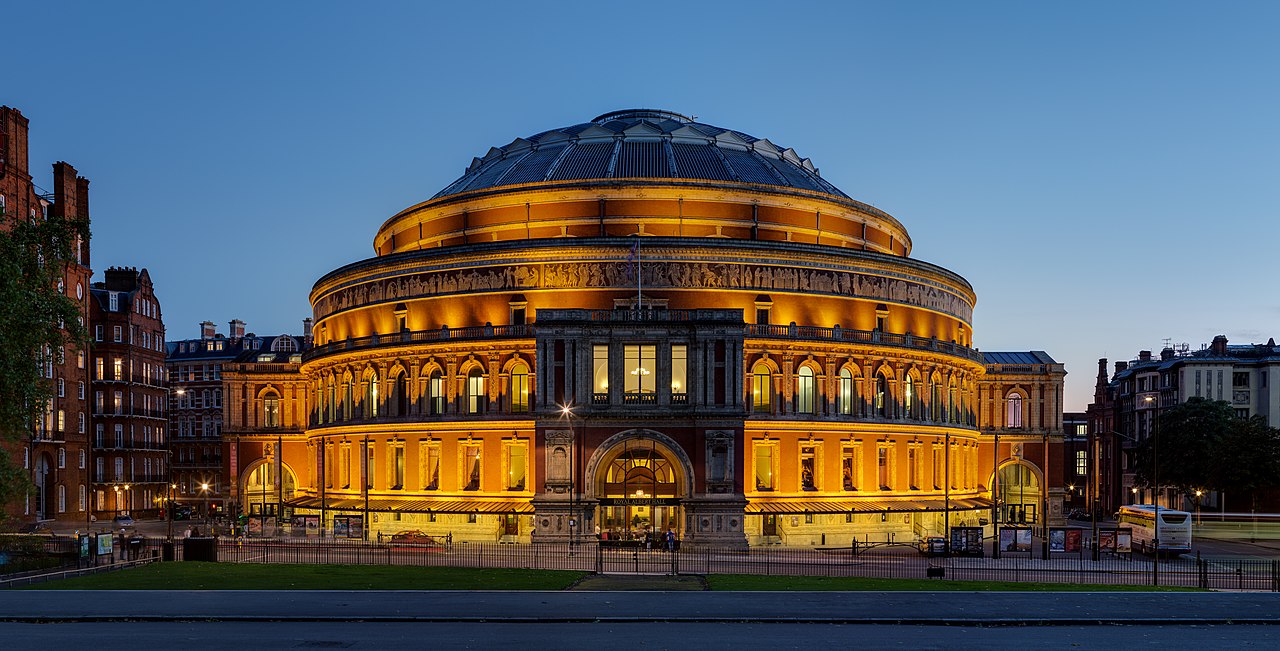


Royal Albert Hall, London - Nov 2012.jpg

Friday, 13 November 2015

Sir Winston Churchill's Blood, Toil, Tears & Sweat

"I have nothing to offer but blood, toil, tears and sweat." (Sir Winston Churchill)


Sir Winston Churchill stood up in the House of Commons and delivered this famous speech on May 13, 1940.  Nazi Germany was goosestepping its way across Europe.  Only three days had passed since the Nazis had invaded Holland.  They had also invaded France and were only weeks away from a takeover of Paris.  Britain was getting nervous.  Would it be next?  

After the appeasement policy of Neville Chamberlain, Britain needed a strong leader.  Churchill was the man for the job.  He had fought on the battlefield in the first World War.  He knew what it was like to get his hands dirty.  He brooked no opposition.  When he stood up and delivered his speech, he rallied the troops, the country and the cause.  Here is an excerpt from his address:

I have nothing to offer but blood, toil, tears and sweat.  We have before us an ordeal of the most grievous kind.  We have before us many long months of struggle and of suffering.  You ask, what is our policy?  I will say, it is to wage war by sea, land and air, with all of our might and with all the strength God can give us; to wage war against a monstrous tyranny; never surpassed in the dark and lamentable catalogue of crime.  That is our policy.  You ask, what is our aim?  I can answer in one word:  victory; victory at all costs, victory in spite of all terror, victory, however long and hard the road might be; for without victory, there is no survival.  Let that be realized; no survival for the British Empire, no survival for all that the British Empire has stood for, no survival for the urge and impulse of the ages, that mankind will move forward towards its goal.  But I take up my task with buoyancy and hope.  I feel sure that our cause will not be suffered to fail among men.  I this time I feel entitled to claim the aid of all and I say:  Come then, let us go forward together with our united strength. (http://www.historyplace.com/speeches/churchill.htm)


Wednesday, 9 September 2015

King George VI & Churchill Plan to Land at Normandy Beach on D-Day

"The war had immeasurably strengthened the link between the King and his people." (http://www.royal.gov.uk/HistoryoftheMonarchy/KingsandQueensoftheUnitedKingdom/TheHouseofWindsor/GeorgeVI.aspx)


King George VI wrote a letter to Sir Winston Churchill on May 31, 1944.  Its contents were shocking:  the prime minister, pushing 70 years old, and the king, pushing 50, both intended on landing on the Normandy beach on D-Day.  How was their plan foiled?

Sir Winston Churchill, a veteran of the Boer War in Africa, was no stranger to combat.  King George VI, a veteran of the First World War, was also familiar with battle.  The king had remained at Buckingham Palace, which was bombed nine times during the first few years of World War II.  He had toured London's East End, sifting through the rubble after the Blitz.

Even so, when Churchill proposed that he would land on the beaches at Normandy with the British troops on D-Day, King George was shocked.  "I don't think I need to emphasize what it would mean if...a chance bomb, torpedo or mine should remove you from the scene," he explained in his letter to Churchill.

King George thought that he would deter Churchill by suggesting that he join him in the D-Day landing.  Churchill, "the Lion", was all for it, however.  Admiral Ramsay intervened and explained to both leaders that they were needed at home to make crucial decisions if D-Day did not go as planned. "I would ask you to reconsider your plan," wrote King George to Churchill.

In the end, neither the king nor the prime minister participated in the D-Day landings.  Sir Winston Churchill made his famous V for Victory sign from 10 Downing Street.  King George delivered a D-Day speech from Buckingham Palace to build moral among the British population.  "The war had immeasurably strengthened the link between the King and his people."