Showing posts with label abolitionist. Show all posts

Tuesday, 22 December 2015

Placide Cappeau's "Cantique de Noel" (O Holy Night)

O Holy Night!
The stars are brightly shining
It is the night of the dear Saviour's birth!
Long lay the world in sin and error pining
Till he appeared and the soul felt its worth.
A thrill of hope the weary world rejoices
For yonder breaks a new and glorious morn!
Fall on your knees
O hear the angel voices
O night divine
O night when Christ was born
O night divine
O night divine.


Placide Cappeau was a one handed businessman who wrote poems as a hobby.  He was also the mayor of the French town of Roquemaure.  Cappeau composed a poem, Cantique de Noel, which a friend of a friend, Adolphe Adam, put to music.  The tune, sometimes called by its first line "Minuit Chretiens" was first performed at a Christmas Eve midnight mass in Roquemaure in 1847.  

Cantique de Noel was translated into English by Sullivan Dwight as O Holy Night and was first broadcast as a violin piece on a Massachusetts radio station on December 24, 1906.  The song focusses on the birth of Jesus and the redemption of humanity.  Both Cappeau and Dwight were abolitionists and therefore when the latter translated the lines of the second verse, he included:  "Chains shall he break for the slave is our brother/And in his name all oppression shall cease."

Minuit Chretiens has been recorded by Mireille Mathieu in 1968 on her Chante Noel album.  Celine Dion recorded O Holy Night on her 1998 album These are Special Times (https://www.youtube.com/watch?v=7OZ5MoUXKgc).


Friday, 30 October 2015

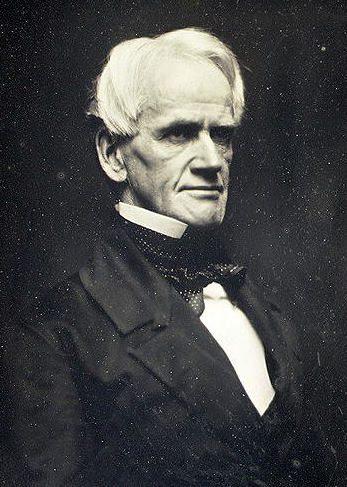
Horace Mann: The Father of American Public Education

"A house without books is like a room without windows.  No man has a right to bring up children without surrounding them with books...Children learn to read being in the presence of books." (Horace Mann)


Horace Mann had a total of six weeks of schooling between the ages of 10 and 20.  Yet, as an adult, he became a successful lawyer, politician, abolitionist and educational reformer.  How did he do it? He visited the town library.

Horace Mann, the son of a Yankee farmer, was born into poverty in 1796.  His health suffered as he had to endure hard manual labour.  His education suffered as well.  It was only through the town library, the nation's first public library, founded by Benjamin Franklin, that Horace was exposed to literature. 

Somehow, Horace prepared himself for the entrance exam which he passed and was accepted at Brown University.  He continued his studies at Litchfield Law School and passed the Norfolk County Bar exam to become a lawyer.

In 1827, Horace was elected to the Massachusetts House of Representatives, a position which he held for several years, along with the Massachusetts State Senate.  In 1837, Horace was appointed the secretary of the Massachusetts Board of Education, a position that he took on with passion.  He set out to visit every school in the state and see what changes needed to made to improve the system.  He planned the common school system, the original teacher's colleges.  He founded and contributed to the Common School Journal.  In 1843, Horace visited Prussia to study their successful educational system and returned to Massachusetts to implement their ideas.

Horace believed strongly in the following reforms:  more school houses, better equipped school houses, longer schooling (up to 16 years of age), higher paid teachers and a wider curriculum. Horace believed not only in promoting the academic subjects but also building the character of each student and the inculcation of Christian values.  He encouraged obedience to authority and promptness in attendance to prepare each student for the working world.  

Horace Mann, who is known as "The Father of American Education" today, also believed strongly in education at home.  "A house without books is like a room without windows.  No man has a right to bring up children without surrounding them with books...Children learn to read being in the presence of books."


Horace Mann, Father of American Public Education, courtesy https://en.wikipedia.org/wiki/Horace_Mann.

Monday, 19 October 2015

George Eastman: Camera Magnate was Methodical Self-Educator

"The progress of the world depends almost entirely upon education.  I selected a limited number of recipients because I wanted to cover certain kinds of education and I felt that I could get results with those named quicker and more directly than if the money were spread." (George Eastman)


Millionaire businessman George Eastman was not born with a silver spoon in his mouth.  He lost his father at 7 and was forced to become the man of the household.  His adversity, however, seemed to drive him forward.  He amassed a fortune with the Eastman Kodak Company, which rather than spending on himself, he chose to invest in education.

George Eastman's parents were both born and raised in abolitionist households.  They believed in the importance of education.  Eastman's father founded a college which would serve as a prototype for America's first business schools.  Tragedy struck when he died, leaving his seven year old son to be the head of the household.  George's mother took in boarders, but he felt badly that she had to cook and clean for these strangers.  Tragedy struck again when George's sister fell ill with polio and died at 16.  

At 13, George quit school to start making money to support his family.  He worked both as a messenger boy and as an insurance salesman.  Following in his father's footsteps, he took a job at a bank where he would work all day, six days a week.  Evenings he spent tinkering with his new purchase, a camera.  George would work well into the night, experimenting with photo emulsions.  He would take catnaps, waking himself at regular intervals to stir the emulsions.  George was constantly trying to educate himself.  

George opened a camera and photography supply business which dominated the market by the turn of the last century.  He amassed a fortune which simply sat in a bank account, accumulating pennies for interest.  George decided to donate his money to the cause of education.  He built one of the best music schools in the world, the Eastman School of Music in Rochester, New York.  He donated upwards of $20 million to the Massachusetts Institute of Technology and more than $50 million to the University of Rochester.  And in keeping with his abolitionist roots, he supported the cause of black education, donating to the Tuskegee Institute and Hampton Institute.  These donations were often done anonymously as George was not one for self-aggrandizement. 


Eastman relaxing in his library courtesy http://www.kodak.com/ek/US/en/George_Eastman.htm.