Showing posts with label Hyde Park. Show all posts

Monday, 11 April 2016

Royal Albert Hall Legacy of the Great Exhibition

"This hall was erected for the advancement of the arts and sciences and works of industry for all nations in fulfillment with the intention of Prince Albert Consort." (http://www.freetoursbyfoot.com/royal-albert-hall-tours/)


First performance at the Royal Albert Hall circa 1871 courtesy https://en.wikipedia.org/wiki/Royal_Albert_Hall#2014.

The Great Exhibition, or Crystal Palace Exhibition, of 1851 was such a success that Prince Albert proposed "Albertopolis", the construction of a series of buildings in Hyde Park to promote the advancement of the arts and sciences.  Queen Victoria laid the granite foundation stone in 1867 in front of a crowd of over 7,000 spectators.  "Invocation to Harmony", a composition by Prince Albert, was played followed by a 21 gun salute in Hyde Park.

A glazed iron dome, the world's largest unsupported dome at the time at 135 feet, covered the Royal Albert Hall. Inside were over 5000 seats facing a large stage in the middle.  A pipe organ, consisting of thousands of pipes, was built in the space of 14 months for the price of 8,000 pounds.

During the First World War, the dome was used as a point of reference for pilots flying over London. During the Second World War, the dome was painted black to block out the light when a performance was going on.


Sir Winston Churchill speaks about Lincoln at Royal Albert Hall circa 1944 courtesy http://www.gettyimages.ca/detail/news-photo/photograph-of-winston-churchill-speaking-at-the-albert-hall-news-photo/513666045.


The first performance, Sullivan's On Shore and Sea cantata, was performed on May 1, 1871.  Since then Royal Albert Hall has attracted the finest musicians, scientists, athletes and politicians.  Richard Wagner played there.  Sir Winston Churchill delivered speeches.  Albert Einstein shared his scientific theories.  Alfred Hitchcock directed his movie The Man Who Knew Too Much at the Hall.  Luciano Pavarotti sang there.

Surprisingly, the Hall did not have the best reputation for acoustics.  It was said that it was "the only place that a British composer could be sure of hearing his work twice".  In the late 1960's, fibreglass "mushrooms" were suspended from the Hall's ceiling as acoustic diffusers, a move that seemed to make a difference.

Today, the Hall hosts up to 350 events a year.  The former conservatory is now the location of the Queen Jubilee steps.
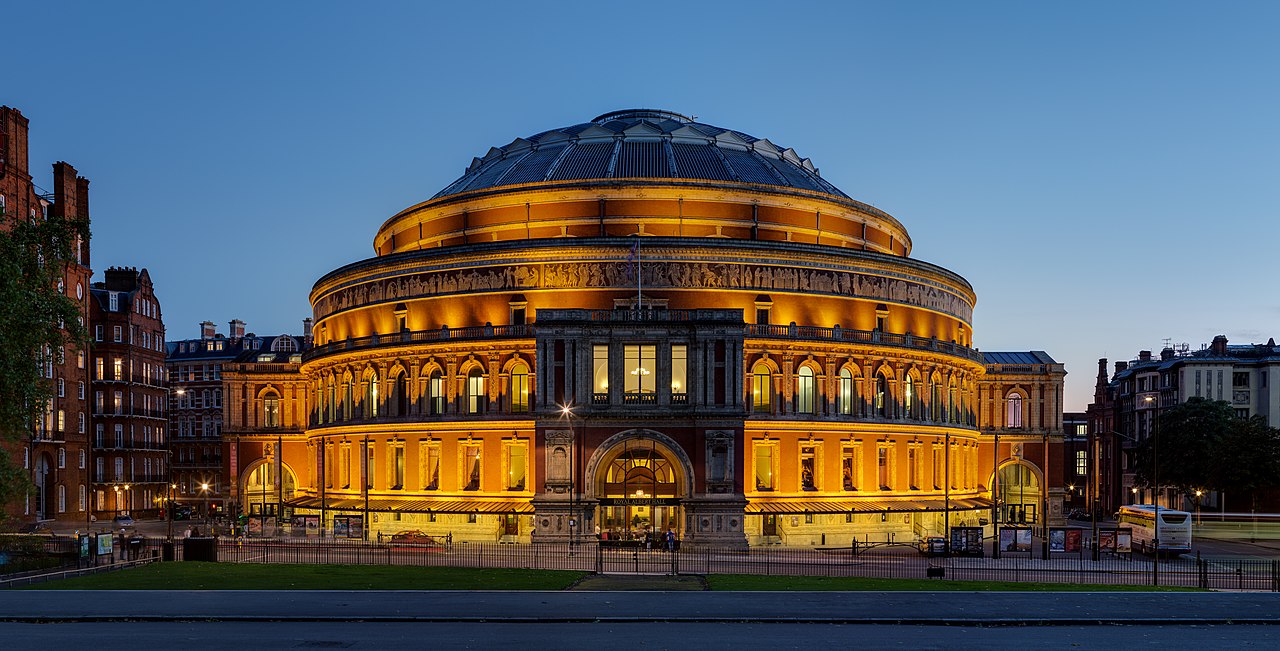


Royal Albert Hall, London - Nov 2012.jpg

Friday, 8 April 2016

The Crystal Palace Exhibition

"Enormous excursion trains daily poured their thousands into the city...Throughout the season...it was like...a giant picnic...large numbers of work people received holidays for the purpose.  Eight hundred agricultural labourers in their peasants attire from Surrey and Sussex conducted by their clergy at a cost of two and twopence each person -- numerous firms in the north sent their people who must have been gratified by the sight of their own handiwork..." (http://www.vam.ac.uk/content/articles/t/travelling-to-the-great-exhibition/)


Over six million people, a third of Britain's population, flocked to The Great Exhibition or The Crystal Palace Exhibition in 1851.  It was the first time so many nations had gathered, other than on the battlefield.  The original entrance cost was 3 pounds for gentlemen and 2 pounds for ladies.  However, the fee was later dropped to 1 shilling for the masses.  

Grandiose describes the exhibition that was set up in London's Hyde Park from April to May.  The Crystal Palace, a glass building measuring 1851 feet long and 128 feet high, dominated the landscape.  The invention of the cast plate glass method allowed for the construction of the palace using large, inexpensive sheets of glass.  A 27 foot tall crystal fountain acted as the centre piece of the building.  Full size elm trees from within Hyde Park stood near the fountain.  There was no need for artificial light during the day thanks to the fact that the glass walls let in the natural light.  The palace featured the first public toilets, "lavatories" for the men and "restrooms" for the women.

The Crystal Palace Exhibition was the first to feature manufactured goods. Guests were dazzled by 100,000 objects displayed by over 15,000 contributors.  While Britain occupied half of the space, France was the largest foreign contributor.  Items were divided into four different categories:  Raw Materials, Machinery, Manufacturers and Fine Arts.  The Koh-i-Noor Diamond and Sevres porcelain were two of the more popular items featured.

The legacy of the Great Exhibition is the Crystal Palace. The building was dismantled and reassembled on Sydenham Hill in 1852 where it was host to several new exhibits including:  Egyptian, Alhambra, Roman, Renaissance, Pompeian and Grecian.  In 1861, the palace hosted the first aeronautical exhibit Lord Baden Powell noticed the interest of girls in scouting while hosting the Boy Scouts.  In 1909, the Festival of Empire was held to mark the coronation of George V.  During the First World War, the site was used as a naval training facility.  Towards the end of the Great War, the Crystal Palace reopened as the Imperial War museum.  In 1936, the building caught fire and burned to the ground, the red flames being seen in eight counties.  The Crystal Palace has been duplicated elsewhere in the world, including a building in Dallas, Texas as well as a restaurant in Walt Disney's Magic Kingdom.