Showing posts with label Hercule Poirot. Show all posts

Wednesday, 31 May 2017

The Hollow

Lucy Angkatell invites Hercule Poirot to her estate for a party.  As a lark, she stages a mock murder for the detective.  By the end  of the evening, everyone is surprised to discover a dead body in the pool.

Doctor John Cristow, husband of Gerda, is having an affair with sculptress Henrietta Savernake.  The beautiful Veronica Cray, a former flame of John's staying at a nearby cottage, appears at the party looking for matches.  John walks Veronica back to her cottage and returns at 3 am.  The next day, Gerda Cristow stands at the edge of the pool next to her husband's bleeding body, a gun in her hand.  Lucy, Henrietta and Edward, a cousin of Lucy's are also present at the scene of the crime.  After uttering one word "Henrietta", John dies.

It would seem obvious that Gerda is the murderer.  However, no one actually saw her pull the trigger.  Henrietta takes the gun away from Gerda and it falls into the swimming pool, destroying the evidence.  Lucy kept a pistol in her basket of eggs, but it is of a different calibre than the one used to kill John.  Henrietta looks suspicious after a strange doodle is found in her sketchbook.  The murder weapon turns up in Poirot's hedge, but with fingerprints not matching any of the suspects.

It turns out Gerda had two pistols, one to shoot John and the other to use as a decoy.  Henrietta assumes that john's appeal to her is to help Gerda.  She takes the pistol out of Gerda's hand and later hides it in the hedge.

Midge Hardcastle is in love with Edward.  However, Edward is in love with Henrietta who has rejected his countless marriage proposals.  Realizing Henrietta has changed, and realizing that Midge is no longer "little Midge", he proposes to the latter.  However, still believing Edward is in love with Henrietta, she turns him down.  Distraught, Edward attempts suicide, but is saved by Midge.  Realizing he really loves her, she agrees to marry him.

Gerda and Henrietta are about to sit down for tea when Poirot arrives.  The detective, concerned that once Gerda is cornered she will murder Henrietta, switches the tea cups.  Gerda drinks from Henrietta's cup and dies.  Distraught, Henrietta visits one of John's former patients for closure.  She decides to make a new sculpture named "Grief".


Saturday, 27 May 2017

Evil Under the Sun

Hercule Poirot is holidaying in Devon.  Also at the hotel is a beautiful actress named Arlena, a known flirt.  She is vacationing with her husband, Kenneth, and teenage stepdaughter, Linda, who hates her stepmother.  Arlena flirts with the handsome Patrick Redfern, angering his wife, Christine, a former schoolteacher.  Other guests at the hotel include Sir Horace Blatt, a braggart, Major Barry, an Anglo-Indian military officer, Rosamund Darnley, a dressmaker and former girlfriend of Kenneth, Carrie Gardener, an American tourist, and her husband Odell, Reverend Stephen Lane and Emily Brewster, a quiet spinster.

Arlena, known for sunbathing, is found face down in the sun, dead.  Poirot collects alibis.  Linda drops a parcel of candles when Christine asks her to Gull Cove.  Arlena paddles to Pixy Cove for a rendezvous.  Both Kenneth and Patrick look for her.  Patrick asks Emily to join her daily row.  He finds a Arlena's limp body lying face down, arms outstretched.  He stays with the body while Emily fetches the doctor who concludes it is death by strangulation, likely a male.

Police questions the suspects.  Kenneth was heard typing letters responding to figures in previous mail.  Linda lies and says she was fond of her stepmother.  She and Christine went to Gull Cove at 10:30  and didn't return until 11:45.  The Gardeners were with Poirot the entire time.  Emily and Patrick saw Rosamund reading at Sunny Edge.  Reverend Lane and Major Barry went out.  Sir Horace Blatt spent the morning sailing.  Christine Rosamund, Kenneth and Mr. Gardener went to play tennis at noon.  Earlier in the day, Miss Brewster narrowly missed being hit on the head with a bottle tossed from a window.  Someone ran a bath at noon but no one is admitting to it.

At Pixy Cove, Poirot finds a new pair of scissors, a pipe fragment and heroin.  Poirot also smells a perfume only used by Arlena and Rosamund.  Poirot invites everyone on a picnic to test their vertigo:  Christine, who claims she has vertigo, easily traverses the bridge.  Linda overdoses on six sleeping pills, and almost dies.  Linda admits to the murder, but Poirot finds her library book and realizes she thinks that piercing a voodoo doll qualifies as murder.  Christine made her sleeping pills availabe and Linda took them.

Poirot investigates any local strangulations and discovers that Alice Corrigan was strangled.  Her husband, Edward, was too far away to have committed the crime.  Police identify Patrick Redfern as Edward Corrigan.  They identify the deceased as Christine Redfern, then known as Christine Deverill, Patrick's true love.  Patrick simply used Arlena for her money.  While Arlena did not suspect anything, if her husband discovered she emptied their bank account, he would be suspicious.  Patrick and Christine decided to get rid of her.

Patrick told Arlena to meet him that fateful day at a cave.  Christine set Linda's watch ahead by 20 minutes to give her an alibi.  Christine put on some tan makeup and pretended to be Arlena.  Emily was fooled by her.  Christine returned to her hotle room to wash off the suntan makeup, the bath that no one had admitted to.  She threw the empty bottle out the window, the one that narrowly missed Miss Brewster.  Meanwhile, Patrick called the unsuspecting Arlena out of the cave and strangled her.

Rosamund gives up her career to marry Kenneth and Linda ends up with a loving stepmother.


Friday, 26 May 2017

Sad Cypress

Elinor and Roddy are engaged to be married when they receive an anonymous letter saying that someon is sucking up to their wealthy aunt, Laura Welman, from whom they expect to inherit a fortune.  Elinor is niece to Mrs. Welman while Roddy is nephew to the late Mr. Welman.  Elinor suspects Mary Gerrard, the lodgekeeper's daughter, as the subject of the letter.  Not knowing who wrote the letter, they burn it.

Elinor visits her aunt who complains about the fact that she is partially paralyzed from a stroke.  She wants to end her life but her doctor will not hear of it.  In the meantime, Roddy falls in love with Mary, prompting Elinor to end their engagement.  After a second stroke, Mrs. Welma asks Elinor to make provision for Mary.  However, before the will can be changed, she dies and her estate goes directly to Elinor.

Elinor sells the house she inherited and gives two thousand pounds to Mary.  The latter dies of poisoning during a lunch at Hunterbury.  Everyone at the house has access to the poison.  Elinor is arrested.  Later, everyone learns that Mrs. Welman also died of poisoning.  Peter Lord, in love with Elinor, brings Hercule Poirot into the case.  Poirot soons discovers the author of the letter.  Was the poison in the sandwiches made by Elinor or in the tea prepared by Nurse Hopkins?  Also, what is the secret of Mary's birth?  What is the significance of the scratch made by a rose thorn on Hopkins' wrist?

It turns out Nurse Hopkins is the murderer.  The thorn scratch on Nurse Hopkin's wrist is really an injfection mark from the needle full of emetic she injected herself with causing her to vomit up the poison in the tea.  She went to wash the dishes so that no one would see her vomit.   Mrs. Welman, and Sir Lewis Rycroft, had an illegitimate daughter and she is Mary.  If this infomration had been learned sooner, Mary would have inherited some of the estate.  When someone encourages Mary to write a will, she names her aunt, Mary Riley, from Australia as beneficiary.  Mary Riley's married name is Draper.  It turns out Mary Draper is really Nurse Hopkins, who is bent on getting her hands on the money.

Elinor is acquitted and she married Peter Lord.


Sad Cypress

Sad Cypress, published in 1939, courtesy http://www.agathachristie.com/stories/sad-cypress


Thursday, 25 May 2017

The Incredible Theft

Lord Mayfield, a rising politician and a millionaire, hosts a house party.  In attendance are Air Marshal, Lord Carrington, his wife Lady Julia, his son Reggie, Mrs. Vanderlyn, a beautiful American woman, and Mrs. Macatta, a forthright MP.  Joining them for dinner is Mr. Carlile, Lord Carrington's secretary.

All the guests leave the table except Lord Mayfield and Sir George, to discuss a new aircraft that will give Britain supremacy over the skies.  Lord Mayfield invites Mrs. Vanderlyn, a spy, to tempt her with the plans for the new fighter jet.  Everyone goes to bed except Lord Mayfield and Sir George.  Mr. Carlile heads to the safe to retrieve plans for the new aircraft where he collides with Mrs. Vanderlyn searching for her handbag.  Lord Mayfield spots a figure leaving the study by the French window.  In the study, Lord Mayfield quickly discovers that the plans for the fighter jet are missing.  Mr. Carlile says he definitely left the plans on the table.  However, he was distracted by a scream which turned out to be Mrs. Vanderlyn's maid, claiming she saw a ghost.

Poirot is called in the middle of the night.  He examines the grass outside the study but finds not footprints.  Therefore he concludes that the theft of the plans was done by someone inside the house.  He questions everyone and discovers that the maid did not see a ghost; she was startled by Reggie who snuck up on her to steal a kiss.  Lady Julia believes her son stole the plans as he is short on money and was unaccounted for at one point in the day.  She promises Poirot that the plan swill be returned in 12 hours if no further action is taken.

Poirot explains that Mrs. Macatta was snoring in her room, Mrs. Vanderlyn called for the maid from upstairs and Sir George was with Lord Mayfield on the terrace.  But what about Mr. Carlile and Lord Mayfield?  Mr. Carlile had access to the safe and therefore could have taken a sketch of the drawings at any time.  Poirot is convinced Lord Mayfield pocketed the drawings.  Lord Mayfield, not wanting to reveal that he was involved with a belligerent foreign power a few years before, was blackmailed into handing the plans over to Mrs. Vanderlyn.


The Incredible Theft

Tuesday, 23 May 2017

Death on the Nile

Almost everyone on the cruise down the Nile River has a reason to hate heiress Linnet Ridgway.  Mrs. Van Schuyler wants her jewels.  Linnet's maid is upset because she won't give her a promised dowry.  Writer Salome Otterbourne faces a lawsuit launched by Linnet.   Salome's daughter, Rosalie, wishes to protect her mother.  American Andrew Pennington has been embezzling from the Ridgway's.  Former friend Jacqueline Bellefort is outraged that Linnet stole her former fiance, Simon.  It is not long before Linnet Ridgway is murdered.  When all is said and down, 5 out of the 13 main characters have died.  It falls to Hercule Poirot, who is also aboard the S. S. Sudan, to unravel the mystery.


Old photos from the S. S. Sudan courtesy http://www.steam-ship-sudan.com/en/slideshow/.


The 1930's were the golden age of Nile River cruising.  Diplomats, businessmen and archeologists paid to ride on boats like the S. S. Sudan.  In 1933, Author Agatha Christie, along with her archeologist husband, took this boat.  Refined ladies with parasols and gentlemen with pipes would stroll its decks.  Fine Egyptian cuisine was served in the charming dining room.  The wooden panelling, gilded and copper bed frames and parquet floors in the cabins kept the passengers coming back. The five day cruise aboard the S. S. Sudan, still running today, follows the Nile River from Luxor in the north, to Aswan in the south.  Highlights include the Giza Pyramids and the Sphinx.  The ship boasts 15 cabins and 8 suites, including the Agatha Christie Suite and Hercule Poirot Suite. It was here that the bestselling novelist penned her famous book Death on the Nile.


Death On The Nile

Death on the Nile, published in 1937, courtesy 


Monday, 22 May 2017

Dumb Witness

Emily Arundell writes to Hercule Poirot complaining that someone is trying to kill her.  She fell down the stairs, an accident attributed to her fox terrier's rubber ball.  However, by the time Poirot receives her letter, she is dead.

Emily's doctor says she died of chronic liver problems.  Emily's companion, Minnie Lawson inherits the deceased's house and fortune.  In a previous will, the inheritors would have been Emily's nephew, Charles, and nieces, Theresa and Bella.  Upon investigation, Poirot discovers a nail with varnish and a string attached to it at the top of the stairs.  "Bob...dog...picture...ajar." had been the message that Emily had given before her death.  Poirot concludes that Bob the dog, who was outside that night, did not leave the ball on the stairs and that Emily was tripped by the string.

Emily's nephew and nieces talk about contesting the will, but it is not pursued.  The gardener reveals that the nephew, Charles, talked to him about his arsenic based week killer.  The bottle is almost empty.  Minnie Lawson says that on the night of Emily's death she saw someone through her bedroom window wearing a broach with the initials T.A. (possibly Theresa Arundell, Emily's niece).

IN the meantime, Bella reveals her husband Jacob is bullying her and she moves with her children to a hotel, with the help of Minnie.  However, for more security Poirot recommends she moves to another hotel.  The next day Bella is found dead due to an overdose of chloral, a sleep aid.

Poirot reveals his theory on the murders.  Theresa stole the arsenic but could not bring herself to use it.  She and her brother suspected each other.  Emily, fearing that Charles might be trying to kill her, revealed that she had revised her will.  He was satisfied with just stealing some of her money.  The brooch which Minnie had seen was really Bella's.  The initials TA, reversed in the mirror, stood for Arabella Tanios.  She hated her husband and wanted to separate from him and keep the children, but she had no means to do so.  Her first attempt with the ball and string failed.  Her second attempt involved inserting elemental phosphorous in one of Emily's liver capsules, which succeeded.

Emily was unaware that her aunt had revised her will.  When Poirot explained the murder, she took her own life and her children went back to their father.  Emily's husband is upset as he did love his wife.  However, he finds out she obtained the chloral to kill him.  Minnie decides to share her wealth with Charles, Theresa and Bella's children.  Theresa marries Dr. Donaldson,  Charles squanders his wealth.  The terrier goes to live with Poirot but he prefers Captain Hastings.


Dumb Witness

Dumb Witness, published in 1937, courtesy http://www.agathachristie.com/stories/dumb-witness


Sunday, 21 May 2017

Cards on the Table

Mr. Shaitana hosts a dinner party and invites four sleuths and four people he thinks could have committed murder.  In a veiled accusation, he lists the way the guests might have committed murder based on their occupations.  After dinner, he seats the fours sleuths at one bridge table and the four other people at another table. When the sleuths finish their game, Hercule Poirot, one of them, discovers his host dead in his chair, a weapon from his own collection in his chest.

Poirot speaks with Superintendent Battle, Colonel Race and Mrs. Olivers while the other four guests wait in another room.  Battle questions each one.  Dr. Roberts Mrs. Lorrimer and Anne Meredith and Major Dethspar all deny any involvement in the murder.  Poirot collects the score sheets from the bridge game to mark the passage of time as well as to give clues to the character of each suspect.

As the investigation proceeds, each sleuth discovers a murder.  Battle finds out that a client of Dr. Roberts, along with the client's spouse, died separately, one of anthrax, the other of blood poisoning. Colonel Race reveals that Despard led botanist Luxmore through the Amazon jungle where the latter died of fever, with rumours he was shot.  Mrs. Oliver learns that a woman who employed Anne as a companion died of accidental poisoning.  Poirot uncovers the fact that Mrs. Lorrimer poisoned her husband.  Colonel Race leaves the country for his work in the Secret Service.  The reactions of the guests vary:  Anne is afraid, Despard engages a lawyer and Dr. Roberts carries on as usual.

Mrs. Lorrimer, who admits she killed her husband, says she has a fatal health condition and that she is the one who killed the host.  However, she is not believed; it appears she is trying to spare Anne.  Anne comes to visit Mrs. Lorrimer and the following morning the latter is found dead of a sleeping drug overdose.  However, when Poirot comes upon the scene he sees a hypodermic needle mark on Mrs. Lorrimer's arm.

Anne takes her flatmate Rhoda out in a boat on the nearby rivers as they await a visit from Despard.  Poirot and Battle race to Anne's cottage where they see Anne deliberately tip Rhoda out of the boat, but the latter pulls the former into the water as well, and neither can swim.  Despard saves Rhoda and then Anne.  Rhoda survives but Anne dies.

At Poirot's apartment he presents his theory on the murders.  The sleuth presents a window washer who saw Dr. Roberts inject Mrs. Lorrimer.  The police ruled she died of an anesthesia overdose.  Dr. Roberts killed Mr. Shaitana as well.  He waited until he was a "dummy" in the bridge game and excused himself to get a glass of water.  Furthermore, Doctor Roberts had killed Mr. Craddock, the husband of one of his patients, by putting anthrax on his shaving brush during a house call.  Then he injected Mrs. Craddock with her required anti typhoid injection before her trip to Egypt but added a germ which led to her fatal blood infection.  Roberts at first protests but eventually admits he is guilty.  The window washer was actually an actor used to solicit the confession from the doctor.

Major Despard is exonerated when it is proven that the botanist died from an accident shooting wound.  Despard ends up courting Rhoda, Anne's flatmate.


Cards on the Table

Cards on the Table published in 1936 courtesy 


Saturday, 20 May 2017

ABC Murders

Poirot receives typed letters from a serial murderer, ABC, explaining where and when the next murder will be.   Alice Ascher is a tobacco shop owner killed in Andover.  Betty Barnard is a flirtatious waitress killed in Bexhill.  Carmichael Clarke is a wealthy man killed in his manor in Churston.  ABC leaves a railway guide with each victim.  Poirot wonders:  "Why would ABC write to him instead of Scotland Yard or any reputed newspaper?" and "Why did a meticulous man like ABC misspell Poirot's address on the Churston letter?"

The murder mystery is unravelled by Captain Hastings who talks about Cust, travelling salesman and Great War veteran, who suffered from epilepsy due to a war injury.  He is prone to memory blackouts and headaches.  Also involved in the investigation are Inspector Crome, who doubts Poirot's investigative abilities, and Dr. Thomson who profiles the serial killer.

Poirot notices a similarity among all three murders.  A stockings salesman visited each home before the murder, selling a pair of stockings to the first two victims, but being turned away by the third.  ABC sends a fourth letter, this time directing everyone to Doncaster where a famous horse race will take place.  But ABC strikes in a cinema where he kills George Earlsfield, instead of Roger Downes, the logical victim sitting only two seats away.  The salesman, Cust, who had suffered a blackout, later slips out of the theatre unnoticed.  Cust finds the murder weapon in his pocket and blood on his sleeve.

Cust, tipped off that the police are after him, flees but collapses at the Andover police station.  Cust, who can't remember the murder, fears that he is guilty.  Cust's room contains many incriminating items:  silk stockings, lists of clients, the fine paper used to type the letters to Poirot, an unopened box of ABC railway guides, and in the hall lies the bloodied knife from the most recent murder.  It is revealed that Cust was never hired by the stocking company and that the letters to Poirot were indeed typed on Cust's typewriter, the one he claimed the company gave him.  Poirot meets with Cust who has no recollection of any of the murders.  He has a solid alibi, however, for the Bexhill murder.

Poirot categorically explains how Cust could not have committed the murders.  Then he points the finger at Franklin Clarke, the brother of Sir Carmichael Clarke, the third victim.  Sir Carmichael was heir to a fortune and a member of Cust's legion.  The third letter, which contained an error, was meant to lead the reader astray.  Franklin had feared that, with Lady Clarke's death imminent, his brother would marry his young beautiful assistant.  When Sir Carmichael died, his wealth would go to his new wife and any children they had.  Franklin's meeting with Cust in a pub served as inspiration for his serial murder plot, with Cust serving as the stalking horse.

Franklin laughs off the accusations until Poirot states that the former's fingerprint was found on Cust's typewriter key.  Further Franklin has been recognized by Milly Higley, a coworker of the deceased Betty Barnard.  Franklin tries to shoot himself but Poirot is one step ahead of him and has emptied the bullets from his gun.  Poirot reveals to Hastings that the fingerprint on the typewriter key was a bluff.  Cust, meanwhile, has an offer from the press to sell his story,  


The ABC Murders

The ABC Murders, published in 1936, courtesy 

Friday, 19 May 2017

Murder in Mesopotamia

Amy Leatheran, a nurse, is hired by Swedish archeologist Dr. Erich Leidner, to care for his wife, Louise.  They are currently on a dig in Iraq, a British protectorate.  Louise was married briefly during the Great War 15 years earlier.  She turned in her husband, Frederick, a German spy, and he was imprisoned.  He escaped and hopped a train, but the train crashed.  A body with his identification was found at the site of the crash.  However, Louise is now receiving letters from her "deceased" husband which puts her on edge.

A week after the nurse is hired to care for Louise, the latter is found dead in her room, the victim of a blow by a blunt instrument.  Dr. Reilly examines the body and establishes a time line, concluding that it was an inside job.  He calls in Hercule Poirot, travelling in Iraq at the time, to solve the crime.  Poirot determines that it must be someone from the expedition who is guilty of the murder.  The murderer must have entered the victim's bedroom from the inside of the house as the bedroom window is barred.  However, after one round of questioning it appears that everyone has an airtight alibi.

Nurse Leatheran tells Poirot the story of Louise's young brother in law, William, who was fifteen years younger.  She points out that Louise always craved the attention of men.  Poirot suspects that William, or even Frederick himself might be part of the expedition as Frederick's identity was never proven on the train wreck.  Poirot warns Nurse Leatheran that she might be a future target of the murderer but she still insists on attending Louise's funeral.

After the funeral, Nurse Leatheran and Miss Johnson are up on the roof and the latter points out how someone could enter the house without being seen.  Later Miss Johnson is poisoned:  someone substituted hydrocholoric acid in her water glass, through her window..  Poirot solves the crimes, but has no proof.

It turns out Mrs. Leidner and Miss Johnson were murdered by Dr. Erich Leidner.  Poirot determines that Leidner is really the long lost husband, Frederick who really didn't die in the crash.  Leidner did die and he has stolen his identity.  Frederick remarried his wife who, after 15 years, didn't recognize him. He was the one who sent her the letters to discourage her from engaging in relationships with other men.  He discovered that his wife was falling in love with his friend, Richard Carey, and he murdered her in a jealous rage.  Miss Johnson figured it out and he in turn murdered her.

On the night of the crime, Louise heard a noise up on the roof.  Unbeknowst to her it was her husband sorting pottery.  She opened her bedroom window to investigate only to be knocked out by a stone quern.  In the meantime, Frederick removed the bloodstained rug and closed the window before calling the nurse.  With the nurse on the scene, she could vouch for the time of death.  Frederick tried to make Miss Johnson's death appear a suicide; however, Poirot points out that hydrolic acid is an incredibly painful way to kill oneself.   


Murder in Mesopotamia

Thursday, 18 May 2017

Death in the Clouds

Hercule Poirot is on a flight from Paris to Croydon when one of the passengers, Madame Giselle, drops dead.  Speculation has it that she died of a wasp sting, but Poirot determines the cause of death to be a poisoned dart.  What instrument was used to shoot the dart?  Was it the flute carried by one of the passengers?  Was it the ancient tubes brought on board by the two archeologists?  Was it Lady Horbury's cigarette holder?  And what were the two coffee spoons doing in the victim's coffee cup?

Poirot discovers that Madame Giselle was known for blackmailing her clients who hadn't paid up.  Also, Madame Giselle had an estranged daughter who should inherit her mother's estate; she might be on board the plane.  Poirot questions several of the passengers including Mr. Clancy, a detective novelist.  Countess Horbury also comes under suspicion.  She came from the lower class but married well.  In the meantime, her husband has cut her off and she had owed Madame Giselle money.  The Countess' maid, called into the compartment during the flight, would have had the perfect opportunity to commit the crime.  The maid is revealed as the long lost daughter of the victim.  It appears as if she is guilty, but she in turn is murdered on the boat train to Bologne.

Dentist Norman Gale, who had a crush on the novel's heroine Jane Grey, is revealed to be Anne's new husband.  Poirot discovers that Gale brought his dentist's jacket on board and excused himself to go to the washroom.  He donned the jacket and posed as a steward.  Under the premise of delivering a coffee spoon to Madame Giselle, he stabbed her with the poison dart.  Gale's intention had been to frame the Countess.  The blowpipe found behind Poirot's seat was supposed to be behind the Countess' but they had switched at the last minute.  Poirot allows the detective novelist to listen in as he joins the dots in the story's denouement.


Wednesday, 17 May 2017

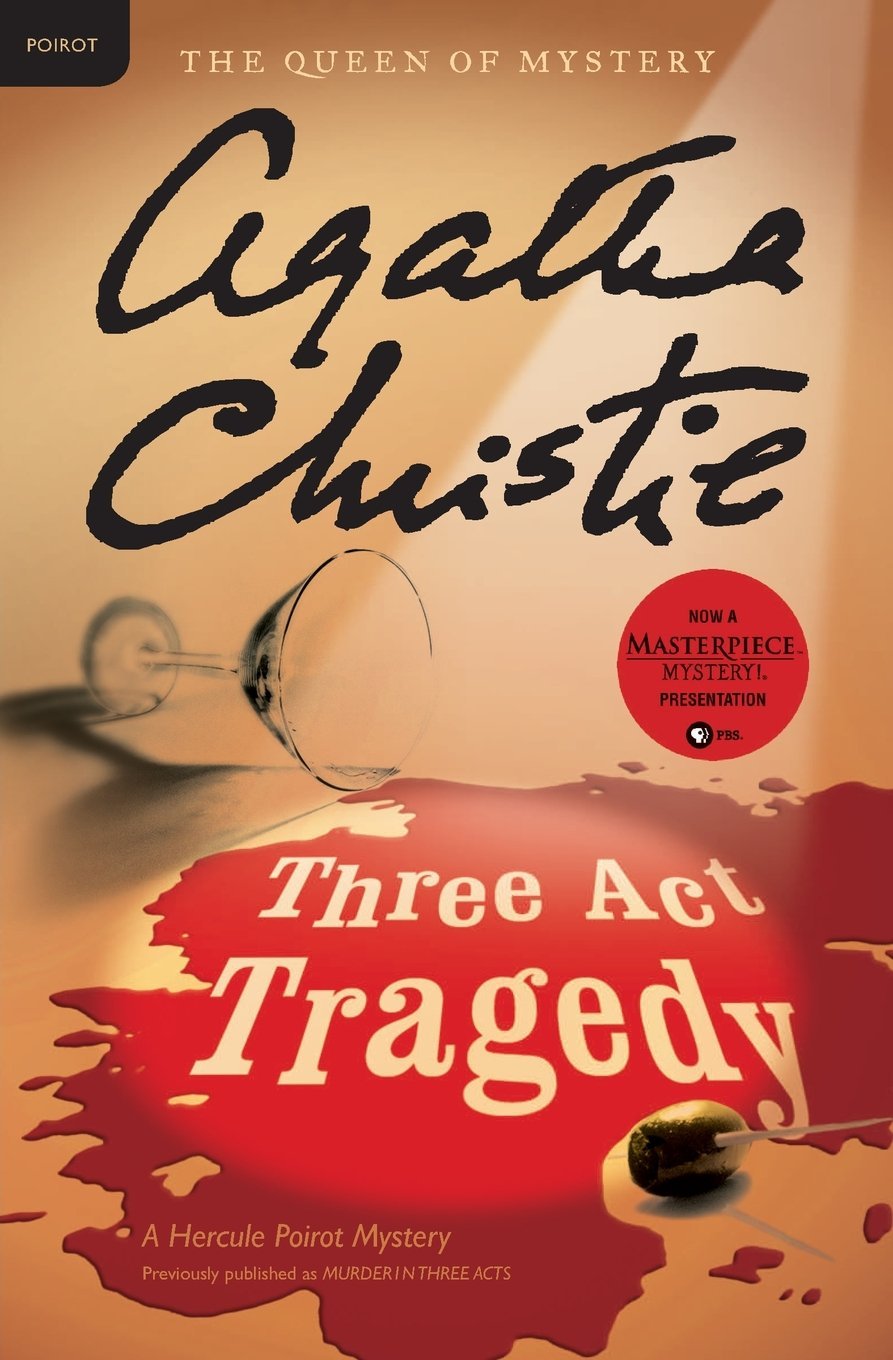
Three Act Tragedy

At a party in Cornwall, the mild-mannered minister, Reverend Stephen Babbington, chokes on his cocktail, goes into convulsions and dies.  Investigation of the glass finds no poison.  Hercule Poirot is baffled; there appears to be no motive.  The party, hosted by Sir Charles Cartwright, also included:  Dr. Strange, Lady Mary Lytton Gore and her daughter Hermione, Captain Dacres and his wife Cynthia, Muriel Wills,Oliver Manders, Mr. Satterthwaite, and Mrs. Babbington.  Sir Charles mixed the drinks.

Another party is hosted in Yorkshire with many of the same guests, except Sir Charles, Mr. Satterthwaite and Poirot.  Oliver Sanders' motorcycle breaks down right in front of the manor. Sir Charles new butler serves port to all of the guests.  Dr. Strange collapses and dies.  His glass is tested and it is determined he died of nicotine poisoning.  Reverend Babbington's exhumed body reveals the same substance.

Mr. Satterthwaite and Sir Charles investigate the two deaths.  It turns out Dr. Strange gave his usual butler a vacation just two weeks before his death.  After his murder, his temporary butler disappeared.  In Ellis' room papers are found indicating he was blackmailing Dr. Strange.

Poirot receives a telegram from Mrs. D at the sanitarium.  Later, Mrs. D is discovered murdered as a result of nicotine poisoning.

It turns out that Sir Charles murdered all three victims. Charles had wanted to marry Hermione but couldn't because he had a wife in the insane asylum.  British law forbade him from divorcing her.  He murdered Dr. Strange who was the one person who knew about his wife.  The Cornwall party was a dress rehearsal for the real murder.  Reverend Babbington was the guinea pig.  Sir Charles managed to switch Babbington's tainted glass with an untainted one.

Sir Charles then convinced Dr. Strange to let him play the role of the butler.  When Muriel spoke up, Sir Charles was prepared to kill her too.  However, Poirot told her to go into hiding.  Mrs. D was silenced because otherwise she would have told Poirot she did not send the telegram and was unconnected to the crime. Sir Charles is arrested and Hermione matches up with Oliver Manders.


Three Act Tragedy, published in 1934, courtesy 

Friday, 12 May 2017

Peril at End House

Someone has it in for a young woman named Nick Buckley:  first, her brakes fail on a hairpin turn in Cornish, England.  Second, a boulder falls as she walks down a coastal path missing her by inches.  Third, an oil painting falls and almost crushes her in bed.  Fourth, a bullet hole is discovered in her hat.  Hercule Poirot decides she needs protection.

Nick's nearest living relative is her cousin Charlie, who arranged for the remortgaging of End House to provide her with much needed funds.  Nick's housekeeper is Ellen.  Mr. and Mrs. Croft lease the lodge near End House.  George Challenger likes Nick.  Her two closest friends are an abused wife named Freddie, and Jim, an art dealer in love with Freddie.

If Nick were to die, Charlie would inherit end House and Freddie would get the rest of the estate.  Poirot recommends that Nick not stay alone.  She sends for her cousin Maggie.  Nick hosts a party at End House inviting everyone but George.  A renowned pilot named Michael Seaton has gone missing. k Guests speculate as to his fate.  Maggie is discovered dead, wearing Maggie's shawl.  Poirot launches an investigation.

To protect Nick, Poirot tells everyone she is staying in the hospital.  IN the meantime, Michael is found dead and Nick confesses that they were secretly engaged.  Michael, the sole inheritor of a wealthy estate, has indicated that it will go to his fiancee.  Poirot finds love letters written by Michael but he does not find Michael's original will.  Mr. Croft says he gave it to Charles who deceives receiving it.  Nick receives a box of chocolates laced with cocaine delivered by Freddie allegedly sent by Poirot.  She only eats one, avoiding disaster.  Poirot suspects Freddie who is a cocaine addict.

Poirot stages Nick's death.  He states that Nick's will awards all of the money to the Crofts who helped Nick's father in Australia.  Everyone is surprised except the Crofts.  It turned out they forged the will after they heard about Nick's death.  Suddenly someone shoots at Freddie; it's her dying husband who has been begging her for money.

Poirot reveals the murderer as Nick.  It turns out that Nick's cousin Maggie was engaged to Michael.  Nick pretended that she was her cousin to inherit Michael's wealth.  George used to supply cocaine to both Freddie and Nick.  The latter used her supply to poison the chocolates.  Nick is arrested but not before she takes Freddie's cocaine box as a souvenir.  She takes a lethal dose of the drug to escape the gallows.


Peril At End House

Peril at End House circa 1931 courtesy http://www.agathachristie.com/stories/peril-at-end-house.


Monday, 8 May 2017

The Mystery of the Blue Train

Hercule Poirot boards Le Train Bleu heading for the French Riviera.  On board he meets Katherine Grey who will be enjoying her first winter out of England thanks to a recent inheritance.  Grey in turn meets Ruth Kettering, an American heiress leaving an unhappy marriage to be with her lover.  The next morning, Ruth is found dead in her compartment and her "Heart of Fire" ruby given to her by her father is missing.  Her father, the American millionaire Rufus Van Alden convinces Poirot to take on the case.

The police suspect that Ruth's lover, Comte de la Roche is guilty of her murder, but Poirot suspects otherwise.  The detective suspects Derek Kettering, Ruth's husband, who is on board but claims he hasn't seen his wife.  A cigarette case inscribed with the letter K found in the dead woman's compartment casts further doubt on Derek.  When Poirot discovers that the famous jewel thief Le Marquis is on board, he realizes that the murder and the jewel theft may not be linked.

The dancer Mireille, on the train with Derek, reveals that she saw him leave Ruth's compartment around the time of the murder.  Derek is arrested but Poirot remains unconvinced.  He asks Van Alden and Knighton to come on the train with him to recreate the murder.  Knighton is really Le Marquis, the jewel thief, but no one suspected him since he was supposed to be in Paris at the time of the murder.  It turns out that the K on the cigarette case stands for Knighton, not Kettering.


The Mystery of the Blue Train First Edition Cover 1928.jpg

Friday, 5 May 2017

The Murder on the Links

First published in 1923, this Agatha Christie novel features Hercule Poirot who discovers the dead body of a millionaire on a golf course in France.  Two clues may help him solve the crime.  Firstly, the dead man had been wearing his son's overcoat.  Suddenly, a love letter was in the pocket of the coat.  Before Poirot can solve the crime, a second dead body is discovered on the golf course, also killed by a paper knife made from airplane wire.  Poirot struggles to explain why the millionaire's son was in the neighbourhood that night.  He also tries to determine the connection among a number of beauties who keep popping up including one who is Captain Hastings latest crush.

At first it appears that the millionaire's son is the culprit, given that his father didn't approve of his choice of a fiancee and he wrote him out of his weeks just two weeks before the murder.  However, Poirot digs deeper and finds out that the millionaire is not Mr. Renaud but really Mr. Conneau who had fallen in love with Mme Beroldy.  He murdered her husband but then found out she wanted to marry someone other than him.  He fled to Canada.

In Canada he gains a wife and a son.  He makes his fortune in South America.  When he returns to France, he is unhappy to discover that his neighbour is Mme Beroldy.  To make matters worse, Mr Conneau's son and Mme Beroldy's daughter fall in love.  Mme Beroldy starts blackmailing Mr. Conneau regarding his crime of 22 years before.  He devises a scheme to fake his own death.  He finds the body of a tramp and digs a grave.  However, before he has a chance to bury the body, someone murders him and puts his body in the grave.  It turns out that Mme Beroldy's daughter overheard Mr. Conneau discussing his ruse and murdered him.


Wednesday, 3 May 2017

The Market Basing Mystery

Poirot and Captain Hastings have gone to stay with Inspector Japp for the weekend in Market Basing.  While eating breakfast, the threesome is interrupted by the local police chief who informs them that a local mansion owner, Mr. Protheroe, has been found dead in his home.  While some suggest it's a suicide, it is soon ruled out due to the location of the wound.

The detectives arrive at the scene of the crime to find the victim lying on the floor with a pistol in his right hand and a fatal wound behind his left ear.  Poirot detects an odour in the air and examines the handkerchief stuffed up the victim's sleeve.  The key missing from the lock is evidence that the crime was a murder, not a suicide.  

The housekeeper points out that a couple named Parker were staying at the house the night before; their presence was not pleasing to Mr. Protheroe.  A tramp comes forward and reveals that he heard Mr. Protheroe arguing with Mr. Parker the night before.  It is further revealed that Protheroe's named was really Wendall and he had been involved with the sinking of a naval vessel years ago.  Mr. Parker was blackmailing him to this effect.

Poirot summons the housekeeper to his room where he accuses her of setting up Mr. Parker.  It turns out that Mrs. Clegg was in love with her boss.  She realized that he killed himself because he was despairing about Mr. Parker's blackmailing.  Therefore, she switched the gun, putting it in the wrong hand to make it look like a murder rather than a suicide.  


Tuesday, 2 May 2017

The Mysterious Affair at Styles

Agatha Christie's first novel, The Mysterious Affair at Styles was the result of a dare her sister Madge made to write a story.  The book features World War I soldier Hastings, who is sent back to England to recover from an injury at the Styles Court owned by his friend John Cavendish.  He meets John's new stepmother, Mrs. Inglethorpe, a rich heiress who later turns up murdered.  An old friend, Belgian detective Hercule Poirot, is hired to track down the murderer.  It was the Belgian refugees from the First World War who settled in Christie's home town of Torquay, England who inspired her to create the character Poirot.  

Note:  Christie called her first house "Styles" after her first book, published in 1920 http://www.agathachristie.com/stories/the-mysterious-affair-at-styles.


Image result


Monday, 1 May 2017

The Best Selling Novelist of All Time


My husband Rob and daughter Jacqueline used to play a video mystery game called Murder on the Orient Express based on the famous novel written by Agatha Christie.  More recently, they played Death on the Nile.  Currently they are playing Evil Under the Sun.  These games peaked Jacqueline's interest and she started searching our bookshelves for Rob's old Agatha Christie Novels.  Last night she begged to stay up later so she could read Murder on the Orient Express.  How could I say no?  I mentioned to her that Daddy and I watched the movie of the same name, directed by Alfred Hitchcock, a few years ago.  The movie was filmed in 1972 but I didn't realize that the book was first published in 1934.  "It's almost as old as Grandpa!" I said to Jacqueline.  


It turns out that Rob has ten of the Agatha Christie mysteries, but the famous author wrote at least 66 detective novels.  In fact, she is the most widely published novelist in history, only outsold by the Bible and Shakespeare.  For a complete list of Christie's novels, visit http://www.agathachristie.com/stories.


Image result


Agatha Christie's main character Hercule Poirot could have been inspired by someone she met while attending school in France where she learned how to speak fluent French.  One source, however, says that Christie's character was inspired by a Belgian gendarme she met in Britain after he fled the Germans during the First World War.  http://www.telegraph.co.uk/culture/books/10825492/Poirot-unmasked-the-Belgian-refugee-who-inspired-Agatha-Christie-character.html


Agatha Christie served as a nurse during the First World War.  Her knowledge of poisons, which she learned at the time, could have been used in any one of the 83 poisonings in her books.  For instance, cyanide features in The Mirror Cracked from Side to Side, And Then There Were None, A Pocket Full of Rye and Sparkling Cyanide.  Kathryn Harkup writes about this in her book A is for Arsenic:  The Poisons of Agatha Christie https://bookshop.theguardian.com/catalog/product/view/id/323440/


Agatha Christie travelled widely through Europe and Africa.  She participated in archeological digs in the Middle East with her second husband Max Mallowan which inspired many book titles.  While on digs, Mallowan discovered artifacts as old as 3000 years.  Christie, always conscious of the fact that she was 15 years older than her husband, used her face cream to clean the artifacts.  As archeologist Charlotte Trumpler explained:  "Christie was of course fascinated by puzzles, by the little archeological fragments, and she had a gift for piecing them together patiently." http://www.cnn.com/2011/WORLD/europe/03/12/uk.christie.writer.archaeology/ Her novel, Murder in Mesopotamia, with an archeologist as the culprit, was the result of these digs.  


Another viewpoint of the Iamassu sculpture, captured by Christie in 1949, shows the figure which guarded the royal court from evil at the ancient site of Nimrud