Showing posts with label murder mystery. Show all posts

Saturday, 27 May 2017

Evil Under the Sun

Hercule Poirot is holidaying in Devon.  Also at the hotel is a beautiful actress named Arlena, a known flirt.  She is vacationing with her husband, Kenneth, and teenage stepdaughter, Linda, who hates her stepmother.  Arlena flirts with the handsome Patrick Redfern, angering his wife, Christine, a former schoolteacher.  Other guests at the hotel include Sir Horace Blatt, a braggart, Major Barry, an Anglo-Indian military officer, Rosamund Darnley, a dressmaker and former girlfriend of Kenneth, Carrie Gardener, an American tourist, and her husband Odell, Reverend Stephen Lane and Emily Brewster, a quiet spinster.

Arlena, known for sunbathing, is found face down in the sun, dead.  Poirot collects alibis.  Linda drops a parcel of candles when Christine asks her to Gull Cove.  Arlena paddles to Pixy Cove for a rendezvous.  Both Kenneth and Patrick look for her.  Patrick asks Emily to join her daily row.  He finds a Arlena's limp body lying face down, arms outstretched.  He stays with the body while Emily fetches the doctor who concludes it is death by strangulation, likely a male.

Police questions the suspects.  Kenneth was heard typing letters responding to figures in previous mail.  Linda lies and says she was fond of her stepmother.  She and Christine went to Gull Cove at 10:30  and didn't return until 11:45.  The Gardeners were with Poirot the entire time.  Emily and Patrick saw Rosamund reading at Sunny Edge.  Reverend Lane and Major Barry went out.  Sir Horace Blatt spent the morning sailing.  Christine Rosamund, Kenneth and Mr. Gardener went to play tennis at noon.  Earlier in the day, Miss Brewster narrowly missed being hit on the head with a bottle tossed from a window.  Someone ran a bath at noon but no one is admitting to it.

At Pixy Cove, Poirot finds a new pair of scissors, a pipe fragment and heroin.  Poirot also smells a perfume only used by Arlena and Rosamund.  Poirot invites everyone on a picnic to test their vertigo:  Christine, who claims she has vertigo, easily traverses the bridge.  Linda overdoses on six sleeping pills, and almost dies.  Linda admits to the murder, but Poirot finds her library book and realizes she thinks that piercing a voodoo doll qualifies as murder.  Christine made her sleeping pills availabe and Linda took them.

Poirot investigates any local strangulations and discovers that Alice Corrigan was strangled.  Her husband, Edward, was too far away to have committed the crime.  Police identify Patrick Redfern as Edward Corrigan.  They identify the deceased as Christine Redfern, then known as Christine Deverill, Patrick's true love.  Patrick simply used Arlena for her money.  While Arlena did not suspect anything, if her husband discovered she emptied their bank account, he would be suspicious.  Patrick and Christine decided to get rid of her.

Patrick told Arlena to meet him that fateful day at a cave.  Christine set Linda's watch ahead by 20 minutes to give her an alibi.  Christine put on some tan makeup and pretended to be Arlena.  Emily was fooled by her.  Christine returned to her hotle room to wash off the suntan makeup, the bath that no one had admitted to.  She threw the empty bottle out the window, the one that narrowly missed Miss Brewster.  Meanwhile, Patrick called the unsuspecting Arlena out of the cave and strangled her.

Rosamund gives up her career to marry Kenneth and Linda ends up with a loving stepmother.


Friday, 26 May 2017

Sad Cypress

Elinor and Roddy are engaged to be married when they receive an anonymous letter saying that someon is sucking up to their wealthy aunt, Laura Welman, from whom they expect to inherit a fortune.  Elinor is niece to Mrs. Welman while Roddy is nephew to the late Mr. Welman.  Elinor suspects Mary Gerrard, the lodgekeeper's daughter, as the subject of the letter.  Not knowing who wrote the letter, they burn it.

Elinor visits her aunt who complains about the fact that she is partially paralyzed from a stroke.  She wants to end her life but her doctor will not hear of it.  In the meantime, Roddy falls in love with Mary, prompting Elinor to end their engagement.  After a second stroke, Mrs. Welma asks Elinor to make provision for Mary.  However, before the will can be changed, she dies and her estate goes directly to Elinor.

Elinor sells the house she inherited and gives two thousand pounds to Mary.  The latter dies of poisoning during a lunch at Hunterbury.  Everyone at the house has access to the poison.  Elinor is arrested.  Later, everyone learns that Mrs. Welman also died of poisoning.  Peter Lord, in love with Elinor, brings Hercule Poirot into the case.  Poirot soons discovers the author of the letter.  Was the poison in the sandwiches made by Elinor or in the tea prepared by Nurse Hopkins?  Also, what is the secret of Mary's birth?  What is the significance of the scratch made by a rose thorn on Hopkins' wrist?

It turns out Nurse Hopkins is the murderer.  The thorn scratch on Nurse Hopkin's wrist is really an injfection mark from the needle full of emetic she injected herself with causing her to vomit up the poison in the tea.  She went to wash the dishes so that no one would see her vomit.   Mrs. Welman, and Sir Lewis Rycroft, had an illegitimate daughter and she is Mary.  If this infomration had been learned sooner, Mary would have inherited some of the estate.  When someone encourages Mary to write a will, she names her aunt, Mary Riley, from Australia as beneficiary.  Mary Riley's married name is Draper.  It turns out Mary Draper is really Nurse Hopkins, who is bent on getting her hands on the money.

Elinor is acquitted and she married Peter Lord.


Sad Cypress

Sad Cypress, published in 1939, courtesy http://www.agathachristie.com/stories/sad-cypress


Wednesday, 24 May 2017

Appointment with Death


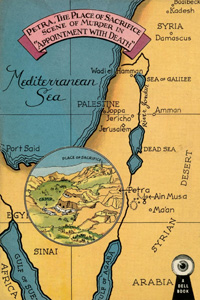
On vacation in Jerusalem, Poirot overhears a brother and sister conversing about their evil stepmother:  "You do see, don't you, that she's got to be killed," Raymond Boynton tells his sister.  On a trip to Petra, the stepmother is found dead, a needle puncture in her wrist.  Poirot offers to solve her murder in 24 hours.

Sarah King, who relays the tale along with Dr. Gerard, is attracted to Raymond Boynton.  Jefferson Cope wants to take Nadine Boynton away from her husband, Lennox Boynton, and the influence of her mother in law.  Confronted with her strategy to take the young Boynton's away from their mother in law, Sarah confronts Mrs. Boynton who replies:  "I;ve never forgotten anything -- not an action, not a name, not a face."

Poirot sets out to interview all the suspects.  He establishes a timeline which seems impossible.  Sarah King places the time of death well before various suspects claim to have seen the deceased alive.  A hypodermic needle was seemingly stolen from Dr. Gerard's tent.  The poison administered to the victim, digitoxin, was something she already took medicinally.  Poirot calls a meeting explaining how each member of the family discovered Mrs. Boynton's victim, but in turn didn't report the crime, suspecting another member of the family as the murderer.  No one in the immediate family would have needed a needle to commit the crime; they simply would have given her a bigger dose of the medicine already prescribed.  Therefore, Poirot suspects an outsider.

Lady Westholme is revealed as the murderer.  A former inmate at the prison where Mrs. Boynton was a warden, she had it in for the woman.  It was to Lady Westholme, not Sarah, that Mrs. Boynton had addressed her threat.  Disguised as an Arab, she had administered the hypodermic needle.  Eavesdropping in an adjoining room, and not wanting her criminal history to be revealed, Lady Westholme commits suicide.

Happier times ensue for the family as Sarah marries Raymond, Carol marries Jefferson and Ginevra marries Dr. Gerard.


Appointment With Death

Appointment with Death, published in 1937, courtesy http://www.agathachristie.com/stories/appointment-with-death.


Monday, 22 May 2017

Dumb Witness

Emily Arundell writes to Hercule Poirot complaining that someone is trying to kill her.  She fell down the stairs, an accident attributed to her fox terrier's rubber ball.  However, by the time Poirot receives her letter, she is dead.

Emily's doctor says she died of chronic liver problems.  Emily's companion, Minnie Lawson inherits the deceased's house and fortune.  In a previous will, the inheritors would have been Emily's nephew, Charles, and nieces, Theresa and Bella.  Upon investigation, Poirot discovers a nail with varnish and a string attached to it at the top of the stairs.  "Bob...dog...picture...ajar." had been the message that Emily had given before her death.  Poirot concludes that Bob the dog, who was outside that night, did not leave the ball on the stairs and that Emily was tripped by the string.

Emily's nephew and nieces talk about contesting the will, but it is not pursued.  The gardener reveals that the nephew, Charles, talked to him about his arsenic based week killer.  The bottle is almost empty.  Minnie Lawson says that on the night of Emily's death she saw someone through her bedroom window wearing a broach with the initials T.A. (possibly Theresa Arundell, Emily's niece).

IN the meantime, Bella reveals her husband Jacob is bullying her and she moves with her children to a hotel, with the help of Minnie.  However, for more security Poirot recommends she moves to another hotel.  The next day Bella is found dead due to an overdose of chloral, a sleep aid.

Poirot reveals his theory on the murders.  Theresa stole the arsenic but could not bring herself to use it.  She and her brother suspected each other.  Emily, fearing that Charles might be trying to kill her, revealed that she had revised her will.  He was satisfied with just stealing some of her money.  The brooch which Minnie had seen was really Bella's.  The initials TA, reversed in the mirror, stood for Arabella Tanios.  She hated her husband and wanted to separate from him and keep the children, but she had no means to do so.  Her first attempt with the ball and string failed.  Her second attempt involved inserting elemental phosphorous in one of Emily's liver capsules, which succeeded.

Emily was unaware that her aunt had revised her will.  When Poirot explained the murder, she took her own life and her children went back to their father.  Emily's husband is upset as he did love his wife.  However, he finds out she obtained the chloral to kill him.  Minnie decides to share her wealth with Charles, Theresa and Bella's children.  Theresa marries Dr. Donaldson,  Charles squanders his wealth.  The terrier goes to live with Poirot but he prefers Captain Hastings.


Dumb Witness

Dumb Witness, published in 1937, courtesy http://www.agathachristie.com/stories/dumb-witness


Sunday, 21 May 2017

Cards on the Table

Mr. Shaitana hosts a dinner party and invites four sleuths and four people he thinks could have committed murder.  In a veiled accusation, he lists the way the guests might have committed murder based on their occupations.  After dinner, he seats the fours sleuths at one bridge table and the four other people at another table. When the sleuths finish their game, Hercule Poirot, one of them, discovers his host dead in his chair, a weapon from his own collection in his chest.

Poirot speaks with Superintendent Battle, Colonel Race and Mrs. Olivers while the other four guests wait in another room.  Battle questions each one.  Dr. Roberts Mrs. Lorrimer and Anne Meredith and Major Dethspar all deny any involvement in the murder.  Poirot collects the score sheets from the bridge game to mark the passage of time as well as to give clues to the character of each suspect.

As the investigation proceeds, each sleuth discovers a murder.  Battle finds out that a client of Dr. Roberts, along with the client's spouse, died separately, one of anthrax, the other of blood poisoning. Colonel Race reveals that Despard led botanist Luxmore through the Amazon jungle where the latter died of fever, with rumours he was shot.  Mrs. Oliver learns that a woman who employed Anne as a companion died of accidental poisoning.  Poirot uncovers the fact that Mrs. Lorrimer poisoned her husband.  Colonel Race leaves the country for his work in the Secret Service.  The reactions of the guests vary:  Anne is afraid, Despard engages a lawyer and Dr. Roberts carries on as usual.

Mrs. Lorrimer, who admits she killed her husband, says she has a fatal health condition and that she is the one who killed the host.  However, she is not believed; it appears she is trying to spare Anne.  Anne comes to visit Mrs. Lorrimer and the following morning the latter is found dead of a sleeping drug overdose.  However, when Poirot comes upon the scene he sees a hypodermic needle mark on Mrs. Lorrimer's arm.

Anne takes her flatmate Rhoda out in a boat on the nearby rivers as they await a visit from Despard.  Poirot and Battle race to Anne's cottage where they see Anne deliberately tip Rhoda out of the boat, but the latter pulls the former into the water as well, and neither can swim.  Despard saves Rhoda and then Anne.  Rhoda survives but Anne dies.

At Poirot's apartment he presents his theory on the murders.  The sleuth presents a window washer who saw Dr. Roberts inject Mrs. Lorrimer.  The police ruled she died of an anesthesia overdose.  Dr. Roberts killed Mr. Shaitana as well.  He waited until he was a "dummy" in the bridge game and excused himself to get a glass of water.  Furthermore, Doctor Roberts had killed Mr. Craddock, the husband of one of his patients, by putting anthrax on his shaving brush during a house call.  Then he injected Mrs. Craddock with her required anti typhoid injection before her trip to Egypt but added a germ which led to her fatal blood infection.  Roberts at first protests but eventually admits he is guilty.  The window washer was actually an actor used to solicit the confession from the doctor.

Major Despard is exonerated when it is proven that the botanist died from an accident shooting wound.  Despard ends up courting Rhoda, Anne's flatmate.


Cards on the Table

Cards on the Table published in 1936 courtesy 


Friday, 19 May 2017

Murder in Mesopotamia

Amy Leatheran, a nurse, is hired by Swedish archeologist Dr. Erich Leidner, to care for his wife, Louise.  They are currently on a dig in Iraq, a British protectorate.  Louise was married briefly during the Great War 15 years earlier.  She turned in her husband, Frederick, a German spy, and he was imprisoned.  He escaped and hopped a train, but the train crashed.  A body with his identification was found at the site of the crash.  However, Louise is now receiving letters from her "deceased" husband which puts her on edge.

A week after the nurse is hired to care for Louise, the latter is found dead in her room, the victim of a blow by a blunt instrument.  Dr. Reilly examines the body and establishes a time line, concluding that it was an inside job.  He calls in Hercule Poirot, travelling in Iraq at the time, to solve the crime.  Poirot determines that it must be someone from the expedition who is guilty of the murder.  The murderer must have entered the victim's bedroom from the inside of the house as the bedroom window is barred.  However, after one round of questioning it appears that everyone has an airtight alibi.

Nurse Leatheran tells Poirot the story of Louise's young brother in law, William, who was fifteen years younger.  She points out that Louise always craved the attention of men.  Poirot suspects that William, or even Frederick himself might be part of the expedition as Frederick's identity was never proven on the train wreck.  Poirot warns Nurse Leatheran that she might be a future target of the murderer but she still insists on attending Louise's funeral.

After the funeral, Nurse Leatheran and Miss Johnson are up on the roof and the latter points out how someone could enter the house without being seen.  Later Miss Johnson is poisoned:  someone substituted hydrocholoric acid in her water glass, through her window..  Poirot solves the crimes, but has no proof.

It turns out Mrs. Leidner and Miss Johnson were murdered by Dr. Erich Leidner.  Poirot determines that Leidner is really the long lost husband, Frederick who really didn't die in the crash.  Leidner did die and he has stolen his identity.  Frederick remarried his wife who, after 15 years, didn't recognize him. He was the one who sent her the letters to discourage her from engaging in relationships with other men.  He discovered that his wife was falling in love with his friend, Richard Carey, and he murdered her in a jealous rage.  Miss Johnson figured it out and he in turn murdered her.

On the night of the crime, Louise heard a noise up on the roof.  Unbeknowst to her it was her husband sorting pottery.  She opened her bedroom window to investigate only to be knocked out by a stone quern.  In the meantime, Frederick removed the bloodstained rug and closed the window before calling the nurse.  With the nurse on the scene, she could vouch for the time of death.  Frederick tried to make Miss Johnson's death appear a suicide; however, Poirot points out that hydrolic acid is an incredibly painful way to kill oneself.   


Murder in Mesopotamia

Thursday, 18 May 2017

Death in the Clouds

Hercule Poirot is on a flight from Paris to Croydon when one of the passengers, Madame Giselle, drops dead.  Speculation has it that she died of a wasp sting, but Poirot determines the cause of death to be a poisoned dart.  What instrument was used to shoot the dart?  Was it the flute carried by one of the passengers?  Was it the ancient tubes brought on board by the two archeologists?  Was it Lady Horbury's cigarette holder?  And what were the two coffee spoons doing in the victim's coffee cup?

Poirot discovers that Madame Giselle was known for blackmailing her clients who hadn't paid up.  Also, Madame Giselle had an estranged daughter who should inherit her mother's estate; she might be on board the plane.  Poirot questions several of the passengers including Mr. Clancy, a detective novelist.  Countess Horbury also comes under suspicion.  She came from the lower class but married well.  In the meantime, her husband has cut her off and she had owed Madame Giselle money.  The Countess' maid, called into the compartment during the flight, would have had the perfect opportunity to commit the crime.  The maid is revealed as the long lost daughter of the victim.  It appears as if she is guilty, but she in turn is murdered on the boat train to Bologne.

Dentist Norman Gale, who had a crush on the novel's heroine Jane Grey, is revealed to be Anne's new husband.  Poirot discovers that Gale brought his dentist's jacket on board and excused himself to go to the washroom.  He donned the jacket and posed as a steward.  Under the premise of delivering a coffee spoon to Madame Giselle, he stabbed her with the poison dart.  Gale's intention had been to frame the Countess.  The blowpipe found behind Poirot's seat was supposed to be behind the Countess' but they had switched at the last minute.  Poirot allows the detective novelist to listen in as he joins the dots in the story's denouement.


Monday, 15 May 2017

Why Didn't They Ask Evans?

While playing a round of golf with his friend Dr. Thomas, Bobby Evans swings his golf ball over a cliff.  At the bottom of the precipice he finds the crumpled body of man whose last words are;  "Why didn't they ask Evans?"  Bobby finds a photograph of a beautiful woman in the dead man's pocket, but without identification.  Another man who comes upon the scene, Roger Bassington-French, offers to stay with the body while Bobby leaves to play the organ at his father's church.  The dead man is identified as Alex Pritchard and the beautiful woman in the photo is his sister Amelia Cayman.

Bobby rejects a job offer from Buenos Aires.  In the meantime he drinks from a poisoned beer bottle.  Bobby discovers that Amelia Cayman is an imposter.  He figures that the stranger at the scene of the crime must have switched the photo in the dead man's wallet.  Bobbie and his friend Frankie search for Bassington-French and find an address in Hampshire.  There, they stage a car accident hoping that Frankie, injured, will be invited into the home.  Inside, Frankie meets Roger's brother, Henryk, and sister in law Sylvia.  Frankie shows the couple a newspaper clipping of the dead man.  Sylvia says he resembles a man who was good friends with a big game hunter, Alan Carstairs, who killed himself after being diagnosed with terminal cancer.

Frankie meets Henry and Sylvia's neighbours, Dr. and Moira Nicholson, who run a sanitarium.  Bobby investigates the sanitarium where he runs into the beautiful woman from the photo.  Moira turns up at the local inn where Bobby is staying and says her husband is trying to kill her.  Frankie asks Roger if he took the photo of the beautiful woman and he admits that he dead, wanting to avoid scandal for her.  In the meantime, Henry is found dead in his home, an apparent suicide.

Frankie asks a solicitor about Savage's will and finds out that he was staying with Mr. and Mrs. Templeton when he first discovered he had cancer.  One specialist, however, said he was perfectly fine.  When he died, he left 700,000 pounds to the Templeton's.  Bobby is kidnapped and Frankie is lured, along with Roger, to an isolated cottage.  Badger Beadon arrives to find a drugged Moira in the cottage.  When the police appear on the scene, Roger has vanished.

They trace the witnesses to the signing of John Savage's will.  They are the former cook and gardener of Mr.and Mrs. Templeton.  The parlourmaid, Gladys, however, was not asked to witness the singing of the will.  In reality, it was not John Savage who signed the document but Roger Bassington-French.  Gladys' last name is Evans, hence the dying man's question:  "Why didn't they ask Evans?" Gladys is now the housekeeper at Bobby's home and the dying man was trying to find her.  

Returning to Wales, they find Moira who claims she is being followed by Roger.  Frankie, suspicious of Moira, spoils the latter's attempt to poison their coffee.  It turns out Moira was really Mrs. Templeton and Roger's accomplice.  Moira attempts to shoot Bobby and Frankie but is overpowered.  Weeks later Frankie received a letter postmarked South America from Roger who admits that he murdered Carstairs and his brother Henry.  Frankie and Bobby get engaged.


Why Didn't They Ask Evans?

Why Didn't They Ask Evans?, published in 1933, courtesy http://www.agathachristie.com/stories/why-didnt-they-ask-evans

Friday, 12 May 2017

Peril at End House

Someone has it in for a young woman named Nick Buckley:  first, her brakes fail on a hairpin turn in Cornish, England.  Second, a boulder falls as she walks down a coastal path missing her by inches.  Third, an oil painting falls and almost crushes her in bed.  Fourth, a bullet hole is discovered in her hat.  Hercule Poirot decides she needs protection.

Nick's nearest living relative is her cousin Charlie, who arranged for the remortgaging of End House to provide her with much needed funds.  Nick's housekeeper is Ellen.  Mr. and Mrs. Croft lease the lodge near End House.  George Challenger likes Nick.  Her two closest friends are an abused wife named Freddie, and Jim, an art dealer in love with Freddie.

If Nick were to die, Charlie would inherit end House and Freddie would get the rest of the estate.  Poirot recommends that Nick not stay alone.  She sends for her cousin Maggie.  Nick hosts a party at End House inviting everyone but George.  A renowned pilot named Michael Seaton has gone missing. k Guests speculate as to his fate.  Maggie is discovered dead, wearing Maggie's shawl.  Poirot launches an investigation.

To protect Nick, Poirot tells everyone she is staying in the hospital.  IN the meantime, Michael is found dead and Nick confesses that they were secretly engaged.  Michael, the sole inheritor of a wealthy estate, has indicated that it will go to his fiancee.  Poirot finds love letters written by Michael but he does not find Michael's original will.  Mr. Croft says he gave it to Charles who deceives receiving it.  Nick receives a box of chocolates laced with cocaine delivered by Freddie allegedly sent by Poirot.  She only eats one, avoiding disaster.  Poirot suspects Freddie who is a cocaine addict.

Poirot stages Nick's death.  He states that Nick's will awards all of the money to the Crofts who helped Nick's father in Australia.  Everyone is surprised except the Crofts.  It turned out they forged the will after they heard about Nick's death.  Suddenly someone shoots at Freddie; it's her dying husband who has been begging her for money.

Poirot reveals the murderer as Nick.  It turns out that Nick's cousin Maggie was engaged to Michael.  Nick pretended that she was her cousin to inherit Michael's wealth.  George used to supply cocaine to both Freddie and Nick.  The latter used her supply to poison the chocolates.  Nick is arrested but not before she takes Freddie's cocaine box as a souvenir.  She takes a lethal dose of the drug to escape the gallows.


Peril At End House

Peril at End House circa 1931 courtesy http://www.agathachristie.com/stories/peril-at-end-house.


Thursday, 11 May 2017

Murder at the Vicarage

When Colonel Lucius Protheroe turns up dead at the vicarage, no one is surprised.  Even the local vicar says "killing him would be doing a service to the townsfolk".  While the vicar looks suspicious, two other people confess to the crime and Miss Marple is called in to solve the murder.  Miss Marple determines that the two people who confessed, Mrs. Protheroe and her lover Lawrence Redding, were indeed the murderers, and simply wanted to deflect guilt by admitting to the crime.  Miss Marple appears in later novels, The Body in the Library (1942) and 4:50 from Paddington (1957).


The Murder at the Vicarage

Murder at the Vicarage, published in 1930, courtesy 


Tuesday, 9 May 2017

The Seven Dials Mystery

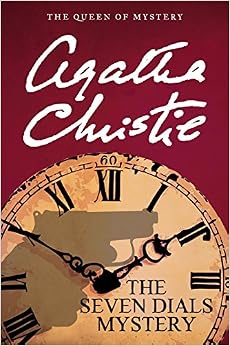
Agatha Christie brings some of her characters back from the novel Mystery of Chimneys in this new novel including Lady Eileen Brent, Lord Caterham, Bill Eversleigh, George Lomax, Tredwell and Superintendent Battle.  The Marquess of Caterham rents out her manor house at Chimneys to a self made millionaire named Sir Oswald Coote.  A party of young people are also staying which includes three young women and five young men.  One of the men, Gerald "Gerry" Wade, has a bad habit of sleeping in.  Therefore the other young people buy eight alarm clocks, set each one for a different time, and place them in Gerry's room.

In the morning, despite all of the alarm clocks having rung, Gerry has not risen.  He is found dead in his bed of a chloral overdose.  Tow of the young men, Jimmy and Ronny, drive over to Gerry's stepsister, Loraine's, house to break the bad news.  They return to Chimneys where they search Gerry's room and find only seven alarm clocks.  The missing one is found in the bushes at Chimneys.

Lord Caterham retakes possession of Chimneys.  His daughter, Lady Eileen "Bundle" Brent, puzzled about the crime, writes a letter to Bill Eversleigh.  It turns out that Gerry died in her bedroom.  In her writing desk she finds an unfinished letter from Gerry to Loraine.  In it, he states:  "Forget what I said about the Seven Dials business."  She decides to visit Bill in London.  On the way, a stranger jumps out of the bushes in front of her car.  She gets out as the stranger collapses to the ground, muttering "Seven dials...Jimmy Thesiger."  Bundle manages to get him in her car and take him to the doctor where he's pronounced dead-- not from Bundle's car but from a gunshot wound.

The dead man is identified as Ronny, one of the young men at the party.  IN the meantime, George Lomax receives a warning letter from the Seven Dials district of London.  Bundles gets Jimmy's address in London and goes to break the news to him.  Loraine is also present.  Jimmy and Loraine reveal Ronny could have had ties to the Mafia.  Loraine says that she discovered a list of names and dates together with an adress in Seven Dials.  The three wonder if the missing alarm clock, leaving seven alarm clocks, was a warning left by the killer.

Bundle discovers that the Seven Dials is a seedy nightclub.  She begs Bill to take her there.  At the club, she recognizes the doorman as the former footman at Chimneys.  She questions the doorman who tells her that a Russian named Mosgorovsky offered him three times the pay to work at the nightclub.  Mosgorovsky also supplied a replacement for the footman, a man named John Bauer.  The doorman shows Bundle a secret room with seven chairs.  Bundle hides in a closet and eavesdrops on a meeting among seven people, all with white hoods with slits and clock faces.  One member of the group talks about the upcoming party at Wyvern Abbey where a German named Everhard will be there with a new invention.

Bundle later learns that the invention is one that makes wire as strong as steel.  Everhard is about to present the invention to the British at the party.  Bundle and Jimmy wrangle invitations to the party where the find Superintendent Battle disguised as a waiter.  Jimmy goes to the library to check something out.  Bundle is told to stay in her room, but sneaks out the window and down the trellis to be a part of the action.  Looking for Jimmy she hears a scuffle on the balcony outside the library and two gunshots.

Battle runs to the library where he finds Jimmy wounded and unconscious.  Sir Stanley runs to his room where he finds the invention formula missing.  Sir Oswald Coote arrives saying he was on a walk and discovered the gun.  The next morning Battle searches the crime scene and finds one set of footprints leading up to where the gun was discovered -- Sir Oswald Coote's.  He also finds a charred glove with teeth marks in the fireplace.  Jimmy gets closer to Lady Coote's and receives an invitation from Lady Coote to their new house in Letherbury where he hopes to investigate Sir Oswald Coote.

Jimmy rings up Bundle and Loraine and tells them to meet him and Bill at the Seven Dials Club.  Jimmy arrives, having left Bill in the car.  Bundle shows him the secret room.  In the meantime, Bill is knocked unconscious in the car.  Bundle goes looking for brandy for Bill and is also knocked out.  Mogorsky takes them to a meeting of the Seven Dials where the identity of Number 7 is revealed;  it's Superintendent Battle.  The Seven Dials is a secret group of criminal catcher and included Gerry Wade and Ronny Devereux.

It turns out that the secret formulae thief was Jimmy Thesiger, along with his accomplice Loraine, both of whom have just been arrested.  Ronny was killed when he got too close to the truth.  HIs last words were a warning to the Seven Dials about Jimmy, not the other way around.  Jimmy climbed on the ivy and threw the stolen formula down to Loraine.  He staged a fight in the library where he shot himself in the right arm.  His right arm being disabled, he had to use his teeth to pull off his glove which he tossed in the fireplace.


The Seven Dials Mystery circa 1929 courtesy https://www.amazon.com/Mystery-Christie-Mysteries-Collection-Paperback/dp/0062074164.

Monday, 8 May 2017

The Mystery of the Blue Train

Hercule Poirot boards Le Train Bleu heading for the French Riviera.  On board he meets Katherine Grey who will be enjoying her first winter out of England thanks to a recent inheritance.  Grey in turn meets Ruth Kettering, an American heiress leaving an unhappy marriage to be with her lover.  The next morning, Ruth is found dead in her compartment and her "Heart of Fire" ruby given to her by her father is missing.  Her father, the American millionaire Rufus Van Alden convinces Poirot to take on the case.

The police suspect that Ruth's lover, Comte de la Roche is guilty of her murder, but Poirot suspects otherwise.  The detective suspects Derek Kettering, Ruth's husband, who is on board but claims he hasn't seen his wife.  A cigarette case inscribed with the letter K found in the dead woman's compartment casts further doubt on Derek.  When Poirot discovers that the famous jewel thief Le Marquis is on board, he realizes that the murder and the jewel theft may not be linked.

The dancer Mireille, on the train with Derek, reveals that she saw him leave Ruth's compartment around the time of the murder.  Derek is arrested but Poirot remains unconvinced.  He asks Van Alden and Knighton to come on the train with him to recreate the murder.  Knighton is really Le Marquis, the jewel thief, but no one suspected him since he was supposed to be in Paris at the time of the murder.  It turns out that the K on the cigarette case stands for Knighton, not Kettering.


The Mystery of the Blue Train First Edition Cover 1928.jpg

Sunday, 7 May 2017

The Murder of Roger Ackroyd

In the town of King's Abbott, a woman named Mrs. Ferrars commits suicide after she can't bear the guilt she feels at poisoning her husband the previous year.  Roger Ackroyd, the town's wealthiest citizen, was expected to marry Mrs. Ferrars.  He invites Dr. Sheppard to dinner, claiming he has something important to tell him.  He also invites Mrs. Cecil  Ackroyd, his sister in law, Miss Flora Ackroyd, his niece, Geoffrey Raymond, Ackroyd's young secretary, and Major Blunt, Ackroyd's friend.  Visibly distraught during dinner, Ackroyd has a private conversation with Dr. Sheppard after dinner revealing that Mrs. Ferrars killed her husband and was being blackmailed for the murder.  At that moment, a letter arrives from the late Mrs. Ferrars which states who the blackmailer is and how she hopes Mr. Ackroyd will seek revenge on him.  Mr. Ackroyd choses not to name the blackmailer.

Dr. Sheppard leaves Fernly Park (Ackroyd's estate) and on the way home bumps into a stranger who asked for directions to Ackroyd's residence.  At home he receives a phonne call from Fernly Park saying that Ackroyd was murdered.  THe next day, Flora Ackroyd suggests to Dr. Sheppard that they recruit Hercule Poirot, the doctor's new neighbour, to solve the murder.  Flora is worried that Ralph Paton will be blamed for the crime since he was spotted at Fernly Park and that footprints matching a pari of shoes owned by Paton were found in the dirt outside Ackroyd's study the night before.  Paton, who was in a lot of debt, expected to inherit a large amount of money upon Ackroyd's death.  Dr. Sheppard points out that after he left Ackroyd's study at 9:30 pm and before the body was found at 10:30 pm, Major Blunt and Geoffrey Raymond overheard someone speaking to Ackroyd in his study.

WHile the police are convinced that Paton is the murderer, Poirot has his own theory.  He fixates on a phone call made to Dr. Sheppard from the King's Abbott train station and on a grandfather chair which was moved into the middle of the study when Ackroyd was discovered.  Poirot assembles Mr.s Cecil Ackroyd, Miss Flora Akroyd, Major Blunt and Geoffrey Raymond together and accuses them all of hiding something.  Mrs. Cecil Ackroyd and Raymond admit that they owed Ackroyd money and his death resolved them of all debts.  It turns out that Parker, Ackroyd's employee, was guilty of nothing more than snooping.  He had heard about blackmailing and thought that maybe he could get in on the act and blackmail his boss.  It turns out that Flora lied about wishing her uncle good night on the night in questions.  She sneaked up to his room to steal money to settle some debts of her own.  Ackroyd's housekeeper Miss Russell explaing that Charles Kent, the stranger found on the grounds that night, cannot be the murderer.  She met Kent, her illegitimate son, at Ackroyd's summer house that night.

Poirot determines that Ackroyd purchased a Dictaphone the week before the murder and therefore that was what people overheard at 9:30 pm on the night of the murder.  He also reveals that Dr. Sheppard had been hiding Ralph Paton by pretending he was a patient in the local insane asylum.  Poirot declares that Dr. Sheppard is the murderer.  He murdered Ackroyd and then programmed the Dictaphone to go off at 9:30 pm.  In the meantime he planted the footprints using Paton's shoes.  He hid Paton so that he would look more suspicious.  Dr. Sheppard's motive was the fact that he was Mrs. Ferrars' blackmailer.


The Murder of Roger Ackroyd

The Murder of Roger Ackroyd, first published in 1926 courtesy http://www.agathachristie.com/stories/the-murder-of-roger-ackroyd.

Thursday, 4 May 2017

The Man in the Brown Suit

Anne Beddingfeld comes to London looking for adventure.  But she gets more than she bargains for when she sees a man fall onto the tracks of the Underground where he is electrocuted.  A man in a brown suit hovers over the body momentarily and then disappears.  Anne becomes obsessed with finding out the identity of the man in the brown suit.  A piece of paper with numbers and two words on it falls out of the dead man's pocket -- the only clue to his identity.  Later Anne realizes that the man who checked the victims moments after he died was the "doctor".  In the meantime, Anne deciphers the words on the paper and heads to South Africa to investigate.

On the ship across the Atlantic, someone knocks on Anne's door, injured and bleeding.  Later, someone makes an attempt on Anne's life.  She eventually realizes that the man in the brown suit is not the murderer.  Her suspicions now rest on the head of a gang, named "Colonel", who is on board the ship.  While he is definitely a criminal he is not the murderer.  In the meantime, the trail Anne is following her leads her to South Africa and a stash of diamonds.  Sir Eustace Pedler, an MP, someone who was in possession of the diamonds, ends up being the one who committed the crime.


The Man in the Brown Suit