Showing posts with label archeological dig. Show all posts

Friday, 19 May 2017

Murder in Mesopotamia

Amy Leatheran, a nurse, is hired by Swedish archeologist Dr. Erich Leidner, to care for his wife, Louise.  They are currently on a dig in Iraq, a British protectorate.  Louise was married briefly during the Great War 15 years earlier.  She turned in her husband, Frederick, a German spy, and he was imprisoned.  He escaped and hopped a train, but the train crashed.  A body with his identification was found at the site of the crash.  However, Louise is now receiving letters from her "deceased" husband which puts her on edge.

A week after the nurse is hired to care for Louise, the latter is found dead in her room, the victim of a blow by a blunt instrument.  Dr. Reilly examines the body and establishes a time line, concluding that it was an inside job.  He calls in Hercule Poirot, travelling in Iraq at the time, to solve the crime.  Poirot determines that it must be someone from the expedition who is guilty of the murder.  The murderer must have entered the victim's bedroom from the inside of the house as the bedroom window is barred.  However, after one round of questioning it appears that everyone has an airtight alibi.

Nurse Leatheran tells Poirot the story of Louise's young brother in law, William, who was fifteen years younger.  She points out that Louise always craved the attention of men.  Poirot suspects that William, or even Frederick himself might be part of the expedition as Frederick's identity was never proven on the train wreck.  Poirot warns Nurse Leatheran that she might be a future target of the murderer but she still insists on attending Louise's funeral.

After the funeral, Nurse Leatheran and Miss Johnson are up on the roof and the latter points out how someone could enter the house without being seen.  Later Miss Johnson is poisoned:  someone substituted hydrocholoric acid in her water glass, through her window..  Poirot solves the crimes, but has no proof.

It turns out Mrs. Leidner and Miss Johnson were murdered by Dr. Erich Leidner.  Poirot determines that Leidner is really the long lost husband, Frederick who really didn't die in the crash.  Leidner did die and he has stolen his identity.  Frederick remarried his wife who, after 15 years, didn't recognize him. He was the one who sent her the letters to discourage her from engaging in relationships with other men.  He discovered that his wife was falling in love with his friend, Richard Carey, and he murdered her in a jealous rage.  Miss Johnson figured it out and he in turn murdered her.

On the night of the crime, Louise heard a noise up on the roof.  Unbeknowst to her it was her husband sorting pottery.  She opened her bedroom window to investigate only to be knocked out by a stone quern.  In the meantime, Frederick removed the bloodstained rug and closed the window before calling the nurse.  With the nurse on the scene, she could vouch for the time of death.  Frederick tried to make Miss Johnson's death appear a suicide; however, Poirot points out that hydrolic acid is an incredibly painful way to kill oneself.   


Murder in Mesopotamia

Monday, 1 May 2017

The Best Selling Novelist of All Time


My husband Rob and daughter Jacqueline used to play a video mystery game called Murder on the Orient Express based on the famous novel written by Agatha Christie.  More recently, they played Death on the Nile.  Currently they are playing Evil Under the Sun.  These games peaked Jacqueline's interest and she started searching our bookshelves for Rob's old Agatha Christie Novels.  Last night she begged to stay up later so she could read Murder on the Orient Express.  How could I say no?  I mentioned to her that Daddy and I watched the movie of the same name, directed by Alfred Hitchcock, a few years ago.  The movie was filmed in 1972 but I didn't realize that the book was first published in 1934.  "It's almost as old as Grandpa!" I said to Jacqueline.  


It turns out that Rob has ten of the Agatha Christie mysteries, but the famous author wrote at least 66 detective novels.  In fact, she is the most widely published novelist in history, only outsold by the Bible and Shakespeare.  For a complete list of Christie's novels, visit http://www.agathachristie.com/stories.


Image result


Agatha Christie's main character Hercule Poirot could have been inspired by someone she met while attending school in France where she learned how to speak fluent French.  One source, however, says that Christie's character was inspired by a Belgian gendarme she met in Britain after he fled the Germans during the First World War.  http://www.telegraph.co.uk/culture/books/10825492/Poirot-unmasked-the-Belgian-refugee-who-inspired-Agatha-Christie-character.html


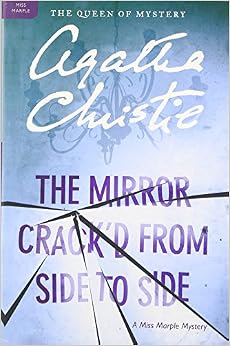
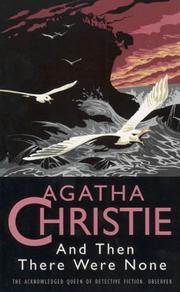
Agatha Christie served as a nurse during the First World War.  Her knowledge of poisons, which she learned at the time, could have been used in any one of the 83 poisonings in her books.  For instance, cyanide features in The Mirror Cracked from Side to Side, And Then There Were None, A Pocket Full of Rye and Sparkling Cyanide.  Kathryn Harkup writes about this in her book A is for Arsenic:  The Poisons of Agatha Christie https://bookshop.theguardian.com/catalog/product/view/id/323440/


Agatha Christie travelled widely through Europe and Africa.  She participated in archeological digs in the Middle East with her second husband Max Mallowan which inspired many book titles.  While on digs, Mallowan discovered artifacts as old as 3000 years.  Christie, always conscious of the fact that she was 15 years older than her husband, used her face cream to clean the artifacts.  As archeologist Charlotte Trumpler explained:  "Christie was of course fascinated by puzzles, by the little archeological fragments, and she had a gift for piecing them together patiently." http://www.cnn.com/2011/WORLD/europe/03/12/uk.christie.writer.archaeology/ Her novel, Murder in Mesopotamia, with an archeologist as the culprit, was the result of these digs.  


Another viewpoint of the Iamassu sculpture, captured by Christie in 1949, shows the figure which guarded the royal court from evil at the ancient site of Nimrud