Showing posts with label triple murder. Show all posts

Wednesday, 17 May 2017

Three Act Tragedy

At a party in Cornwall, the mild-mannered minister, Reverend Stephen Babbington, chokes on his cocktail, goes into convulsions and dies.  Investigation of the glass finds no poison.  Hercule Poirot is baffled; there appears to be no motive.  The party, hosted by Sir Charles Cartwright, also included:  Dr. Strange, Lady Mary Lytton Gore and her daughter Hermione, Captain Dacres and his wife Cynthia, Muriel Wills,Oliver Manders, Mr. Satterthwaite, and Mrs. Babbington.  Sir Charles mixed the drinks.

Another party is hosted in Yorkshire with many of the same guests, except Sir Charles, Mr. Satterthwaite and Poirot.  Oliver Sanders' motorcycle breaks down right in front of the manor. Sir Charles new butler serves port to all of the guests.  Dr. Strange collapses and dies.  His glass is tested and it is determined he died of nicotine poisoning.  Reverend Babbington's exhumed body reveals the same substance.

Mr. Satterthwaite and Sir Charles investigate the two deaths.  It turns out Dr. Strange gave his usual butler a vacation just two weeks before his death.  After his murder, his temporary butler disappeared.  In Ellis' room papers are found indicating he was blackmailing Dr. Strange.

Poirot receives a telegram from Mrs. D at the sanitarium.  Later, Mrs. D is discovered murdered as a result of nicotine poisoning.

It turns out that Sir Charles murdered all three victims. Charles had wanted to marry Hermione but couldn't because he had a wife in the insane asylum.  British law forbade him from divorcing her.  He murdered Dr. Strange who was the one person who knew about his wife.  The Cornwall party was a dress rehearsal for the real murder.  Reverend Babbington was the guinea pig.  Sir Charles managed to switch Babbington's tainted glass with an untainted one.

Sir Charles then convinced Dr. Strange to let him play the role of the butler.  When Muriel spoke up, Sir Charles was prepared to kill her too.  However, Poirot told her to go into hiding.  Mrs. D was silenced because otherwise she would have told Poirot she did not send the telegram and was unconnected to the crime. Sir Charles is arrested and Hermione matches up with Oliver Manders.
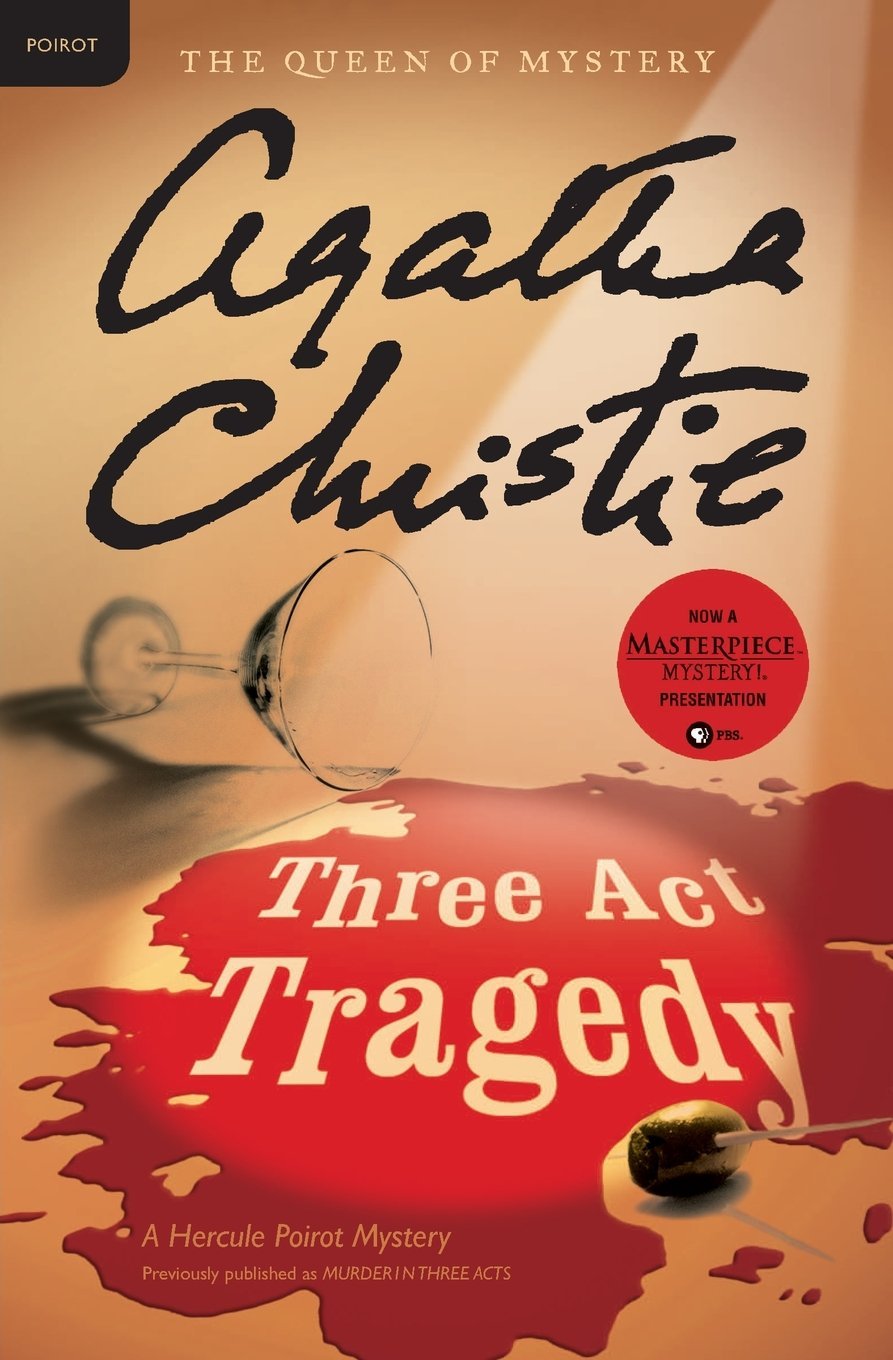


Three Act Tragedy, published in 1934, courtesy 

Sunday, 14 May 2017

Lord Edgware Dies

Actress Jane Wilkinson asked Poirot to convince her husband Lord Edgware to agree to a divorce.  Poirot speaks to Lord Edgware who says he has already written a letter to his wife to that effect.  That evening, Lord Edgware is found dead in his study.  The newspaper reports the next morning that Jane was at a prominent party the previous night.

Inspector Japp informs Poirot of the murder.  It turns out that Jane arrived at Regent Park the night before, announced herself to the butler and was spotted entering her husband's study by the secretary. The prominent dinner party had thirteen guests.  One guest pointed out that a table of thirteen meant bad luck for the first one to rise.  Jane was the first to get up to answer a telephone call.

In the meantime, Carlotta Adams, who liked to do impersonations of Jane, is found dead from an overdose of Veronal.  The butler, along with some money, disappeared on the day of Lord Edgware's death.  Ross is suspicious of Jane when he discovers she demonstrates an unusual amount of knowledge of Paris of Troy.  He phones Poirot to tell him of his suspicions and while on the phone, he is murdered.

Poirot tries to piece together the three murders.  He believes that Carlotta Adams impersonated Jane at the dinner party enabling Jane to take a taxi to Regent Park and murder her husband.  Carlotta and Jane meet up later where Jane has promised her money for her impersonation, but gives her a fatal dose of Veronal instead.  Jane then planted a case with Verona in it on Carlotta's person to make it seem like she was addicted to the drug.  Jane, knowing that Ross was a risk as he pursued Poirot, murdered him.  Jane's motive for killing her husband was that she wanted to marry the Duke of Merton.  The Duke was a Roman Catholic who was permitted to marry a widow but not a divorcee.


Lord Edgware Dies

Lord Edgware Dies circa 1933 courtesy http://www.agathachristie.com/stories/lord-edgware-dies.

Monday, 22 February 2016

The Power of the Pen

Don’t let anyone ever tell you that one voice can’t make a difference.  Here’s a story of how powerful the written word can be.  One day back in 1983 a teenage boy bought a used book at the Toronto Library.  He took it home and devoured the words.  He immediately discovered that he had a lot in common with the writer of the book.  They were both Black, both from the New York City area, both from humble roots. 

Lesra loved the book so much that he gave it to his housemates to read, including a lawyer.  He sat down and wrote a letter to the writer, introducing himself and commending him for his book.  Soon, Lesra took a train to New Jersey and met the writer who was serving time in jail.  It turned out that the writer was a former boxer who was convicted of a triple murder that he claimed he did not commit.  He had spent his early years in prison writing his life story to explain what had really happened.  However, the establishment did not believe him.  His case became a “cause celebre” for certain celebrities, though, including Bob Dylan who wrote a song about the conviction.  The boxer was front page news for a few months. 

However, the headlines soon changed and the boxer was forgotten, languishing in prison.  He would sit in his jail cell, night after night, typing on his typewriter his life story, including the events that transpired the night of the murders.  When the jail guard came to inspect his cell, the boxer’s manuscript was off limits.  He had given up his freedom and he certainly wasn’t giving up that manuscript!  Page by page, chapter by chapter, he poured out his story.  Although he had little formal education, he was a great storyteller, something the reader quickly discovered upon reading his book.  A second trial brought a second conviction.  The boxer tried to resolve himself to the strong possibility that he might be in jail for life. 

Then he got a letter from Lesra.  They struck up a friendship and before he knew it, Lesra and three of his housemates were on their way to New Jersey to help the boxer.  They moved into a hotel near the prison and set to work researching his case in the hope of securing another trail.  Despite intimidation from locals who wanted to preserve the status quo, the three Canadians worked tirelessly to seek justice for the boxer. 

Incredibly, after several months, the do-gooders got their wish.  It had been almost twenty years since the original murders in 1966 and some witnesses had died in the meantime.  Fortunately, the boxer would have a new judge this time who seemed willing to listen.  In 1985, the boxer stood trial for a third time.  He received an innocent verdict!!!  The judge ruled that the original conviction had been based on racial prejudice. 

That boxer’s name is Rubin “The Hurricane” Carter and his book is titled The Sixteenth Round.  His story was made into a movie starring Denzel Washington called “The Hurricane” in 1999.  Rubin Carter has gone on to champion the cause of other wrongfully convicted individuals.  He lives in Toronto and does speaking engagements in Southern Ontario.  He walks free now because he had the courage to tell his story.  Never underestimate the power of the pen.

P.S.  I should mention that the teenage boy, Lesra Martin, who bought the book at the Toronto Library went on to become a lawyer himself. 


Photo courtesy http://search.barnesandnoble.com

Friday, 2 October 2015

Hurricane Carter uses Bibliotherapy to Break the Bonds of Prison

"Carter's spirits rose at [Victor] Frankl's words, which he read over and over.  He had always seen prison as a scourge on his spirit, not as an opportunity for growth.  Frankl confirmed that true freedom could be realized not by digging through a prison barrier but by excavating one's inner life." 
(James S. Hirsch)


Rubin "Hurricane" Carter was wrongly convicted of a triple murder in Paterson , New Jersey in 1966. He spent almost 20 years in jail, rotting away in a cell.  Full of anger and bitterness, he found himself wasting away.  He decided to do something about it.  He wrote a book about his life, a book that would make him famous, at least for a short time.  However, it did not secure his freedom, at least not for many years.
Carter figured he had two options:  he could vegetate in jail or he could rise above his circumstances, a type of "inner triumph".  One day, Carter was walking on the prison grounds when a pinprick of light appeared in the prison wall.  It grew bigger and he could see on the other side of the barricade.  "He noticed cars driving down the street, children walking to school."  Carter thought to himself:  "...perhaps the prison walls were not real.  Perhaps he could walk right through that wall."  (http://www.amazon.ca/Hurricane-Miraculous-Journey-Rubin-Carter/dp/0618087281)

Transcending the prison became Carter's mission.  "From that moment on, I decided to take control of my life.  I made up my mind to turn my body into a weapon.  I would be a warrior scholar.  I boxed. I went to school.  I began reading W. E. B. Dubois, Richard Wright." http://www.metacafe.com/watch/an-oxeeb7bJ7hbbYm/the_hurricane_1999_rubin_carter_training/ 

Thom Kidrin, a part of Carter's defence committee, started making monthly visits to the prison, loaded down with books.  Carter would stay awake for two days straight in his cell, with four or five books laying on his bed, pouring over them.

Victor Frankl's Man's Search for Meaning spoke to him.  The Nazi concentration camp reminded him of Trenton prison.  Frankl's message rang true.  "Carter's spirits rose at [Victor] Frankl's words, which he read over and over.  He had always seen prison as a scourge on his spirit, not as an opportunity for growth.  Frankl confirmed that true freedom could be realized not by digging through a prison barrier but by excavating one's inner life." 

Carter devoured book after book.  The Autobiography of Malcolm X was another title which really affected him.  He requested works that had inspired Malcolm X.  Kidrin brought him W. E. B. Duboi's Souls of Black Folk, an anthology of essays on race first published in 1903.  

Carter was beginning to comprehend the redemptive power of literature, how reading a book helped put the reader in another man's shoes.  Ouspensky's A New Model of the Universe, helped Carter understand his adversaries.  The anger and bitterness, which had once held him hostage, were beginning to dissipate.  The walls of the prison, which had once seemed insurmountable, were now merely walls of concrete, not barriers to freedom.

Carter served almost 20 years in jail.  A young man from Brooklyn read his autobiography which set off a series of events leading to Carter's release from prison in 1986.  For the full story, read my post "The Power of the Pen" at http://alinefromlinda.blogspot.ca/2011/05/power-of-pen.html.