Tuesday, 7 June 2016

Canada Post Recognizes British Home Children


A group of British Home Children, accompanied by Dr. Barnardo's widow, head to Canada courtesy http://www.guelphmercury.com/news-story/4532437-wellington-county-families-explore-their-connections-to-british-home-children/. 


From 1869 to 1939, 100,000 destitute children from Britain's cities immigrated to Canada where they worked as child labourers (http://alinefromlinda.blogspot.ca/2011/08/british-home-children.html).   While the churches and philanthropic organizations which sent them here had good intentions, they were unable to properly monitor their situations.  Some of these "little immigrants" were treated well, but many were overworked and even abused.

One in ten Canadians, including myself, is a descendant of a British Home Child, named after the Children's Homes that they lived in.  They settled all across Canada, but the majority settled in Ontario.  The highest concentration of Home Children was in North Muskoka, where my great- grandma lived once she immigrated here.  These children worked on Canada's farms, in Canada's factories and on the battlefield in Europe during the First World War.  They helped build this country.

Many people do not know that they are descendants of the Home Children since it was a source of shame for the children. As they die off, however, some are sharing their stories.  Rose McCormick Brandon, another Home Child descendant, features many of these accounts in her book Promises of Home:  Stories of Canada's British Home Children (https://littleimmigrants.wordpress.com/promises-of-home-stories-of-canadas-british-home-children/).

Brant MP Phil McColeman, the nephew of a British Home Child, championed a bill declaring 2010 the Year of the British Home Child in Canada.  The same year, Canada Post issued a stamp in their honour.  "The stamp features an image of the SS Sardinian ( a ship that carried children from Liverpool to Quebec), a map symbolizing their trans-Atlantic journey, a photograph of a child at work on a farm and one of a newly arrived Home Child, standing beside a suitcase while en route to a distributing home in Hamilton, Ontario."


Monday, 6 June 2016

D-Day: The Element of Surprise

"Our intention is to honour the survivors and their fallen comrades while the events of June 6, 1944 remain within living memory." (Bill Danard, Canada Post)


On the 60th anniversary of D-Day, Canada Post issued a stamp to commemorate the historic event of World War II. "With the imagery of this stamp, we aim to capture the experience of the very first Canadian troops to land on Juno Beach that day.  We tried to balance a sense of victory achieved with an acknowledgment of the human price," explained Bill Danard of Canada Post (https://www.canadapost.ca/web/en/blogs/collecting/details.page?article=2004/06/06/d-day&cattype=collecting&cat=stamps)

Much preparation went into the D-Day invasion, which included Canadian, American and British troops.  The Allies wanted to capitalize on a number of factors.  The moon had to be full (June 5, 6 or 7).  The tides had to be low.  The weather had to be appropriate (low winds, light cloud cover).  If all went well, they would catch the Germans sleeping.  The forecast for June 5, the original invasion day, was horrible:  a stiff wind, choppy seas and overcast.  Operation Neptune would have to be postponed for a day.  

The landing place also had to be perfect.  The Allies had dropped clues hinting that they would land at Pas de Calais.  However, it was too fortified.  In the end, they chose Normandy.  The word went out:  "Halycon Five finally and definitely confirmed."  On June 6, 1944, the Canadians debarked at Juno Beach.  By midday, the beachhead had been won.  "[By] nightfall, Canadians had penetrated further inland than any other seaborne forces."  The Canadian Army had proven once again, like in the First World War, that they were a formidable fighting force.  

Why were the Germans caught sleeping?  While the Allies employed expert meteorologists (two British teams and one American team) to predict the Normandy coast weather that month, so too did the Germans.  The former had decided that a Beaufort Scale rating of 4 or lower was acceptable for winds while the latter had decided that 4 was too strong.  Furthermore, General Eisenhower went ahead and made the ultimate decision to launch the D-Day invasion whereas General Rommel, shopping for birthday shoes with his wife in Berlin, waited for an ultimate order from Hitler, which never came.

Sadly, Canadians suffered 359 losses while the Allies suffered 12,000 deaths on D-Day.  However, the number was a lot lower than the 75,000 predicted without the element of surprise.  


What a glorious sight!  D-Day invasion on June 6, 1944 courtesy https://medium.com/@wwnorton/the-weather-on-d-day-85ea0491a14f#.29huzcj3c.


Sunday, 5 June 2016

Rural Mailboxes


David Wilcox of Oxford County, Ontario, after witnessing free rural mail delivery in Michigan, returned to Ontario and started a campaign to achieve rural mail delivery in Ontario.  However, both the government of the day and the official opposition rejected the idea.  Wilcox set out on a letter writing campaign, sending 40 or 50 to as many newspapers as possible.  Anxious to retain the farm vote, Prime Minister Wilfrid Laurier responded to the pressure.  Finally, Postmaster Lemieux announced free rural delivery "so Canadians could get their mail without the necessity of sending after it to the village post office."

On October 10, 1908, the first rural mail delivery run, consisting of 37 boxes, was established between Hamilton and Ancaster, Ontario.  The mailbox, known as the King Edward, "had to be located within easy reach of rural couriers so that delivery and collection could be done without dismounting from the horse or carriage".


The Establishment of Free Rural Mail Delivery

Saturday, 4 June 2016

The Group of Seven

The Group of Seven, also known as the Algonquin School, was a collection of Canadian landscape artists from 1920 to 1933.   Their inspiration was Algonquin Park, where Thom Thomson, another painter associated with the group, was a guide.  One of their members, Lawren Harris, heir to the Massey-Harris fortune, financed their studio in Toronto where Franklin Carmichael, Frank Johnston, Arthur Lismer, J. E. H. MacDonald, and Frederick Varley painted.  A.Y. Jackson and Frederick Varley served as official war artists during the First World War.  Thom Thomson died mysteriously while canoeing in Algonquin Park.  However, the remaining members reunited after the war.  The Group of Seven held their first official exhibition in 1920, the same year as Frank Johnston left the group.  A.J. Casson joined the group in 1926 followed by Edwin Holgate in 1930 and LeMoine Fitzgerald in 1932.  In 1995, Canada Post issued ten stamps to commemorate The Group of Seven, seven for the original members and another three for the additional members.

1.  Serenity Lake of the Woods (Frank Johnston)


2.  A September Gale, Georgian Bay (Arthur Lismer)


3.  Falls, Montreal River (J. E. H. MacDonald)


4.  Open Window (Frederick Varley)


5.  October Gold (Franklin Carmichael)


6.  NOrth of Lake Superior (Lawren Harris)


7.  Evening, Les Eboulements (A. Y. Jackson)


8.  Mill Houses (A. J. Casson)


9.  Pembina Valley (LeMoine Fitzgerald)


10.  The Lumberjack (Edwin Holgate)


Friday, 3 June 2016

Tulip Festival

Canada Post issues commemorative stamps each month to recognize certain events in our history.  In August of 2002. it issued a stamp to commemorate Ottawa's Tulip Festival.  Back in 1944, under Nazi occupation, the Dutch were starving.  That winter, they survived on tulip bulbs and sugar beets. The American driven Operation Market Garden which attempted to drive the Germans out of Holland, largely failed.  Therefore, in 1945, it was up to the Canadian Army to liberate much of Holland, and that they did.  The Dutch will always have a special place in their hearts for Canadians for ending their oppression under the Nazis.


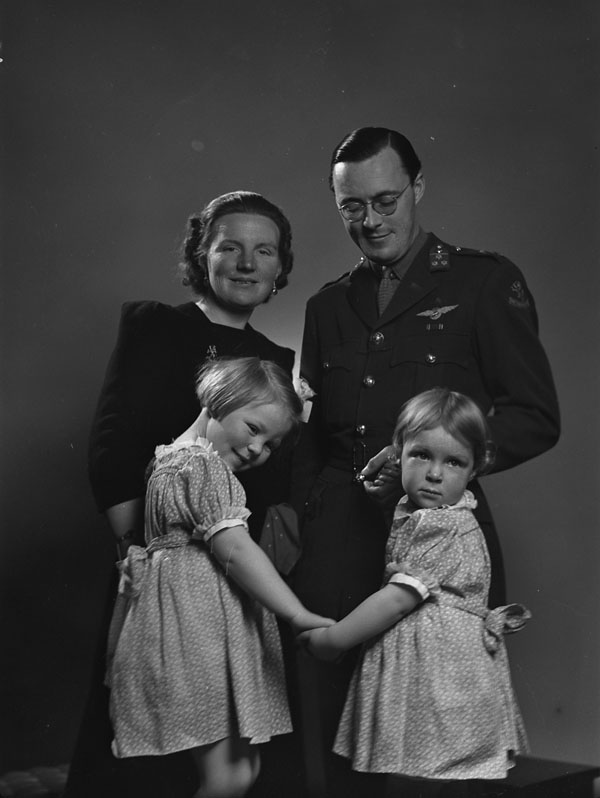
It was the Canadian government which took in Queen Juliana, the Dutch royalty who had fled her country when the Nazis occupied it in 1940.  She came to Canada with her husband and two daughters.  In 1943, she gave birth to a third child at an Ottawa hospital.  The hospital was declared an international zone in order that Queen Juliana's baby could be of Dutch citizenry and therefore eligible for the crown.


Princess Juliana and Prince Bernhard with two daughters in Ottawa circa 1942 courtesy https://en.wikipedia.org/wiki/Juliana_of_the_Netherlands.


After the Second World War, the Dutch government sent 100,000 tulip bulbs to Canada, the origin of Ottawa's Tulip Festival.  The tradition has continued ever since.


Thursday, 2 June 2016

In Flanders Fields

"In Flanders Fields the poppies blow
Between the crosses row on row
That mark our place, and in the sky
The larks, still bravely singing, fly
Scarce heard among the guns below."
(In Flanders Fields, John McCrae)


The image features a brilliant red poppy, the flower we wear to remember the fallen.  In the centre is the silhouette of a soldier.  At the bottom sit the crosses, row on row.  And at the top, under a grey sky, fly the larks, still bravely singing.  

It is Canada Post's tribute to the poem In Flanders Fields, written by Dr. John McCrae from Guelph, Ontario, right after his friend, Lieutenant Alexis Helmer, succumbed to a hit by an 8 inch German shell.  The poem served as a tribute to all of the Canadians who lost their lives at the World War I battle at Ypres Salient. In Flanders Fields has been recited, memorized, and memorialized by millions of Canadians.  The Canadian stamp was issued in May of 2015 to mark the centennial of the famous poem.  "One hundred years later, the power of its verses to evoke the horror of war remains as strong as the day they were written." (https://www.canadapost.ca/web/en/blogs/collecting/details.page?article=2015/05/03/in_flanders_fields&cattype=collecting&cat=stamps)


Wednesday, 1 June 2016

The Expulsion of the Acadians

"Still stands the forest primeval ; but far away from its shadow, 
Side by side, in their nameless graves, the lovers are sleeping." 
(Evangeline, Henry Wadsworth Longfellow)


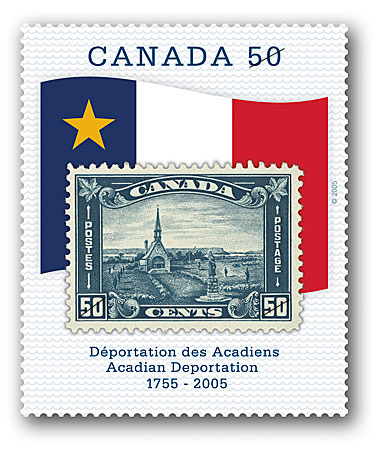
The Acadians were a group of French settlers who lived in modern day Nova Scotia in the 1600's and 1700's.  When the province got a new lieutenant-governor, Charles Lawrence, it was the beginning of the end for the Acadians.

The British French relations grew tense as the French built Fort Louisbourg on Cape Breton Island and the English built a naval base at Halifax.  The French constructed Fort Beausejour followed by the English construction of Fort Lawrence (http://www.thecanadianencyclopedia.ca/en/article/the-deportation-of-the-acadians-feature/).

In 1755, the lieutenant governor insisted that all Acadians take an oath of allegiance to the British King, but they refused.  That summer, a decree was issued for all men and boys 10 years of age and older meet at the Grand Pre Church with an important message from His Excellency.  The decree read:

"That your land and Tennements, Cattle of all Kinds and Livestocks of all sorts are forfeited to the Crown with all other your Effects Savings your money and Household Goods, and you yourselves to be removed form this Province."

When the men refused to go, their families were threatened with bayonets.  That fall, 1100 Acadians were on transports headed for South Carolina, Georgia, Pennsylvania, Virginia, Connecticut, New York, Maryland and Massachusetts.  Those who were deported to other English colonies often faced a hostile reception like the legendary Evangeline of Longfellow's poem, who was forced to wander endlessly, pining for her family (http://www.bartleby.com/42/791.html).  Many families were torn apart.

However, some remained in current day Canada, fleeing to New France (current day Quebec), Cape Breton and the forests of New Brunswick.  

After the fall of Louisbourg in 1758, another 3100 Acadians were expelled, of which an estimated 1649 died of starvation, drowning or disease.  In total, the Expulsion of the Acadians or Le Grand Derangement, involved about 11,000 French settlers from 1755 to 1763.  Some were deported to the Caribbean while 3,500 were sent back to France (https://en.wikipedia.org/wiki/Expulsion_of_the_Acadians).

Although none of the Acadians was formally shipped to Louisiana, many were attracted to the area due to the familiar language.  The French "Acadien", if said quickly, sounds like Cajun, the name used to identify this group, along with their cuisine.  The city of New Orleans is filled with Acadian descendants.


Canada Post commemorates the Acadian Deportation with a stamp, featuring the Grand Pre Church, surrounded by the British with bayonets courtesy https://www.canadapost.ca/cpo/mc/assets/images/stamps/2005_acadian_stamp.jpg.