Showing posts with label Quebec City. Show all posts

Wednesday, 24 August 2016

Louis Vallee Photographs Old Quebec

Basse-ville de Quebec - Louis-Prudent Vallee vers 1880.jpg


In 1839, Louis DaGuerre succeeded in capturing a unique image on a copper plate, named the daguerrotype.  People called it "a mirror with a memory".  The Quebec Gazette, the Toronto Patriot, and the Halifax Colonial Pearl reported on the daguerrotype and itinerant daguerrotypists set up shop in hotel rooms and stores, eager to capitalize on the new technology.  However, the process was slow and was eventually replaced with photography.

In the 1860's, Louis Prudent Vallee opened a studio in Quebec City and soon became known for his photographs of his hometown.  Vallee captured the capital before the departure of British troops in 1871 and after the demolition of military installations.  Old Quebec's walls remind us of how the city used to serve as a fort.  Vallee also documented the urban development at the end of the 1800's.  Vallee's Catalogue of Photographic Views of Quebec City and Vicinity, published in 1899, served as a good record of local history in the latter half of the 19th Century.


Louis-Prudent Vallée: His work is a record of the 19th century in Quebec City. “The photograph on the stamp was taken circa 1894.”

A Quebec City street circa 1894

Monday, 27 June 2016

German U-Boats Offshore

Halifax Herald, May 13, 1942.<br />  Library and Archives Canada NL125952


Growing up in Toronto during the Second World War, my Dad remembers reading in the Toronto Star that German U-boats were spotted in the St. Lawrence River, that German soldiers were spotted entering a Montreal movie theatre.  He remembered air raid wardens marching up and down his street during blackouts in Toronto.  I had always thought that the World War Two theatre was restricted to Europe, not North America (with the exception of Pearl Harbor).  I couldn't believe that the Germans had come that close to home.


                             On September 11, 1942, <abbr title='Her Majesty's Canadian Ship'>HMCS</abbr> <em>Charlottetown</em> (I) was destroyed<br /> within sight of horrified onlookers on the shores near Cap-Chat. <br />Department of National Defence, CN-3636.


HMCS Charlottetown was one of the first targets of the German U-boats courtesy http://www.veterans.gc.ca/eng/remembrance/history/second-world-war/battle-gulf-st-lawrence/intro.


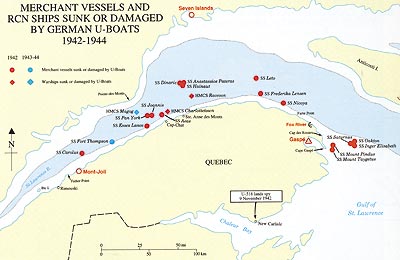
As part of the book that I'm writing about wartime Toronto and the Maple Leafs, I researched German U-boats in Canada and found out that a full battle took place here, the Battle of the St. Lawrence, from 1942 to 1944.  Submarines penetrated the Cabot Strait and the Strait of Belle Isle (my mother in law was born and raised on Belle Isle) to sail down the St. Lawrence.  There, they torpedoed and sunk an amazing 23 Allied ships, some within 300 kilometres of Quebec City.


German U-boats posed not only a military threat but also an economic one:  they decreased cargo shipments by 25%.  Quebec City, Trois Rivieres and Montreal were essentail ports, the latter accounting for "more tons of shipping than all over East Coast ports combined" (http://www.veterans.gc.ca/eng/remembrance/history/second-world-war/battle-gulf-st-lawrence/intro).


                                                Victory Bond advertisement in the <br /><em>Montreal Daily Star</em>, November 2, 1942.<br />  Library and Archives Canada NL12595.

http://www.veterans.gc.ca/eng/remembrance/history/second-world-war/battle-gulf-st-lawrence/intro


Some Canadian cities started imposing blackouts and employing air raid wardens.  The war campaign at home went into full swing.


Canadian stamp issued on the 50th Anniversary of the Battle of the St. Lawrence courtesy https://www.pinterest.com/agent713/war-stamps/.


Tuesday, 7 June 2016

Canada Post Recognizes British Home Children


A group of British Home Children, accompanied by Dr. Barnardo's widow, head to Canada courtesy http://www.guelphmercury.com/news-story/4532437-wellington-county-families-explore-their-connections-to-british-home-children/


From 1869 to 1939, 100,000 destitute children from Britain's cities immigrated to Canada where they worked as child labourers (http://alinefromlinda.blogspot.ca/2011/08/british-home-children.html).   While the churches and philanthropic organizations which sent them here had good intentions, they were unable to properly monitor their situations.  Some of these "little immigrants" were treated well, but many were overworked and even abused.

One in ten Canadians, including myself, is a descendant of a British Home Child, named after the Children's Homes that they lived in.  They settled all across Canada, but the majority settled in Ontario.  The highest concentration of Home Children was in North Muskoka, where my great- grandma lived once she immigrated here.  These children worked on Canada's farms, in Canada's factories and on the battlefield in Europe during the First World War.  They helped build this country.

Many people do not know that they are descendants of the Home Children since it was a source of shame for the children. As they die off, however, some are sharing their stories.  Rose McCormick Brandon, another Home Child descendant, features many of these accounts in her book Promises of Home:  Stories of Canada's British Home Children (https://littleimmigrants.wordpress.com/promises-of-home-stories-of-canadas-british-home-children/).

Brant MP Phil McColeman, the nephew of a British Home Child, championed a bill declaring 2010 the Year of the British Home Child in Canada.  The same year, Canada Post issued a stamp in their honour.  "The stamp features an image of the SS Sardinian ( a ship that carried children from Liverpool to Quebec), a map symbolizing their trans-Atlantic journey, a photograph of a child at work on a farm and one of a newly arrived Home Child, standing beside a suitcase while en route to a distributing home in Hamilton, Ontario."


Wednesday, 3 December 2014

All I Want for Christmas is a Pair of Skates

"Jean Beliveau in Quebec is like Joe DiMaggio or Mickey Mantle in the United States.  When Jean Beliveau walks down the street in Quebec, the women smile, the men shake his hand and the little boys follow him." (New York journalist Leonard Shecter)


Three year old Jean Beliveau wished for a pair of skates for Christmas.  And that's exactly what he found under the tree on Christmas Eve.  Those skates would lead him to 10 Stanley Cups, an Art Ross Trophy, a Conn Smythe Trophy, two Hart Memorial Trophies and a place in the Hockey Hall of Fame.

Jean Beliveau's family history is the history of many French Canadians.  He was born in 1931 in Trois Rivieres, Quebec, the first of eight children.  His parents, Roman Catholics, believed in family values, strict religious observance and hard work.  Moving to Victoriaville at age 6, Jean used to play shinny on his family's backyard rink, like so many Quebecois children did.  At the age of 12, he played his first formal hockey.  Jean grew up with the Montreal Canadiens, listening to NHL broadcasts on the family radio.

While he was a Montreal fan, his loyalty remained with Quebec City, where he signed with the Citadelles and later the Aces, despite the recruiting tactics of the Canadiens.  By his mid teens, Beliveau was a 6 foot 3 and 200 pounds, a gentle giant.  Despite his size, he skated with long, fluid strides.  Soon he was pulling in twice the salary of the average NHL player.

The Montreal Canadiens invited him to play in 1950, and he agreed for a short stint.  However, his loyalty kept drawing him back to Quebec.  Finally, in order to sign him, the Canadiens bought the whole Quebec league.  Now he was one of their players and his contract dictated that he had to play for Montreal.  Nicknamed "Le Gros Bill" after a French Canadian folkhero, he quickly became one of the strongest players on the team.  While Maurice "Rocket" Richard was known for his fiery temper, Jean Beliveau became known for his grace and poise.  A natural leader, he wore the 'C' on his bleu, blanc et rouge jersey for 10 years, a Canadiens record.  

Beliveau drank champagne from the Stanley Cup ten times during his 20 seasons with the Canadiens. A favourite with the fans, he took pride in answering every piece of fan mail himself, at least until health problems prevented him from doing so in 2012.  He remembered his father's words "Loyalty is another form of responsiblity."

Beliveau's loyalty showed both on and off the ice.  He and his wife were married for 61 years.  After his daughter Helene's husband, a Montreal police officer, committed suicide, Beliveau declined the Prime Minister's offer to be governor general to spend time with Helene and her two young children.

Jean Beliveau passed away yesterday, surrounded by his family.  The legend lives on.

For more information, please see the news clip here:
http://www.sportsnet.ca/hockey/nhl/beliveau-obituary/


www.sportsnet.ca