Showing posts with label Capitol. Show all posts

Tuesday, 11 April 2017

Harrisburg Rebuilds Capitol, Thumbs Nose at Philadelphia

Harrisburg Capitol Building


The City Beautiful Movement, which started in Chicago with the World's Fair in 1893, spread to Washington DC, Boston, Cleveland and Philadelphia.  Smaller cities were not to be outdone.  When a fire consumed the Capitol in Harrisburg, Pennsylvania, there was talk of moving the Capitol to Philadelphia.  However, the House of Representatives voted 103 to 75 to keep the Capitol. Concerned citizens, in the meantime, formed a city improvement committee.  Just as Chicago had risen from the ashes after the Great Fire of 1871, owing its reputation for great architecture from the subsequent rebuilding, so too could Harrisburg.

Conservationist Mira Lloyd Dock delivered a riveting speech, "The City Beautiful", to the Harrisburg Board in 1901.  Dock joined forces with Horace McFarland, president of the Civic Association, to promote the cause of civic improvement.  The same year, The City Telegraph printed a front page article pointing out Harrisburg's problems and highlighting Dock's message of beautification and recreation.  In February of 1901, the public voted to set aside $1.1 million for new buildings and city planning.

Harrisburg was bound and determined that they, not Philadelphia, deserved the title of state capital.  A contest was held to find an architect to build the new Capitol won by Joseph M. Huston.  Painters Violet Oakley and Edwin Austin Abbey along with sculptor George G. Barnard, were hired to decorate the building.  A Philadelphia newspaper called the new Capitol, built in 1906, "one of the most artistic monuments of the state".

The project  however was not without controversy.  Oakley's paintings, which highlighted that Pennsylvania was founded on religious freedom, offended some Roman Catholics.  The bas-relief heads on the Capitol doors, intended to represent the different men who lived in Pennsylvania, were mocked by political cartoonists.  The nude statues which arrived from France offended some Pennsylvanians and were covered up in 1911.

Nonetheless, the Times of Buffalo pointed out that it was the only Capitol to be completed within its estimates.  President Theodore Roosevelt presided over the official opening of the building on February 5, 1906.  Mary D. Fitzgerald called the new Capitol "perfectly wonderful, marvelously beautiful [and] a superb success."


8 final.tif


Saturday, 10 October 2015

Thomas Jefferson: "I Cannot Live Without Books"

"I cannot live without books." (Thomas Jefferson to John Adams)


Before Monticello, the domed house that Thomas Jefferson designed and built in Virginia, there was Shadwell, the birthplace of the third president of the United States.  Shadwell burned in 1779, taking with it Jefferson's beloved collection of books.  

Jefferson spent the rest of his life trying to replenish his personal library.  By 1773, he owned 1250 books, and by 1815, over 6500 titles.  That year, the British Army burned both the White House and the Capitol, destroying the 3000 volumes inside.  The retired president, despite the fact that he loved his books, sold the collection to the Library of Congress for $23, 950.  The books were transported from Monticello to Washington D.C. in ten wagons.  

On May 8, 1815, after the packing and shipping of his collection of books, Jefferson penned a letter to Samuel Smith, stating:  "an interesting treasure is added to your city now become the depository of unquestionably the choicest collection of books in the U.S. and I hope it will not be without some general effect on the literature of our country." (http://www.loc.gov/exhibits/jefferson/jefflib.html)

Once again, Jefferson rebuilt his library.  Although he had debts to pay, he continued to collect a plethora of books on every subject.  Upon his death, his books were sold to pay off outstanding debts. Today, the Library of Congress is the largest library in the world.


Friday, 18 September 2015

Jacqueline Kennedy's Letter to Khrushchev

"So now, in one of the last nights I will spend in the White House, in one of the last letters I will write on this paper at the White House, I would like to write you my message."  
(Jacqueline Kennedy)


On December 1, 1963, the tears had barely dried on her cheeks when Jacqueline Kennedy sat down and drafted a letter to Premier Krushchev, thanking him for sending a representative to her husband's funeral.  Although hundreds of thousands had lined up to view President Kennedy's coffin while it lay in the Capitol, although hundreds of thousands more had lined the route of the President's caisson, and millions had watched the funeral procession on television, this mourner stood out (http://www.nydailynews.com/news/national/jfk-funeral-article-1.1514720).  Only a year before, Kennedy and Krushchev had faced off at the brink of World War III.  

In a delicate hand, Jacqueline wrote:

"I send it [the letter] only because my husband cared so much about peace and how the relation between you and him was central to this care in mind.  He used to quote your words in some of his speeches:  'In the next war, the survivors will envy the dead.' (https://history.state.gov/historicaldocuments/frus1961-63v06/d120)


It had only been a little over a year since President Kennedy had looked out his Oval Office window, his arms folded, worry etched on his face, agonizing over how to react during the Cuban Missile Crisis.  For thirteen days, the world stood at the brink of war.  Kennedy and Krushchev drafted and exchanged several letters, carefully measuring each word (see "Building Missiles Like Sausages" at http://alinefromlinda.blogspot.ca/2012/10/october-14.html).  The exchanges brought new meaning to the term Cold War.

The former First Lady continued:

"The danger which troubled my husband was that war might be started not so much by the big men but by the little ones.  While big men know the needs for control and self-restraint  -- little men are sometimes moved by fear and pride.  If only in the future the big men can continue to make the little men sit down and talk, before they start to fight."

Just over a week before, Jacqueline Kennedy had been living in the White House, the wife of a president, raising their son and daughter.  But on November 22, 1963, all that changed.  Jacqueline sat beside her husband as he was gunned down in a Dallas motorcade by an assassin.  She watched the priest stand over the President's bullet-ridden body and administer the last rites at Parkland Hospital. She laid her husband to rest on a hill at Arlington overlooking Washington D.C. (http://alinefromlinda.blogspot.ca/2013/11/one-brief-shining-moment-interrupted.html).

And now she was drafting an eloquent letter to a Soviet leader, even offering political advice, challenging him to be the "bigger man", all on the heels of the personal tragedy.  Jacqueline ended her letter with a nod to Kruschev's wife:  

"I read that she had tears in her eyes when she left the American Embassy in Moscow, after signing the book of mourning.  Please thank her for that."  

Eloquence, grace, class:  that sums up Jacqueline Kennedy.


Three-year-old John F. Kennedy Jr., salutes his father's casket in Washington three days after the president was assassinated in Dallas. Widow Jacqueline Kennedy (center) and daughter Caroline Kennedy are accompanied by the late president's brothers Sen. Edward Kennedy, left, and Attorney General Robert Kennedy.

A veiled Jacqueline Kennedy waits for the Presidential caisson, her daughter Caroline on her right, and John Jr. on her left, saluting his father's coffin as it heads to Arlington Cemetery on November 26, 1963 courtesy http://www.nydailynews.com/news/national/jfk-funeral-article-1.1514720.


Friday, 5 December 2014

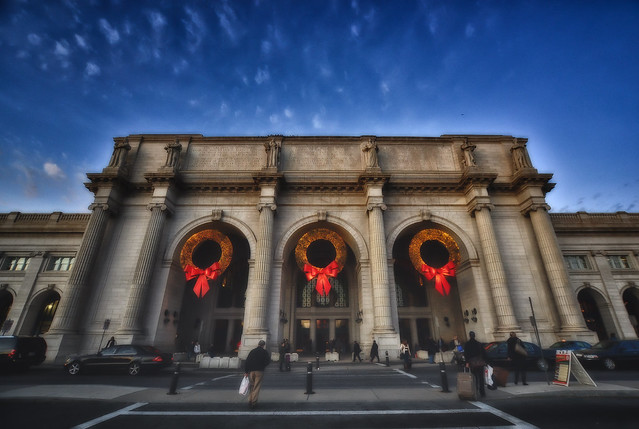
Christmas in Washington D.C.


1.  Capitol Building courtesy www.allaccess.com.


2.  Washington Monument courtesy www.photographybykent.com.


3.  Union Station courtesy staticflickr.com.


4.  White House courtesy twinamerica.net.


5.  Arlington Cemetery, Virginia, courtesy www.toledoblade.com.