Showing posts with label Christmas carol. Show all posts

Sunday, 27 December 2015

William Chatterton Dix's "As With Gladness Men of Old"

As with gladness men of old
Did the guiding star behold
As with joy they hailed its light
Leading onward, beaming bright
So, most gracious Lord, may we
Evermore be led by Thee.

William Chatterbox Dix languished in bed, stricken by an illness.  Rather than feeling sorry for himself he took out a pen and paper and wrote a new hymn praising God.   Called As With Gladness Men of Old,  it would be accompanied by music composed by Konrad Kocher in 1838  This is the same tune as For the Beauty of the Earth, a hymn often sung at Thanksgiving.  As With Gladness Men of Old, which soon became known as a Christmas carol, was first published in Hymns of Love and Joy in 1867.  Only a year before the hymn was published, Dix was stricken with a near fatal illness, which triggered the onset of depression. However, from this tragedy came many new compositions, some of Dix's best hymns (https://www.youtube.com/watch?v=IakAMPoK9Dk).


Sunday, 13 December 2015

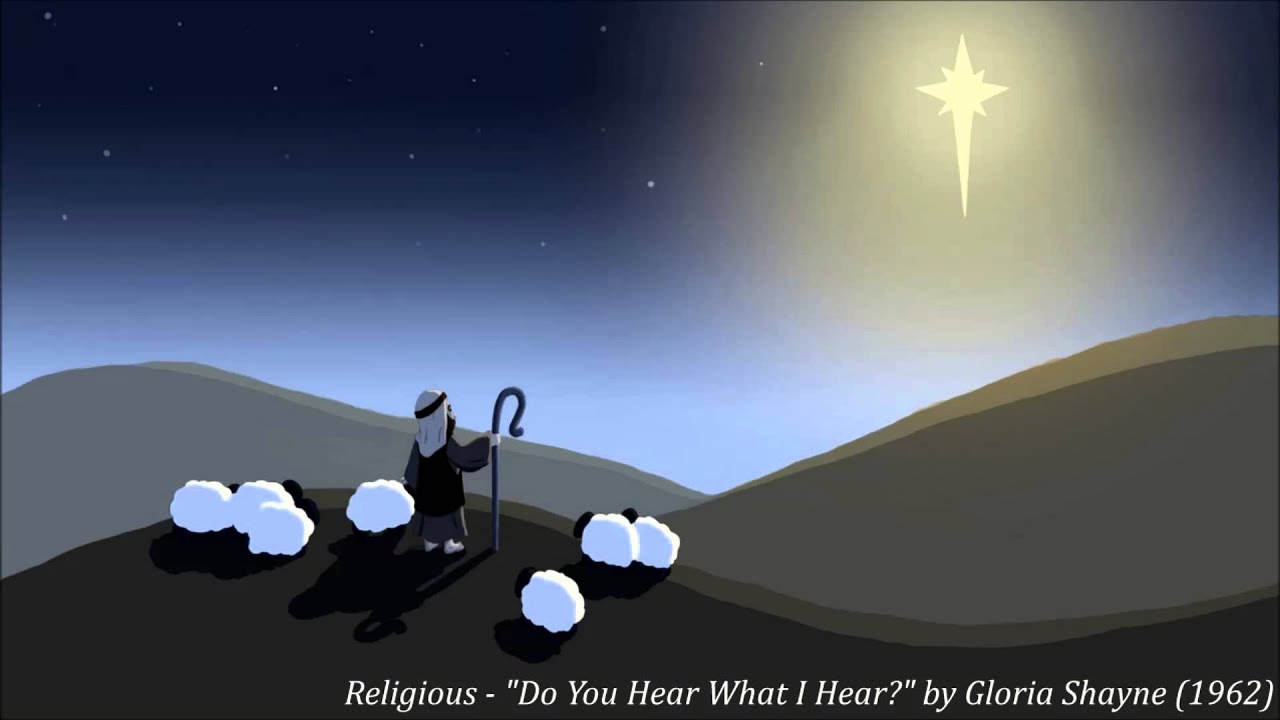
Noel Regney & Gloria Shayne's "Do You Hear What I Hear?"

Said the night wind to the little lamb,
Do you see what I see
Way up in the sky, little lamb,
Do you see what I see
A star, a star, dancing in the night
With a tail as big as a kite
With a tail as big as a kite.


In October of 1962, Noel Regney walked down the street in Manhattan, discouraged and disillusioned.  The world was on the brink of war:  America and the U.S.S.R. were arguing over missiles recently built in Cuba, aimed at the United States.  Rather than enjoying the autumn colours in their backgrounds, people were building bomb shelters.  The tension was so real, they could feel it.

Noel Regney was no stranger to war.  Born and raised in France, he had been drafted by the Germany Army during the Second World War.  Unbeknownst to the Germans, he went underground as part of the French Resistance.  Wounded during the war, some suspect he was hit by the French, to protect his identity from the Germans.

Noel Regney survived the war and in 1952, he immigrated to the United States.  The composer was smitten by a young singer named Gloria Shayne.  After a whirlwind courtship, the couple married.  Shayne was a talented lyricist, Noel a talented composer, so the two teamed up to write songs.  "Rain, Rain Go Away" was one of their trademark tunes.

However, in October of 1962, their arrangement changed.  As Noel walked down the Manhattan streets with a heavy heart, he looked up and spotted two babies in carriages.  He was struck by their joy and innocence.  They gave him hope.  Back at his apartment, he started to compose a Christmas song about the hope that the two babies brought, despite the world being on the brink of war.  Noel's wife, Gloria, wrote the music.  Do You Hear What I Hear? was the result.

"Pray for peace, people everywhere" became Noel's plea.  The two babies became the "little lamb".  "A star in the night" brought hope.  A "child sleeping in the night", the baby Jesus, brought "goodness and light".  Noel and Gloria struggled to perform the song at first, explaining:  "Our little song broke us up.  You must realize there was a threat of nuclear war."

The carol was first recorded on Thanksgiving of 1962 by the Harry Simeone Chorale.  However, it was Bing Crosby who made it a hit with his recording of October 1963 (https://www.youtube.com/watch?v=XuE_DXrt2Js)  The carol was by far the biggest hit for Noel and Gloria Regney.   

The Cuban Missile Crisis was resolved after a few weeks, in large part thanks to President John F. Kennedy's levelheadedness and diplomacy (see http://alinefromlinda.blogspot.ca/2012/10/october-14.html and http://alinefromlinda.blogspot.ca/2015/09/the-cuban-missile-crisis-kennedys.html).  Sadly, the President didn't get to enjoy the peace that resulted as he was assassinated only a year later in November of 1963.




Thursday, 10 December 2015

James R. Murray's Away in a Manger

Away in a manger, no crib for a bed,
The little Lord Jesus laid down his sweet head.
The stars in the bright sky looked down where he lay
The little Lord Jesus asleep on the hay.

James R. Murray of Philadephia wrote the lyrics for the carol Away in a Manger for the Lutheran Song Book of 1885.  The music, known as Mueller, was composed in 1887.  The third verse was composed by John T. McFarland in 1904.  William Kirkpatrick composed an alternate tune in 1895.  Some believe that Martin Luther himself composed the original carol.  However, the hymn is not found among Luther's works.  It is more likely that the hymn was simply composed to celebrate the 400th anniversary of Luther.

Sir David Willcock's version of the carol is often performed by English choirs.  Petula Clark recorded a version of the carol on her 1958 EP A Christmas Carol.  Jazz guitarist Royce Campbell recorded a version on his CD A Solo Guitar Christmas (https://www.cdbaby.com/cd/roycecampbell9).


Friday, 4 December 2015

John Henry Hopkins Jr.'s "We Three Kings"

"We three Kings of Orient are
Bearing gifts we traverse afar
Field and fountain, moor and mountain
Following yonder star."


John Henry Hopkins Jr., the son of pioneer parents from Ireland and Germany, was born in Pittsburgh, Pennsylvania.  He worked as a journalist while he studied law.  However, when he graduated, he felt called by the Holy Spirit to become a pastor.  He entered the General Theological Seminary of New York.

At the Seminary, Hopkins put his writing skills by founding and editing the Church Journal.  He also put his artistic talent to work, designing stain glass windows.  In 1857, as musical director of the Seminary, Hopkins was asked to write a new carol for the Christmas pageant. Likely with his young nieces and nephews in mind, Hopkins wrote "We Three Kings of Orient Are". He presented it to his nieces and nephews on his Christmas visit to Vermont, where he also saw his father, bishop of the Episcopal Diocese of the state.  

Six years passed before We Three Kings was published in "Carols, Hymns and Song.  Later, it became the first fully American carol to be published in England where it appeared in Christmas Carols Old and New. (http://www.hymnary.org/person/Hopkins_JohnHJr)

To listen to the carol, visit https://www.youtube.com/watch?v=k8mjRxkMBkE.