Showing posts with label White House. Show all posts

Thursday, 28 July 2016

The Executive Mansion


9/*The White House boasts 132 rooms, 32 bathrooms, six levels, eight staircases, three elevators and 28 fireplaces.  The 55,000 square foot house takes 570 gallons of white paint to cover its exterior.  The residence, which sits on 18 acres of land, was formerly known as the "President's Palace", the "President's House" and the "Executive Mansion".  

1.  George Washington never lived in the White House since it wasn't built until 1800.


2.  The British burned it down in 1814 (War of 1812) and it was repainted white to hide the charred walls.  


The White House after it was burned by the British in 1814 courtesy https://en.wikipedia.org/wiki/White_House.


3.  Abraham Lincoln met Frederick Douglass within its walls and promised him that slavery would be abolished, a decision which would cost him his life in 1863. 


"Frederick Douglass Appealing to President Lincoln and His Cabinet to Enlist Negroes," by William Edouard Scott, 1943


4.  William H. Taft, who called the residence "the most depressing House", got his 325-pound frame stuck in the bathtub in 1909.  Read President Taft is Stuck in the Bath https://www.amazon.ca/President-Taft-Stuck-Bath-Barnett/dp/0763663174.

William Howard Taft


5.  Harry S Truman, a native of Missouri, added a balcony in 1947.


George Bush Jr. and his wife entertain guests on the Truman Balcony in 2001 courtesy https://en.wikipedia.org/wiki/Truman_Balcony.

6.  Dwight D. Eisenhower, who added a putting green, used to hit golf balls off of the balcony in a game of "Hit the Secret Service Man" in the 1950's.  (In fact, the Oval Office floor was pockmarked from his golf cleats.)  


President Eisenhower putting on the green in 1957 courtesy http://www.whitehousemuseum.org/grounds/putting-green.htm.


7.  Jacqueline Kennedy had the Executive Mansion restored and redecorated (see my blog post "George Washington Didn't Sleep Here" dated February 15, 2013).  She received an honourary Emmy for the her televised tour of the White House in 1962.


Jacqueline Kennedy's televised White House tour courtesy 


8.  Lyndon B. Johnson had two pet beagles at the White House.


President Johnson and his family play with their pet beagles in the White House Garden courtesy https://www.washingtonpost.com/news/in-sight/wp/2016/03/24/a-presidential-menagerie-animals-that-have-lived-at-the-white-house/.


9.  Winston Churchill refused to stay in the Lincoln Bedroom after Lincoln's ghost appeared as he emerged nude from the bathtub during the Second World War.


Sir Winston Churchill at White House circa 1943 courtesy http://www.accentbritain.com/2013/07/16/10-downing-street-and-the-white-house/.


10.  Franklin D. Roosevelt added a heated indoor pool to help with his physiotherapy in 1933.


White House swimming pool courtesy 

11.  John Quincy Adams grew the first flower garden in 1825.


First Lady Edith Roosevelt added the Rose Garden in 1902 courtesy http://www.whitehousemuseum.org/grounds/rose-garden.htm.

12.  Benjamin Harrison brought the first Christmas tree inside in 1889.


13.  Richard Nixon added a bowling alley in 1969.


14.  Grover Cleveland's wife, Frances, was the only First Lady to give birth in the White House in 1893.


15.  Andrew Johnson was the first to host the Easter Egg Roll in 1878.


Friday, 9 October 2015

Theodore Roosevelt Devoured Books Like a Hungry Lion

"Theodore Roosevelt devoured books like a hungry lion feasting on a fresh kill." (Brett McKay)


While Theodore Roosevelt was known as a hunter, as a rough rider, as a statesman and as the man for whom the Teddy Bear is named, he is not known for his intellect.  Yet the 26th President, with an IQ of 149, was one of the most well read presidents.  It is estimated he read tens of thousands of books in his lifetime.

As a child, Theodore suffered from vicious asthma attacks.  While he recuperated in bed, he would read voraciously.  "He devoured books like a hungry lion feasting on a fresh kill."  At an early age, he developped a lifelong passion for knowledge.  (http://www.artofmanliness.com/2009/10/18/how-to-speed-read-like-theodore-roosevelt/)  

Once in the White House, Theodore Roosevelt liked to read a book every morning before breakfast.  He went about his presidential duties during the day.  In the evening, he would read two or three more books.  Not only did he read the books, but he could recall minutes details about what he read. Three factors worked to Theodore's advantage:  firstly, he had a photographic memory; secondly, he knew how to speed read; thirdly, he had keen concentration powers.  As one biographer wrote, "his occupation for the moment was to the exclusion of everything else; if he were reading, the house might fall about his head, he could not be diverted." (http://www.artofmanliness.com/2014/02/03/the-libraries-of-great-men-theodore-roosevelts-reading-list/)

Theodore's love of reading not only helped him to acquire knowledge, but also helped him to connect with others, a skill which came in handy as a politician.  "Whether the subject of the moment was political economy, Greek drama, tropical fauna or flora, the Irish sagas, protective coloration in nature, metaphysics, the technique of football, or post futuristic painting, he was equally at home with the experts and drew out the best that was in them." (http://teachingamericanhistory.org/past-programs/hfotw/120624-2/)

The avid reader became an avid writer, penning more than 35 books in his lifetime, including The Naval War of 1812, helping to establish him as an historian.  

For a list of books that Theodore Roosevelt read, some more than once, visit: http://www.artofmanliness.com/2014/02/03/the-libraries-of-great-men-theodore-roosevelts-reading-list/.


Wednesday, 23 September 2015

Nixon's Letter Welcome Respite from Watergate

"Now you be a good boy and eat your vegetables like I had too [sic]!" (John W. James III)


After a year of dealing with issues like Watergate, a break in, Deep Throat and a cover up, the letter that President Nixon received on July 12, 1973 was a breath of fresh air.  Nixon had just been released from the hospital after suffering from pneumonia.  An eight year old boy offered his advice to the ailing president.

"I heard you were sick with pneumonia.  I just got out of the hospital yesterday with pneumonia and I hope you did not catch it from me.  Now you be a good boy and eat your vegetables like I had too [sic]!  If you take your medicine and your shots, you'll be out in 8 days like I was!"
http://www.dailymail.co.uk/news/article-2531205/Letters-Of-Note-Some-greatest-missives-read.html


President Nixon was so touched by the letter that he read it aloud to his White House staff.  The following summer, Nixon was forced to admit he had a role in the cover up of the Watergate break in and resigned.  The letter now sits in the Richard Nixon Library.  


Friday, 18 September 2015

Jacqueline Kennedy's Letter to Khrushchev

"So now, in one of the last nights I will spend in the White House, in one of the last letters I will write on this paper at the White House, I would like to write you my message."  
(Jacqueline Kennedy)


On December 1, 1963, the tears had barely dried on her cheeks when Jacqueline Kennedy sat down and drafted a letter to Premier Krushchev, thanking him for sending a representative to her husband's funeral.  Although hundreds of thousands had lined up to view President Kennedy's coffin while it lay in the Capitol, although hundreds of thousands more had lined the route of the President's caisson, and millions had watched the funeral procession on television, this mourner stood out (http://www.nydailynews.com/news/national/jfk-funeral-article-1.1514720).  Only a year before, Kennedy and Krushchev had faced off at the brink of World War III.  

In a delicate hand, Jacqueline wrote:

"I send it [the letter] only because my husband cared so much about peace and how the relation between you and him was central to this care in mind.  He used to quote your words in some of his speeches:  'In the next war, the survivors will envy the dead.' (https://history.state.gov/historicaldocuments/frus1961-63v06/d120)


It had only been a little over a year since President Kennedy had looked out his Oval Office window, his arms folded, worry etched on his face, agonizing over how to react during the Cuban Missile Crisis.  For thirteen days, the world stood at the brink of war.  Kennedy and Krushchev drafted and exchanged several letters, carefully measuring each word (see "Building Missiles Like Sausages" at http://alinefromlinda.blogspot.ca/2012/10/october-14.html).  The exchanges brought new meaning to the term Cold War.

The former First Lady continued:

"The danger which troubled my husband was that war might be started not so much by the big men but by the little ones.  While big men know the needs for control and self-restraint  -- little men are sometimes moved by fear and pride.  If only in the future the big men can continue to make the little men sit down and talk, before they start to fight."

Just over a week before, Jacqueline Kennedy had been living in the White House, the wife of a president, raising their son and daughter.  But on November 22, 1963, all that changed.  Jacqueline sat beside her husband as he was gunned down in a Dallas motorcade by an assassin.  She watched the priest stand over the President's bullet-ridden body and administer the last rites at Parkland Hospital. She laid her husband to rest on a hill at Arlington overlooking Washington D.C. (http://alinefromlinda.blogspot.ca/2013/11/one-brief-shining-moment-interrupted.html).

And now she was drafting an eloquent letter to a Soviet leader, even offering political advice, challenging him to be the "bigger man", all on the heels of the personal tragedy.  Jacqueline ended her letter with a nod to Kruschev's wife:  

"I read that she had tears in her eyes when she left the American Embassy in Moscow, after signing the book of mourning.  Please thank her for that."  

Eloquence, grace, class:  that sums up Jacqueline Kennedy.


Three-year-old John F. Kennedy Jr., salutes his father's casket in Washington three days after the president was assassinated in Dallas. Widow Jacqueline Kennedy (center) and daughter Caroline Kennedy are accompanied by the late president's brothers Sen. Edward Kennedy, left, and Attorney General Robert Kennedy.

A veiled Jacqueline Kennedy waits for the Presidential caisson, her daughter Caroline on her right, and John Jr. on her left, saluting his father's coffin as it heads to Arlington Cemetery on November 26, 1963 courtesy http://www.nydailynews.com/news/national/jfk-funeral-article-1.1514720.


Friday, 19 December 2014

A $35,800 Christmas Card

1.  Sir Henry Cole commissioned the first Christmas card in London, England, featuring artwork by Callcott Horsley, in 1843.  The hand coloured card read:  "Merry Christmas and a Happy New Year to You."

2.  Postmen in Victorian England were called "robins" due to their red uniforms.  Many Christmas cards at the time depicted a robin delivering Christmas mail.

3.  The Christmas card designed by Horsley evoked controversy due to the people on the front drinking wine during a Holy holiday.  In 2001, it became the world's most expensive Christmas card when it was auctioned for $35,800.

4.  The first official White House Christmas card was issued by President Eisenhower in 1953.

5.  In 1962, the first official Christmas postage stamp was issued by the United States Post Office.

6.  Over 200 billion Christmas cards are sent in the United States each year.  Fifteen percent of these are purchased by men.

7.  About 500 million e-cards are sent each year.

8.  Fifty three percent of Christmas card purchasers prefer the greeting "Merry Christmas".

9.  Canada Post released the first Christmas stamp in 1898.

10,  Licensed properties like Thomas Kinkade, Peanuts and Disney's "Frozen" are featured on this year's Christmas cards.

Source:  hubspot.net


Friday, 5 December 2014

Christmas in Washington D.C.


1.  Capitol Building courtesy www.allaccess.com.


2.  Washington Monument courtesy www.photographybykent.com.


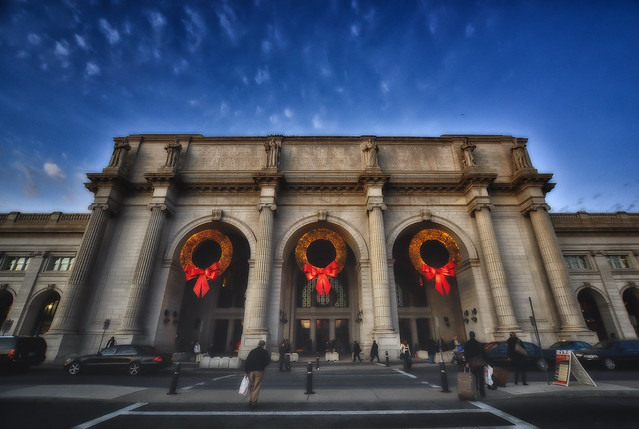
3.  Union Station courtesy staticflickr.com.


4.  White House courtesy twinamerica.net.


5.  Arlington Cemetery, Virginia, courtesy www.toledoblade.com.