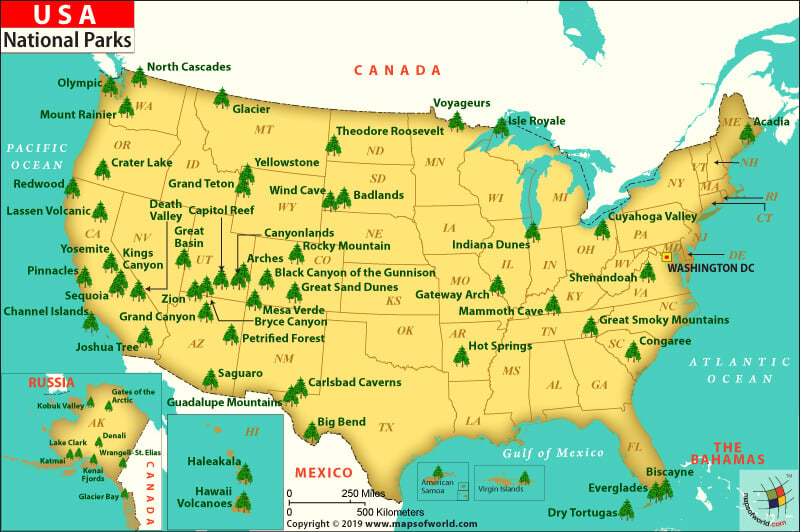
"The National Parks: America's Best Idea" is nonetheless the story of people...who were willing to devote themselves to saving some of the precious land they loved and in doing so, reminded their fellow citizens of the full meaning of democracy." (http://www.pbs.org/nationalparks/)

The National Park Service has a presence in 49 of the 50 states (all but Delaware). It overseas 58 national parks as well as 333 national monuments and historic sites. "As America expanded westward, pioneers would 'discover' landscapes of such breathtaking and unusual beauty, that written descriptions of the lands were sometimes assumed by people in the East to be works of fiction. Eventually there emerged a belief that these places should be kept untarnished by development and commerce so they could be experienced by all people." (http://www.pbs.org/nationalparks/about/)
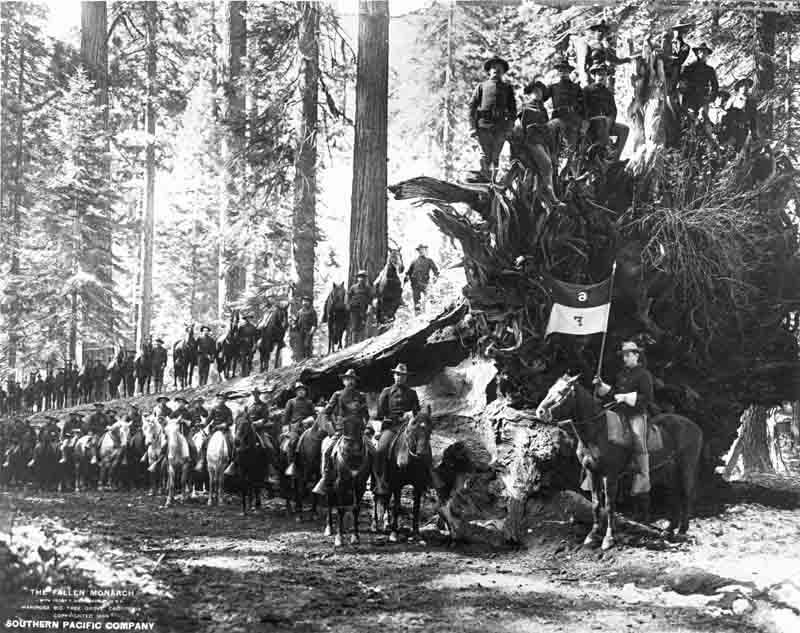
US 6th Calvary on top and beside the Fallen Monarch Tree, Yosemite, circa 1899 courtesy https://www.nps.gov/media/photo/gallery.htm?id=B17BC4E5-155D-4519-3EC6B73FCE2806A8.
"The National Parks: America's Best Idea is nonetheless the story of people...who were willing to devote themselves to saving some of the precious land they loved and in doing so, reminded their fellow citizens of the full meaning of democracy." John Muir, a deeply religious man, found inspiration in the mountains of Yosemite. James Mason Hutchings, a magazine publisher who promoted Yosemite. George Masa, a Japanese immigrant, took photographs of North Carolina and Tennessee's Great Smoky Mountains, which later became a national park. Marjory Stoneman fell in love with the Florida Everglades and convinced the powers that be to make it a national park. Adolphe Murie, a young biologist who focussed on protecting the land but also the animals that inhabited it. And city slicker Thomas Moran, who joined the trek through the Rocky Mountains to Yellowstone River and painted the mural which later convinced Congress to make it a national park. (http://www.yellowstonepark.com/the-history-of-yellowstone-national-park/)

The Grand Canyon of the Yellowstone circa 1872 courtesy https://upload.wikimedia.org/wikipedia/commons/1/1b/Thomas_Moran_-_Grand_Canyon_of_the_Yellowstone.jpg.