Saturday, 20 May 2017

ABC Murders

Poirot receives typed letters from a serial murderer, ABC, explaining where and when the next murder will be.   Alice Ascher is a tobacco shop owner killed in Andover.  Betty Barnard is a flirtatious waitress killed in Bexhill.  Carmichael Clarke is a wealthy man killed in his manor in Churston.  ABC leaves a railway guide with each victim.  Poirot wonders:  "Why would ABC write to him instead of Scotland Yard or any reputed newspaper?" and "Why did a meticulous man like ABC misspell Poirot's address on the Churston letter?"

The murder mystery is unravelled by Captain Hastings who talks about Cust, travelling salesman and Great War veteran, who suffered from epilepsy due to a war injury.  He is prone to memory blackouts and headaches.  Also involved in the investigation are Inspector Crome, who doubts Poirot's investigative abilities, and Dr. Thomson who profiles the serial killer.

Poirot notices a similarity among all three murders.  A stockings salesman visited each home before the murder, selling a pair of stockings to the first two victims, but being turned away by the third.  ABC sends a fourth letter, this time directing everyone to Doncaster where a famous horse race will take place.  But ABC strikes in a cinema where he kills George Earlsfield, instead of Roger Downes, the logical victim sitting only two seats away.  The salesman, Cust, who had suffered a blackout, later slips out of the theatre unnoticed.  Cust finds the murder weapon in his pocket and blood on his sleeve.

Cust, tipped off that the police are after him, flees but collapses at the Andover police station.  Cust, who can't remember the murder, fears that he is guilty.  Cust's room contains many incriminating items:  silk stockings, lists of clients, the fine paper used to type the letters to Poirot, an unopened box of ABC railway guides, and in the hall lies the bloodied knife from the most recent murder.  It is revealed that Cust was never hired by the stocking company and that the letters to Poirot were indeed typed on Cust's typewriter, the one he claimed the company gave him.  Poirot meets with Cust who has no recollection of any of the murders.  He has a solid alibi, however, for the Bexhill murder.

Poirot categorically explains how Cust could not have committed the murders.  Then he points the finger at Franklin Clarke, the brother of Sir Carmichael Clarke, the third victim.  Sir Carmichael was heir to a fortune and a member of Cust's legion.  The third letter, which contained an error, was meant to lead the reader astray.  Franklin had feared that, with Lady Clarke's death imminent, his brother would marry his young beautiful assistant.  When Sir Carmichael died, his wealth would go to his new wife and any children they had.  Franklin's meeting with Cust in a pub served as inspiration for his serial murder plot, with Cust serving as the stalking horse.

Franklin laughs off the accusations until Poirot states that the former's fingerprint was found on Cust's typewriter key.  Further Franklin has been recognized by Milly Higley, a coworker of the deceased Betty Barnard.  Franklin tries to shoot himself but Poirot is one step ahead of him and has emptied the bullets from his gun.  Poirot reveals to Hastings that the fingerprint on the typewriter key was a bluff.  Cust, meanwhile, has an offer from the press to sell his story,  


The ABC Murders

The ABC Murders, published in 1936, courtesy 

Friday, 19 May 2017

Murder in Mesopotamia

Amy Leatheran, a nurse, is hired by Swedish archeologist Dr. Erich Leidner, to care for his wife, Louise.  They are currently on a dig in Iraq, a British protectorate.  Louise was married briefly during the Great War 15 years earlier.  She turned in her husband, Frederick, a German spy, and he was imprisoned.  He escaped and hopped a train, but the train crashed.  A body with his identification was found at the site of the crash.  However, Louise is now receiving letters from her "deceased" husband which puts her on edge.

A week after the nurse is hired to care for Louise, the latter is found dead in her room, the victim of a blow by a blunt instrument.  Dr. Reilly examines the body and establishes a time line, concluding that it was an inside job.  He calls in Hercule Poirot, travelling in Iraq at the time, to solve the crime.  Poirot determines that it must be someone from the expedition who is guilty of the murder.  The murderer must have entered the victim's bedroom from the inside of the house as the bedroom window is barred.  However, after one round of questioning it appears that everyone has an airtight alibi.

Nurse Leatheran tells Poirot the story of Louise's young brother in law, William, who was fifteen years younger.  She points out that Louise always craved the attention of men.  Poirot suspects that William, or even Frederick himself might be part of the expedition as Frederick's identity was never proven on the train wreck.  Poirot warns Nurse Leatheran that she might be a future target of the murderer but she still insists on attending Louise's funeral.

After the funeral, Nurse Leatheran and Miss Johnson are up on the roof and the latter points out how someone could enter the house without being seen.  Later Miss Johnson is poisoned:  someone substituted hydrocholoric acid in her water glass, through her window..  Poirot solves the crimes, but has no proof.

It turns out Mrs. Leidner and Miss Johnson were murdered by Dr. Erich Leidner.  Poirot determines that Leidner is really the long lost husband, Frederick who really didn't die in the crash.  Leidner did die and he has stolen his identity.  Frederick remarried his wife who, after 15 years, didn't recognize him. He was the one who sent her the letters to discourage her from engaging in relationships with other men.  He discovered that his wife was falling in love with his friend, Richard Carey, and he murdered her in a jealous rage.  Miss Johnson figured it out and he in turn murdered her.

On the night of the crime, Louise heard a noise up on the roof.  Unbeknowst to her it was her husband sorting pottery.  She opened her bedroom window to investigate only to be knocked out by a stone quern.  In the meantime, Frederick removed the bloodstained rug and closed the window before calling the nurse.  With the nurse on the scene, she could vouch for the time of death.  Frederick tried to make Miss Johnson's death appear a suicide; however, Poirot points out that hydrolic acid is an incredibly painful way to kill oneself.   


Murder in Mesopotamia

Thursday, 18 May 2017

Death in the Clouds

Hercule Poirot is on a flight from Paris to Croydon when one of the passengers, Madame Giselle, drops dead.  Speculation has it that she died of a wasp sting, but Poirot determines the cause of death to be a poisoned dart.  What instrument was used to shoot the dart?  Was it the flute carried by one of the passengers?  Was it the ancient tubes brought on board by the two archeologists?  Was it Lady Horbury's cigarette holder?  And what were the two coffee spoons doing in the victim's coffee cup?

Poirot discovers that Madame Giselle was known for blackmailing her clients who hadn't paid up.  Also, Madame Giselle had an estranged daughter who should inherit her mother's estate; she might be on board the plane.  Poirot questions several of the passengers including Mr. Clancy, a detective novelist.  Countess Horbury also comes under suspicion.  She came from the lower class but married well.  In the meantime, her husband has cut her off and she had owed Madame Giselle money.  The Countess' maid, called into the compartment during the flight, would have had the perfect opportunity to commit the crime.  The maid is revealed as the long lost daughter of the victim.  It appears as if she is guilty, but she in turn is murdered on the boat train to Bologne.

Dentist Norman Gale, who had a crush on the novel's heroine Jane Grey, is revealed to be Anne's new husband.  Poirot discovers that Gale brought his dentist's jacket on board and excused himself to go to the washroom.  He donned the jacket and posed as a steward.  Under the premise of delivering a coffee spoon to Madame Giselle, he stabbed her with the poison dart.  Gale's intention had been to frame the Countess.  The blowpipe found behind Poirot's seat was supposed to be behind the Countess' but they had switched at the last minute.  Poirot allows the detective novelist to listen in as he joins the dots in the story's denouement.


Wednesday, 17 May 2017

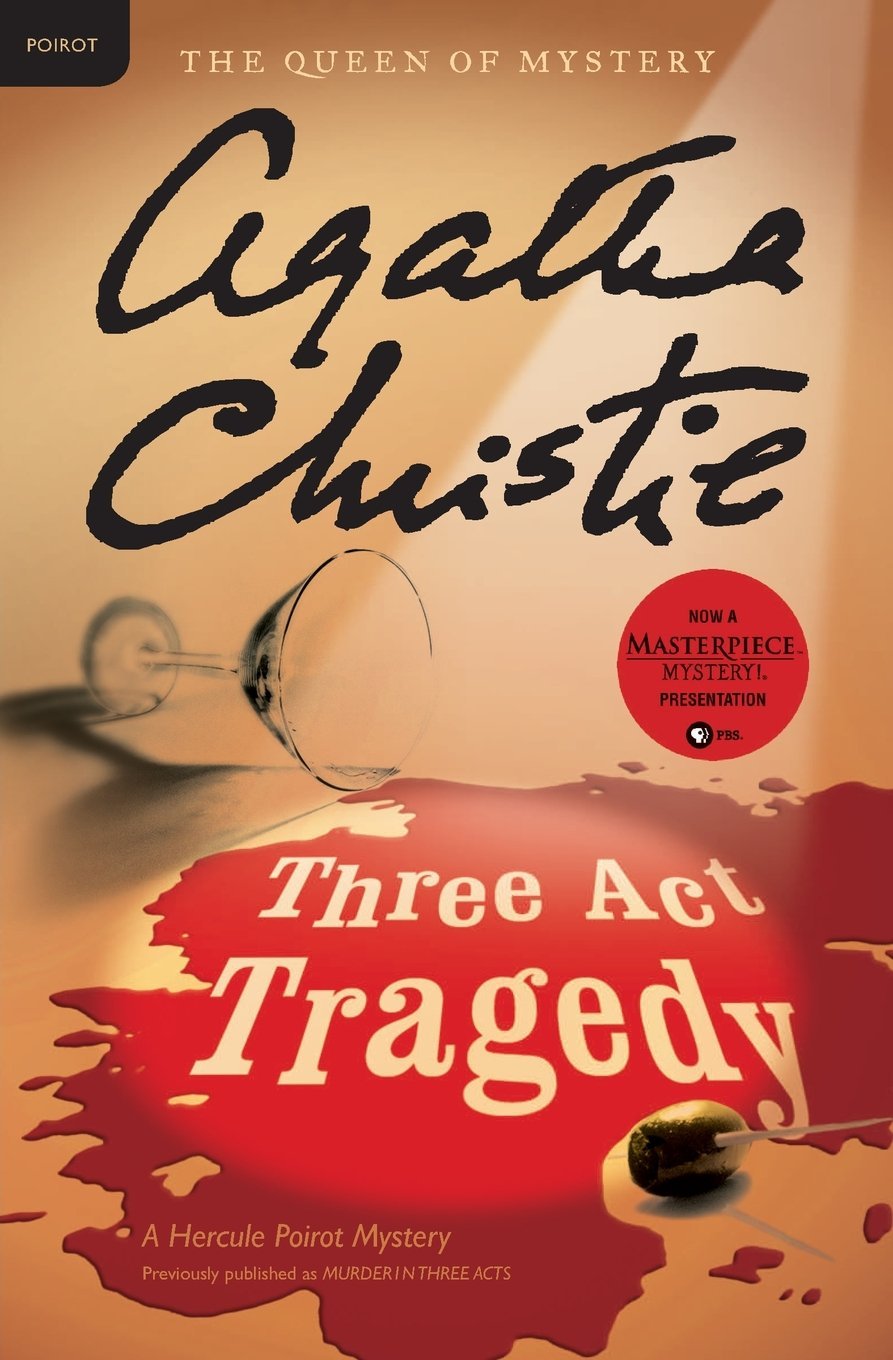
Three Act Tragedy

At a party in Cornwall, the mild-mannered minister, Reverend Stephen Babbington, chokes on his cocktail, goes into convulsions and dies.  Investigation of the glass finds no poison.  Hercule Poirot is baffled; there appears to be no motive.  The party, hosted by Sir Charles Cartwright, also included:  Dr. Strange, Lady Mary Lytton Gore and her daughter Hermione, Captain Dacres and his wife Cynthia, Muriel Wills,Oliver Manders, Mr. Satterthwaite, and Mrs. Babbington.  Sir Charles mixed the drinks.

Another party is hosted in Yorkshire with many of the same guests, except Sir Charles, Mr. Satterthwaite and Poirot.  Oliver Sanders' motorcycle breaks down right in front of the manor. Sir Charles new butler serves port to all of the guests.  Dr. Strange collapses and dies.  His glass is tested and it is determined he died of nicotine poisoning.  Reverend Babbington's exhumed body reveals the same substance.

Mr. Satterthwaite and Sir Charles investigate the two deaths.  It turns out Dr. Strange gave his usual butler a vacation just two weeks before his death.  After his murder, his temporary butler disappeared.  In Ellis' room papers are found indicating he was blackmailing Dr. Strange.

Poirot receives a telegram from Mrs. D at the sanitarium.  Later, Mrs. D is discovered murdered as a result of nicotine poisoning.

It turns out that Sir Charles murdered all three victims. Charles had wanted to marry Hermione but couldn't because he had a wife in the insane asylum.  British law forbade him from divorcing her.  He murdered Dr. Strange who was the one person who knew about his wife.  The Cornwall party was a dress rehearsal for the real murder.  Reverend Babbington was the guinea pig.  Sir Charles managed to switch Babbington's tainted glass with an untainted one.

Sir Charles then convinced Dr. Strange to let him play the role of the butler.  When Muriel spoke up, Sir Charles was prepared to kill her too.  However, Poirot told her to go into hiding.  Mrs. D was silenced because otherwise she would have told Poirot she did not send the telegram and was unconnected to the crime. Sir Charles is arrested and Hermione matches up with Oliver Manders.


Three Act Tragedy, published in 1934, courtesy 

Tuesday, 16 May 2017

Murder on the Orient Express

Spanning a continent, from Paris to Istanbul, the Orient Express was the "King of Trains".  Presidents rode it for its luxuries; spies used it as a secret weapon; businessmen rode it for its connections.  The train would be the subject of books and movies.

In the mid-1800's, Belgian businessman Nagelmackers had a dream for a train route from Paris to Constantinople.  He travelled to America where the Pullman sleeping car made quite an impression on him.  In 1883, Nagelmackers' Compangie Internationale des Wagons-Lits opened a Paris-Constantinople route.  The journey would span 1500 miles and would take 80 hours.  Newspapers dubbed the route "The Orient Express", even though it never reached the Orient.

The train resembled a fine European hotel with its wooden panelling, its deluxe leather armchairs, its silk sheets and its five-course meals.  Its elegance attracted royalty.  The king of Bulgaria, an amateur engineer, insisted on driving the train through his country.  Czar Nicholas II ordered extra cars built for his trip to France.  And one president, likely in the sauce, fell off the train.

Diplomats made history on the train:  the German surrender of 1918 took place in one of its cars.  Hitler ordered the same car for the French surrender of 1940.  Later when the tide of the war turned, the dictator ordered the famous car destroyed.

Spies conducted operations on the train.  Robert Baden Powell posed as a lepidopterist during the war.  He made intricate butterfly sketches which turned out to be coded representations of the enemy's fortifications, helping the Allies to clinch a victory.

Agatha Christie wrote her famous "Murder on the Orient Express" in the 1930's.  The movie adaptation was directed by Alfred Hitchcock and starred Ingrid Bergman in the 1970's.

Shortly after Hitchcock's movie, the Orient Express stopped its service to Istanbul.  Bit by bit it cut back its service.  Finally, in 2009, it shut down completely.


Monday, 15 May 2017

Why Didn't They Ask Evans?

While playing a round of golf with his friend Dr. Thomas, Bobby Evans swings his golf ball over a cliff.  At the bottom of the precipice he finds the crumpled body of man whose last words are;  "Why didn't they ask Evans?"  Bobby finds a photograph of a beautiful woman in the dead man's pocket, but without identification.  Another man who comes upon the scene, Roger Bassington-French, offers to stay with the body while Bobby leaves to play the organ at his father's church.  The dead man is identified as Alex Pritchard and the beautiful woman in the photo is his sister Amelia Cayman.

Bobby rejects a job offer from Buenos Aires.  In the meantime he drinks from a poisoned beer bottle.  Bobby discovers that Amelia Cayman is an imposter.  He figures that the stranger at the scene of the crime must have switched the photo in the dead man's wallet.  Bobbie and his friend Frankie search for Bassington-French and find an address in Hampshire.  There, they stage a car accident hoping that Frankie, injured, will be invited into the home.  Inside, Frankie meets Roger's brother, Henryk, and sister in law Sylvia.  Frankie shows the couple a newspaper clipping of the dead man.  Sylvia says he resembles a man who was good friends with a big game hunter, Alan Carstairs, who killed himself after being diagnosed with terminal cancer.

Frankie meets Henry and Sylvia's neighbours, Dr. and Moira Nicholson, who run a sanitarium.  Bobby investigates the sanitarium where he runs into the beautiful woman from the photo.  Moira turns up at the local inn where Bobby is staying and says her husband is trying to kill her.  Frankie asks Roger if he took the photo of the beautiful woman and he admits that he dead, wanting to avoid scandal for her.  In the meantime, Henry is found dead in his home, an apparent suicide.

Frankie asks a solicitor about Savage's will and finds out that he was staying with Mr. and Mrs. Templeton when he first discovered he had cancer.  One specialist, however, said he was perfectly fine.  When he died, he left 700,000 pounds to the Templeton's.  Bobby is kidnapped and Frankie is lured, along with Roger, to an isolated cottage.  Badger Beadon arrives to find a drugged Moira in the cottage.  When the police appear on the scene, Roger has vanished.

They trace the witnesses to the signing of John Savage's will.  They are the former cook and gardener of Mr.and Mrs. Templeton.  The parlourmaid, Gladys, however, was not asked to witness the singing of the will.  In reality, it was not John Savage who signed the document but Roger Bassington-French.  Gladys' last name is Evans, hence the dying man's question:  "Why didn't they ask Evans?" Gladys is now the housekeeper at Bobby's home and the dying man was trying to find her.  

Returning to Wales, they find Moira who claims she is being followed by Roger.  Frankie, suspicious of Moira, spoils the latter's attempt to poison their coffee.  It turns out Moira was really Mrs. Templeton and Roger's accomplice.  Moira attempts to shoot Bobby and Frankie but is overpowered.  Weeks later Frankie received a letter postmarked South America from Roger who admits that he murdered Carstairs and his brother Henry.  Frankie and Bobby get engaged.


Why Didn't They Ask Evans?

Why Didn't They Ask Evans?, published in 1933, courtesy http://www.agathachristie.com/stories/why-didnt-they-ask-evans

Sunday, 14 May 2017

Lord Edgware Dies

Actress Jane Wilkinson asked Poirot to convince her husband Lord Edgware to agree to a divorce.  Poirot speaks to Lord Edgware who says he has already written a letter to his wife to that effect.  That evening, Lord Edgware is found dead in his study.  The newspaper reports the next morning that Jane was at a prominent party the previous night.

Inspector Japp informs Poirot of the murder.  It turns out that Jane arrived at Regent Park the night before, announced herself to the butler and was spotted entering her husband's study by the secretary. The prominent dinner party had thirteen guests.  One guest pointed out that a table of thirteen meant bad luck for the first one to rise.  Jane was the first to get up to answer a telephone call.

In the meantime, Carlotta Adams, who liked to do impersonations of Jane, is found dead from an overdose of Veronal.  The butler, along with some money, disappeared on the day of Lord Edgware's death.  Ross is suspicious of Jane when he discovers she demonstrates an unusual amount of knowledge of Paris of Troy.  He phones Poirot to tell him of his suspicions and while on the phone, he is murdered.

Poirot tries to piece together the three murders.  He believes that Carlotta Adams impersonated Jane at the dinner party enabling Jane to take a taxi to Regent Park and murder her husband.  Carlotta and Jane meet up later where Jane has promised her money for her impersonation, but gives her a fatal dose of Veronal instead.  Jane then planted a case with Verona in it on Carlotta's person to make it seem like she was addicted to the drug.  Jane, knowing that Ross was a risk as he pursued Poirot, murdered him.  Jane's motive for killing her husband was that she wanted to marry the Duke of Merton.  The Duke was a Roman Catholic who was permitted to marry a widow but not a divorcee.


Lord Edgware Dies

Lord Edgware Dies circa 1933 courtesy http://www.agathachristie.com/stories/lord-edgware-dies.