Saturday, 23 July 2016

Seabiscuit: The Race of the Century


Trainer Tom Smith with Seabiscuit circa 1936 courtesy 


"He was undersized, knobby-kneed and given to sleeping and eating for long periods of time." (https://en.wikipedia.org/wiki/Seabiscuit).  Seabiscuit was not your typical racehorse.  But given his sire was Hardtack, a son of Man o' War, big things were expected from this little horse. With a slow start, Seabiscuit won 11 out of 15 races in the year 1937. However, because War Admiral had won the Triple Crown, he was declared the Horse of the Year.  

The rivalry led to a 1938 match up at Maryland's Pimlico Track.  Forty thousand fans watched the race from the grandstand.  Forty million Americans listened on their radios, including President Roosevelt who postponed his meetings until the race was complete.  Although Seabiscuit was the underdog, he managed to outsmart and outpower War Admiral, reaching the finish line four lengths ahead.  In under two minutes, he had stopped the nation, diverting their attention from the Great Depression and the impending war to the "The Race of the Century".


Friday, 22 July 2016

For a More Beautiful America

"Where flowers bloom so does hope." (Lady Bird Johnson)


Description: LB Johnson beautiful highways25

Yellow & blue wildflowers along a highway courtesy
http://about.usps.com/news/national-releases/2012/pr12_117.htm.


It was just over 50 years ago that the Lady Bird Bill was signed.  President Eisenhower had overseen the building of the Interstate Highway System.  Now, President Johnson, with his wife leading the effort, would oversee the beautification of those highways.

The Highway Beautification Act of 1965 called for the control of outdoor advertising, for the removal of junkyards along the highways and for "scenic enhancement and roadside development" (https://www.fhwa.dot.gov/infrastructure/beauty.cfm).


Description: LB Johnson beautiful parks25

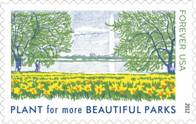
Daffodils along the Potomac River courtesy 


Lady Bird concentrated not only on beautifying the nation's highways, but also cities.  Focusing on the Washington DC, which in the 1960's was in a dilapidated state, she hoped to set an example for other cities in the United States.  She believed that the state of America's cities was reflected in the state of the nation's minds.  In January 1965, Lady Bird wrote in her diary:

"Getting on the subject of beautification is like picking up a tangled skein of wool. All the threads are interwoven -- recreation and pollution and mental health, and the crime rate and rapid transit and highway beautification, and the war on poverty and parks -- national, state and local.  It is hard to stitch the conversation into one straight line, because everything leads to something else." (http://www.pbs.org/ladybird/shattereddreams/shattereddreams_report.html)


Description: LB Johnson more beautiful cities25

Pink & red azaleas and white tulips in front of the Capitol courtesy http://about.usps.com/news/national-releases/2012/pr12_117.htm.


The Beautification Act faced fierce opposition:  the billboard industry, which had sprung up under Eisenhower, would have no part of it.  The President and the First Lady, who made frequent road trips from their Texas ranch to Washington DC, had tired of the endless advertisements along America's highways.  

Lady Bird Johnson would not not give up the fight.  The First Lady was so involved in the beautification effort that Kansas Representative Robert Dole, who is still alive today, suggested an amendment to the bill which would replace the title "Secretary of Commerce" with Lady Bird, but lost by a voice vote.
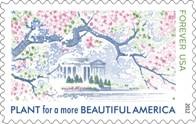

Description: LB Johnson more beautiful america25

Cherry trees in blossom by the Jefferson Memorial courtesy
https://about.usps.com/news/national-releases/2012/pr12_141.htm/ 


Robert Dole may have lost the battle, but Lady Bird won the war.  Her husband, who had just gotten out of the hospital for gall bladder surgery, signed the bill on October 22, 1965.  Commenting on his drive from Bethesda Naval Hospital to the White House along George Washington Memorial Parkway, he said:  

"I saw Nature at its purest.  The dogwoods had turned red.  The maple leaves were scarlet and gold.  And not one foot of it was marred by a single unsightly man-made obstruction -- no advertising signs, no junkyards.  Well, doctors could prescribe no better medicine for me."(http://www.pbs.org/ladybird/shattereddreams/shattereddreams_report.html)


Description: LB Johnson beautiful streets25

Rows of crab apple trees along a suburban road courtesy
http://about.usps.com/news/national-releases/2012/pr12_117.htm.


For more information, read A White House Diary by Lady Bird Johnson at https://www.amazon.ca/White-House-Diary-Lady-Johnson/dp/0292717490.


Lady Bird Johnson circq 1963 courtesy http://tti.tamu.edu/about/hall-of-honor/inductees/yr2012/


Thursday, 21 July 2016

Centennial of Engineering


They are responsible for some of the great American landmarks:  the San Francisco Bay Bridge, Hoover Dam and the Empire State Building.  They design roads, bridges , dams and similar structures, along with a good dose of "courage and inspiration".  They are America's engineers.

In 1952, the U.S. Post Office designed a stamp to celebrate the Centennial of Engineering.  A century before in New York City, twelve engineers and architects assembled to form the American Society of Civil Engineers and Architects.  While the architects formed their own society in 1857, the engineers remained.  Their purpose of the society is "to provide essential value to its members and partners, advance civil engineering, and serve the public good" (https://en.wikipedia.org/wiki/American_Society_of_Civil_Engineers).

Today, the American Society of Civil Engineers oversees 36 peer reviewed journals including the Journal of Architectural Engineering, the Journal of Bridge Engineering and the Journal of Aerospace Engineering.

In 1999, with the century drawing to a close, the ASCE selected Monuments of the Millenium, the top ten civil engineering feats of the 20th Century that demonstrated a "combination of technical engineering achievement, courage and inspiration, and a dramatic influence of the development of their communities."  They are:


  • Kansai International Airport, Osaka, Japan
  • Hoover Dam
  • Interstate Highway System (under President Eisenhower)
  • Golden Gate Bridge, San Francisco, California
  • Eurotunnel Rail System 
  • sanitary landfills & solid waste disposals
  • Empire State Building, Manhattan, NYC
  • Chicago Wastewater System
  • California State Water Project
  • Panama Canal


Construction of the Hoover Dam circa May 1935 courtesy https://en.wikipedia.org/wiki/Hoover_Dam.

Wednesday, 20 July 2016

Enrico Fermi: Chicago Pile 1

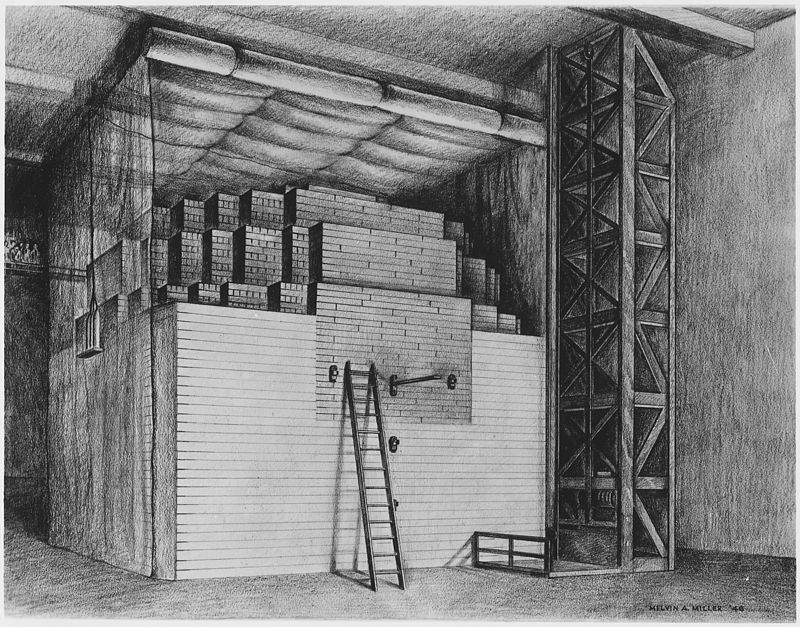
Stagg Field reactor.jpg


What do you get when you combine 45,000 graphite blocks, 6 short tons of uranium metal and 50 short tons of uranium oxide?  A big reaction.  In 1942, Enrico Fermi supervised the first man made, self sustaining nuclear chain reaction,  describing the apparatus as "a crude pile of black bricks and wooden timbers."  Chicago Pile 1 was the world's first nuclear reactor.

No stranger to success in the scientific field, Fermi had won the 1938 Nobel Prize in Physics for the discovery of nuclear reactions caused by slow neutrons.  Fermi taught at the University of CHicago all the while contributing to the nuclear experiments, all part of the Manhattan Project which would produce the atomic bomb in 1945.

Enrico Fermi passed away in 1954, but other scientists, such as his manhattan Project colleague Robert Wilson, took up his cause.  It was Wilson who made sure that Fermilab took on the name of his late colleague.  Dedicated in 1974, Enrico's widow, Laura Fermi, who had fled Fascist Italy in 1939 with her husband, was present at the ceremony.  Comparing particle accelerators to Egypt's pyramids Laura Fermi explained:  "Both were tangible victories of men over the brute power of nature."

Note:  For more information visit Einstein's Letter to FDR sparks Manhattan Project at http://alinefromlinda.blogspot.ca/2015/09/einsteins-letter-to-fdr-sparks.html.


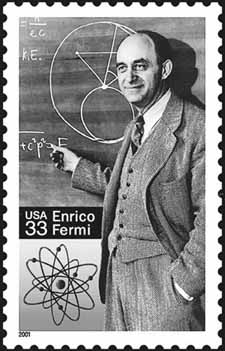
The Enrico Fermi stamp.


Enrico Fermi explains a model of the carbon atom circa 1948 on the 100th anniversary of Fermi's birth courtesy https://www.fnal.gov/pub/ferminews/ferminews01-02-02/p3.html.


Tuesday, 19 July 2016

50th Anniversary of Motion Picture Industry


On April 16, 1902, Tally's Theatre opened its doors in Los Angeles, the first theatre to exclusively feature motion pictures.  In 1952, a total of 1753 daily newspapers across the United States featured full or half page ads announcing the 50th anniversary of motion pictures.  Two hundred and fifty Hollywood stars visited communities to promote the event (https://news.google.com/newspapers?nid=348&dat=19511004&id=hwoFAAAAIBAJ&sjid=fjEDAAAAIBAJ&pg=6753,230803&hl=en).

A spokesman for the event explained:  "The purpose of the celebration is to focus unique position the motion picture industry has won in the last 50 years as the centre of each community's entertainment and to call attention to the superior quality of pictures to be released in the coming year."  A contest was held at participating theatres, searching for "the typical American family", with the grand prize of a trip to Hollywood.

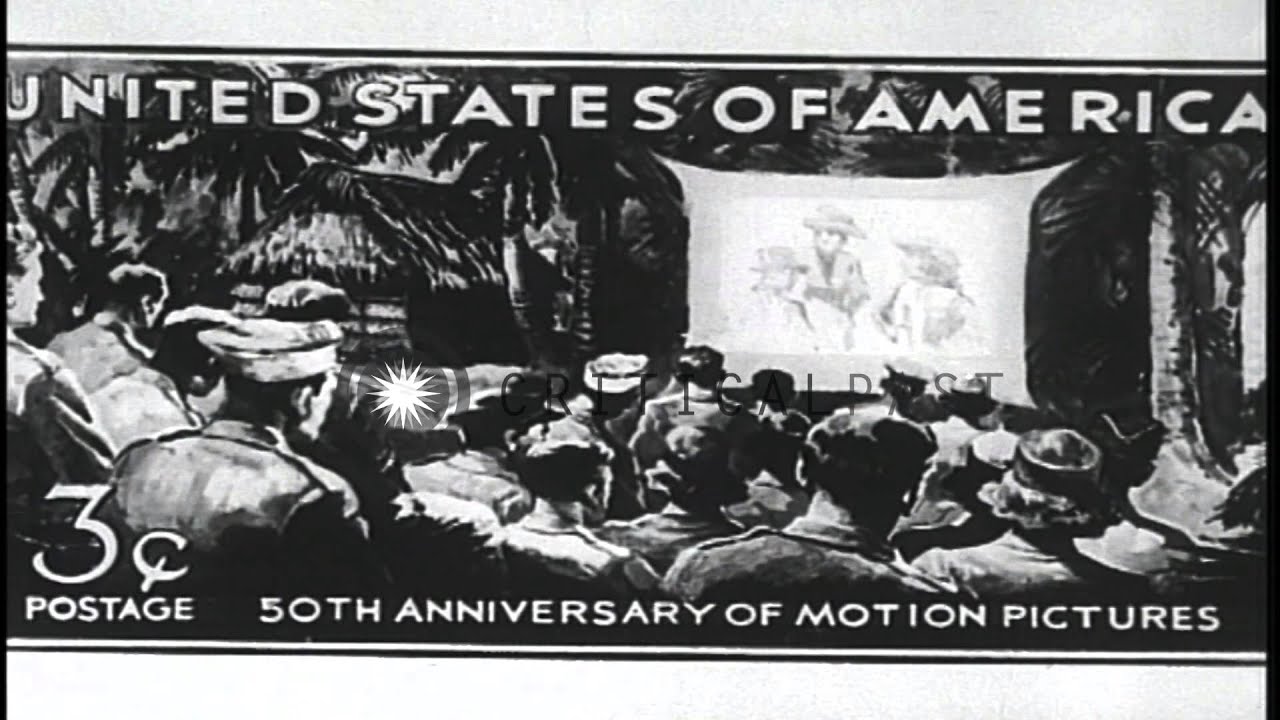
The same year, the U.S. Post Office issued a stamp to mark the anniversary, focussing on the unique role that motion pictures played in the lives of American troops.  Far from home and immersed in battle, motion pictures were a welcome diversion for war weary soldiers (https://www.youtube.com/watch?v=Bdufvv_zevE).


President Truman greets Hollywood stars on the 50th Anniversary of Motion Pictures circa 1952 courtesy http://www.gettyimages.ca/pictures/washington-dc-president-truman-greets-motion-picture-news-photo-514704472.


Monday, 18 July 2016

Made in America: Building a Nation

"The 4 x 5 Graflex Lewis Wicks Hine carried seemed outsized in his hands, yet the photographer surprised the ironworkers -- whom Hine christened the Skyboys -- by scaling the dizzying heights alongside them to capture what today stand as some of the most arresting documentary images made." (Shutterbug)


In 1930, Lewis Wicks Hine showed up at the corner of Fifth Avenue and West 34th Street in New York City with a camera and a mission:  to document the building of a 102 story skyscraper.  Set during the Great Depression, men were hungry for work and signed up for a modest sum to build the mighty skyscraper.  Before Hine's camera, the ironworkers raised 57,000 tonnes of steel, almost 50% more than the Chrysler Building and Bank of Manhattan combined, to form the Empire State Building.  Photographing a building that reached 1250 feet, Hine used a special basket which hung 1000 feet above the ground to document the builders at work, capturing surreal images in the process.  In 1931, when the Empire State Building was completed, it was the world's tallest building, a title it retained until 1972 when the World Trade Center was constructed.  


Hine didn't always photograph skyscrapers.  Hailing from the Populist tradition of Wisconsin, Hine always had a heart for those less fortunate.  Drawn to the new immigrants who arrived daily from Southern and Eastern Europe, he worked as a photographer at the Ellis Island Immigration Station from 1904 to 1909.  In 1908, the National Child Labor Committee hired him to document the violation of child labor laws in Pennsylvania coal mines and South Carolina cotton mills, a project which led to the passage of the Child Labor laws in 1938.  

Ten Hine images were selected by the U.S. Post Office to commemorate construction workers of the time period, a collection titled "Made in America:  Building a Nation".   


Sunday, 17 July 2016

The Ghosts of Ebbets Field

"[It is] one of the most notorious abandonments in the history of sports." (U.S. Federal Judge)


Ebbets Field

https://en.wikipedia.org/wiki/Ebbets_Field#/media/File:Ebbets1913OpeningDay.jpg


Charlie Ebbets started buying up parcels of land in Brooklyn, a block at a time, including a garbage dump where pigs used to dine which they called Pigtown.  Within five years, he built a baseball stadium, but neglected to include a flag, keys to the bleachers and a press box.

The opening game featured the Brooklyn Dodgers, named after the streetcars that its fans used to dodge, and the Philadelphia Phillies.  The Dodgers quickly worked their way into the hearts of Brooklynites.  With the bleachers full, more seats were added in the 1920's.  Lights were added in 1938 to pave the way for the first night game.  The press box was added in 1929, along with a scoreboard in 1940.

The scoreboard came at the time of major success for the Dodgers, a baseball team that captured the pennant several times including 1941, 1947, 1949, 1952, 1953, 1955 and 1956.  

Probably Ebbets Field's biggest claim to fame came in 1947, when the color barrier in baseball was broken with manager Branch Rickey's hiring of Jackie Robinson.  Number 42 stole many a base at Ebbets Field with his wife Rachel, and later his children, cheering him on from the stands (http://alinefromlinda.blogspot.ca/2013/04/april-15.html).

While the Dodgers kept knocking on the door of success, they were never able to clinch the World Series.  That all changed in 1955.  Once more, the Brooklyn Dodgers faced the New York Yankees, the heavy favourites.  Ebbets Field was packed for the series.  For Brooklynites who couldn't get tickets, they stayed home and watched the series on their televisions or listened to it on the radio.  One fan pointed out that he was going to the game to watch it "in colour, rather than in black and white".  Things looked bleak for the Dodgers after the Yankees took the first two games.  No baseball team had ever come back to win the World Series after such a start.  However, with players like Jackie Robinson, the team came back to win the championship.

Henry Petroksi, a former Brooklyn resident, said in his book Paper Boy that the streets surrounding Ebbets Field were surprisingly quiet at first, filled with disappointed Yankee fans returning home.  Brooklyn fans were in shock.  However, within 90 minutes, Brooklynites erupted in celebration.  After decades, Brooklyn's loyal fans had finally been rewarded.

Sadly, the celebration was short lived.  As one writer says, the Dodgers were "victims of their own success".  Dodgers owner Walter O'Malley wanted to expand Ebbets Field, but had no where to go.  He wanted to build a new stadium at the Atlantic Yards where an old market was being torn down.  New York City Commissioner Robert Moses (after whom the Parkway is named) wanted a baseball stadium built at Flushing Meadows.  However, Walter O'Malley said that his team was called the "Brooklyn Dodgers, not the Queen's Dodgers".  In 1956, real estate developper bought Ebbets Field.  The following year, the Dodgers moved to Los Angeles (https://en.wikipedia.org/wiki/Ebbets_Field).

In 1960, Ebbets field met the fate of the wrecking ball.  Where famous ball players once played, a massive apartment complex was built, named Ebbets Field apartments.  In 1972, when Jackie Robinson died, the complex was renamed in his memory. 

Ebbets Field would not soon be forgotten.  Frank Sinatra sang about it in his tune "There Used to be a Ballpark".  Roger Kahn wrote about it in his book The Boys of Summer.  The HBO documentary filmed it in Brooklyn Dodgers:  Ghosts of Flatbush.  One U.S. federal judge called it "one of the most notorious abandonments in the history of sports".