Showing posts with label Hollywood. Show all posts

Tuesday, 19 July 2016

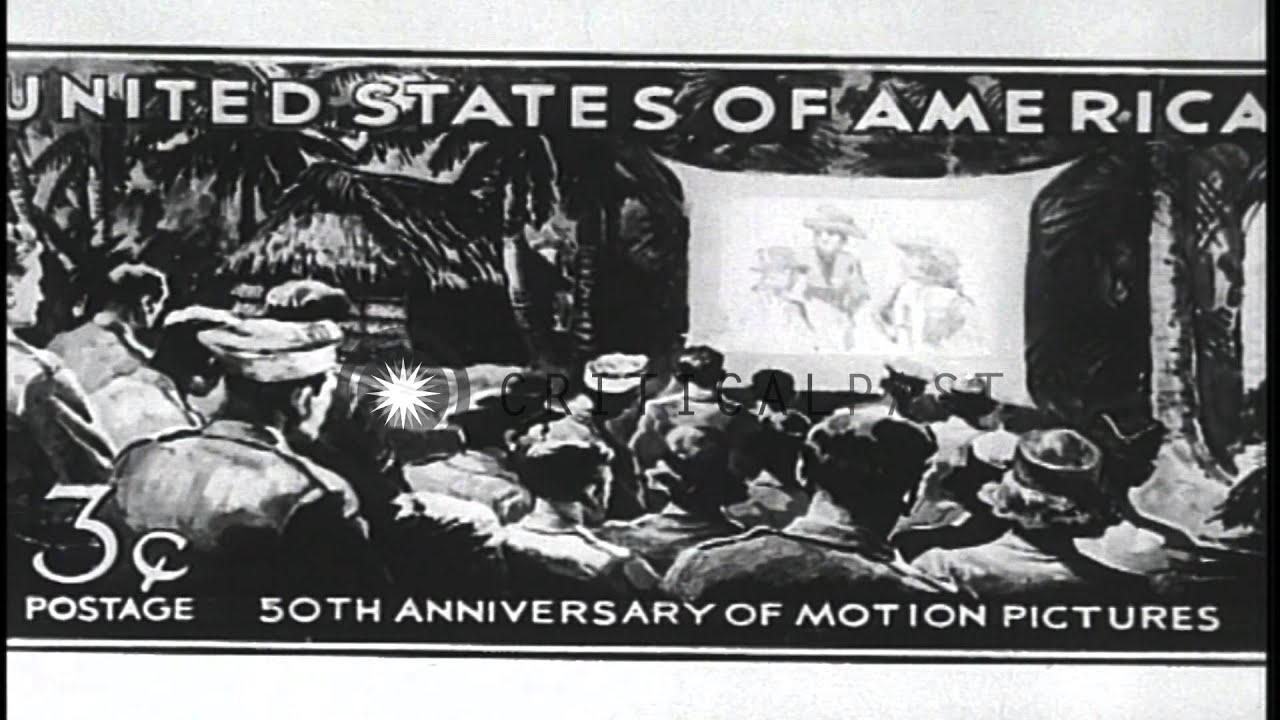
50th Anniversary of Motion Picture Industry


On April 16, 1902, Tally's Theatre opened its doors in Los Angeles, the first theatre to exclusively feature motion pictures.  In 1952, a total of 1753 daily newspapers across the United States featured full or half page ads announcing the 50th anniversary of motion pictures.  Two hundred and fifty Hollywood stars visited communities to promote the event (https://news.google.com/newspapers?nid=348&dat=19511004&id=hwoFAAAAIBAJ&sjid=fjEDAAAAIBAJ&pg=6753,230803&hl=en).

A spokesman for the event explained:  "The purpose of the celebration is to focus unique position the motion picture industry has won in the last 50 years as the centre of each community's entertainment and to call attention to the superior quality of pictures to be released in the coming year."  A contest was held at participating theatres, searching for "the typical American family", with the grand prize of a trip to Hollywood.

The same year, the U.S. Post Office issued a stamp to mark the anniversary, focussing on the unique role that motion pictures played in the lives of American troops.  Far from home and immersed in battle, motion pictures were a welcome diversion for war weary soldiers (https://www.youtube.com/watch?v=Bdufvv_zevE).


President Truman greets Hollywood stars on the 50th Anniversary of Motion Pictures circa 1952 courtesy http://www.gettyimages.ca/pictures/washington-dc-president-truman-greets-motion-picture-news-photo-514704472.


Thursday, 13 August 2015

Sister Mary Benedict Based on Director Leo McCarey's Aunt

"[She was] a very sporty, laughing girl who liked boxing and tennis, who adored children and caring for them, and built for herself a life full of love and faith." (Leo McCarey:  From Marx to McCarthy, Wes D. Gehring)


Sister Benedict, played by Ingrid Bergman in the movie Bells of St. Mary's, was the aunt of director Leo McCarey.  Just as the character in the movie helped acquire a new building for her school, the real Sister Benedict helped build Immaculate Heart Convent in Hollywood.  Just as the character in the movie loved boxing, Sister Benedict was fascinated with the sport; her father, a boxing promoter, likely taught her everything she knew.  Just as the nun in the film had a winning smile, so too did Sister Benedict.

Leo McCarey explained:  "[My aunt] made a great impression on my life [and] she had a wonderful sense of humor.  We were close friends and I learned from her the magic of a smile."  Sadly, just as the character in the film suffered from a disease, tuberculosis, Sister Benedict suffered from typhoid fever.  But before she passed away, Ingrid Bergman was able to get acquainted with her personality and study her mannerisms.


Tuesday, 9 June 2015

Gay Talese's "Frank Sinatra Has a Cold"

"Sinatra with a cold is like Picasso without paint, Ferrari without fuel -- only worse." (Gay Talese)


It is one of the most famous pieces of magazine journalism ever.  Gay Talese, who had worked for the New York Times, wanted to try his hand at magazines.  His task?  To write six stories in the space of one year for Esquire magazine, the Vanity Fair of the 1960's.  With suitcase in hand, he flew to Los Angeles to interview the music legend, Frank Sinatra.  The problem was, the 50-year-old Sinatra was bound and determined not to speak to reporters:  he was tired of the relentless questions about his current love, a 20-year-old named Mia Farrow; he was tired of the endless queries about his Mafia connections; he was tired of the movie he was shooting; and to top it all off, he had a cold.  

But Gay Talese was up for a challenge.  For the next three months, he followed Sinatra to every corner of Hollywood and Las Vegas.  He pursued the singer's entourage of 75, gaining glimpses into the private man.  He did what needed to be done to get the scoop.  The result was a brilliant essay written in the "New Journalism" style.  Esquire called it "a work of rigorously faithful fact enlivened with the kind of vivid storytelling that had previously been reserved for fiction".  Blogger Maria Henson explained:  "The 15,000 word story is as finely crafted as Sinatra's (and Talese's) custom-tailored suits."  Here is an excerpt from the article that everyone was talking about in April of 1966:

"Sinatra with a cold is Picasso without paint, Ferrari without fuel -- only worse.  For the common cold robs Sinatra of that uninsurable jewel, his voice, cutting into the core of his confidence, and it affects not only his psyche but also seems to cause a kind of psychosomatic nasal drip within dozens of people who work for him, love him, depend on him for their own welfare and stability.  A Sinatra with a cold, can, in a small way, send vibrations through the entertainment industry and beyond as surely as a President of the United States, suddenly sick, can shake the national economy."  


Esquire magazine cover for April of 1966 courtesy http://en.wikipedia.org/wiki/Frank_Sinatra_Has_a_Cold.


Note:  For more about this style of essay writing, read Tom Wolfe's The New Journalism (http://www.amazon.com/The-New-Journalism-Tom-Wolfe/dp/0060471832).