Showing posts with label Washington DC. Show all posts

Saturday, 1 April 2017

Lady Bird Johnson's Beautification Project

"When I go into a neighborhood, I look for the flash of color -- a geranium in a coffee can, a window box set against the scaling side of a tenement, a border of roses struggling in a tiny patch of open ground.  Where flowers bloom, so does hope -- and hope is the precious, indispensable ingredient without which the war on poverty can never be won." (Lady Bird Johnson)
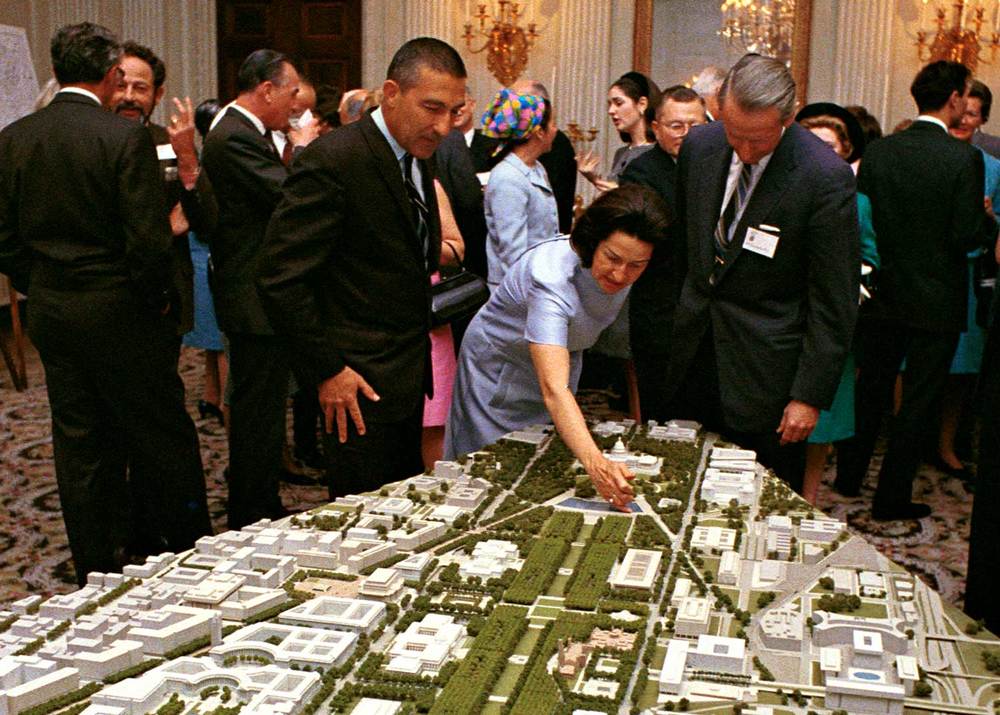

Foreground L-R: Sec. Stewart Udall, Lady Bird Johnson and Laurance Rockefeller look at an architectural model of the Washington, D.C. in 1967. LBJ Library photo by Robert Knudsen.

Lady Bird Johnson and Laurence Rockefeller study model of Washington D.C. circa 1967 courtesy http://www.ladybirdjohnson.org/biography/.


Since Earth Day falls in the month of April, I thought I would blog about Lady Bird Johnson's Beautification Project.  Mrs. Johnson first took on the role of First Lady in the 1960's at a time of urban renewal.  She pointed out that 75% of the American population lived on 1% of the land.  The nation's cities were not only crowded but also run down, particularly, Washington D.C., the nation's capital.  Lady Bird maintained that there should be a way for the natural and man-made components of the city could live in harmony.  She believed that the nation's physical beauty affected the nation's psyche.

Lady Bird started with a grassy triangle of land at the corner of 3rd and Independence Ave where she broke land and planted the first azalea in March of 1965.  The First Lady relied heavily on donations from private donors including $100,000 from the Rockefeller Foundation, 10,000 azaleas, 4,000 cherry trees along with dogwoods and daffodils.


Hains Point circa 1935 courtesy 


Lady Bird's goal was to create "functional, attractive surroundings", for a more beautiful Capital.  She took a cruise down the Potomac River to spot areas of concern.  Hains Point received attention as many cherry trees were planted there.  The First Lady took a ferry to Columbia Island, in the middle of the Potomac, for a daffodil bulb planting ceremony.  She hosted a planting at the White House for Arbor Day.


Lady Bird's efforts didn't just pertain to the flowers and trees, but also the buildings or lack thereof.  Farrell School was a drab, two story building with broken windows.  She championed an effort to get a playground for the children.  Buchanan School soon received a similar playground.

In an effort to attract more people to the downtown, the First Lady suggested that F Street be transformed into a shopping mall, one of two malls to be built.


Lady Bird focussed on Sherman Square, Farragut Square and Twining Square.  Trees were planted in Hobart Place Park and Lafayette Park.  She revitalized Pennsylvania Avenue and Rock Creek Parkway.


Washington Circle post beautification courtesy 


The First Lady was concerned about Washington's ghettos:  the urban decay, the graffiti, the garbage, the rats.  She enlisted youth to clean up the Shaw section of the capital which led to the formation of Project Pride, a group of Harvard University students and high school students to clean up other cities.

In May 1966 Lady Bird was front and centre at the White House Conference on Natural Beauty which encouraged conservation and anti litter campaigns.  Just before Lyndon Johnson left office, Columbia Island in the Potomac was renamed Lady Bird Johnson Island.  The First Lady's efforts, part of the "Keep America Beautiful" campaign, would bloom for years to come.


Lady Bird plants a cherry tree courtesy http://davesgarden.com/guides/articles/view/3473#b.

For more information, watch Showcase for the Nation:  The Beautification Project at https://www.youtube.com/watch?v=Cd2t2MsOMnc.


Friday, 22 July 2016

For a More Beautiful America

"Where flowers bloom so does hope." (Lady Bird Johnson)


Description: LB Johnson beautiful highways25

Yellow & blue wildflowers along a highway courtesy
http://about.usps.com/news/national-releases/2012/pr12_117.htm.


It was just over 50 years ago that the Lady Bird Bill was signed.  President Eisenhower had overseen the building of the Interstate Highway System.  Now, President Johnson, with his wife leading the effort, would oversee the beautification of those highways.

The Highway Beautification Act of 1965 called for the control of outdoor advertising, for the removal of junkyards along the highways and for "scenic enhancement and roadside development" (https://www.fhwa.dot.gov/infrastructure/beauty.cfm).


Description: LB Johnson beautiful parks25

Daffodils along the Potomac River courtesy 


Lady Bird concentrated not only on beautifying the nation's highways, but also cities.  Focusing on the Washington DC, which in the 1960's was in a dilapidated state, she hoped to set an example for other cities in the United States.  She believed that the state of America's cities was reflected in the state of the nation's minds.  In January 1965, Lady Bird wrote in her diary:

"Getting on the subject of beautification is like picking up a tangled skein of wool. All the threads are interwoven -- recreation and pollution and mental health, and the crime rate and rapid transit and highway beautification, and the war on poverty and parks -- national, state and local.  It is hard to stitch the conversation into one straight line, because everything leads to something else." (http://www.pbs.org/ladybird/shattereddreams/shattereddreams_report.html)


Description: LB Johnson more beautiful cities25

Pink & red azaleas and white tulips in front of the Capitol courtesy http://about.usps.com/news/national-releases/2012/pr12_117.htm.


The Beautification Act faced fierce opposition:  the billboard industry, which had sprung up under Eisenhower, would have no part of it.  The President and the First Lady, who made frequent road trips from their Texas ranch to Washington DC, had tired of the endless advertisements along America's highways.  

Lady Bird Johnson would not not give up the fight.  The First Lady was so involved in the beautification effort that Kansas Representative Robert Dole, who is still alive today, suggested an amendment to the bill which would replace the title "Secretary of Commerce" with Lady Bird, but lost by a voice vote.


Description: LB Johnson more beautiful america25

Cherry trees in blossom by the Jefferson Memorial courtesy
https://about.usps.com/news/national-releases/2012/pr12_141.htm


Robert Dole may have lost the battle, but Lady Bird won the war.  Her husband, who had just gotten out of the hospital for gall bladder surgery, signed the bill on October 22, 1965.  Commenting on his drive from Bethesda Naval Hospital to the White House along George Washington Memorial Parkway, he said:  

"I saw Nature at its purest.  The dogwoods had turned red.  The maple leaves were scarlet and gold.  And not one foot of it was marred by a single unsightly man-made obstruction -- no advertising signs, no junkyards.  Well, doctors could prescribe no better medicine for me."(http://www.pbs.org/ladybird/shattereddreams/shattereddreams_report.html)


Description: LB Johnson beautiful streets25

Rows of crab apple trees along a suburban road courtesy
http://about.usps.com/news/national-releases/2012/pr12_117.htm.


For more information, read A White House Diary by Lady Bird Johnson at https://www.amazon.ca/White-House-Diary-Lady-Johnson/dp/0292717490.


Lady Bird Johnson circq 1963 courtesy http://tti.tamu.edu/about/hall-of-honor/inductees/yr2012/


Monday, 11 July 2016

Washington's Cherry Blossoms


The roots of the cherry tree orchard that lines Washington's Tidal Basin at Potomac Park go back to American Eliza Scidmore.  She had visited Japan back in 1885 and suggested that Washington DC plant some cherry trees along the Tidal Basin, but her idea was rejected for 25 years straight.  Finally, Mrs. Scidmore raised the funds to donate the cherry trees herself, writing a letter to Mrs Taft in 1909 stating her intentions.  A visiting Japanese chemist named Jokichi Takamine happened to be visiting Washington DC and heard about Mrs. Scidmore's plan and offered to donate an extra 2000 trees in the name of the city of Tokyo.

The cherry trees arrived in January 1910, but they were infested with insects and subsequently were burned.  Not to be deterred, the city of Tokyo sent an addtional 3020 cherry trees, of a different variety, shipping them to Seattle on the Awa Maru and then by railcar to Washington DC.  On March 27, 1912, First Lady Helen Taft stood side by side with the wife of the Japanese Ambassador to plant two of these cherry trees in West Potomac Park.  From 1913 to 1920, 1800 of these donated trees were planted along Washington DC's Tidal Basin.  The remaining trees were planted in East Potomac Park.  In 1935 the first Cherry Blossom Festival was held.

Four days after the Japanese attack on Pearl Harbor in 1941, four of the cherry trees were chopped down by an unknown person, probably as a statement against the attack.  The Cherry Blossom Festival was suspended during World War II not to be resumed until 1947.  The city of Tokyo donated an additional 3800 cherry trees, of the Yoshimo variety in 1965 and Lady Bird Johnson planted one in a ceremony at the White House.

In 1915, as a sign of appreciation, the United States gave some flowering dogwood trees to Japan.  To celebrate the centennial of this gift, the U.S. Post Office issued the stamp "Gifts of Friendship".


Gifts of Friendship U.S. Stamp courtesy