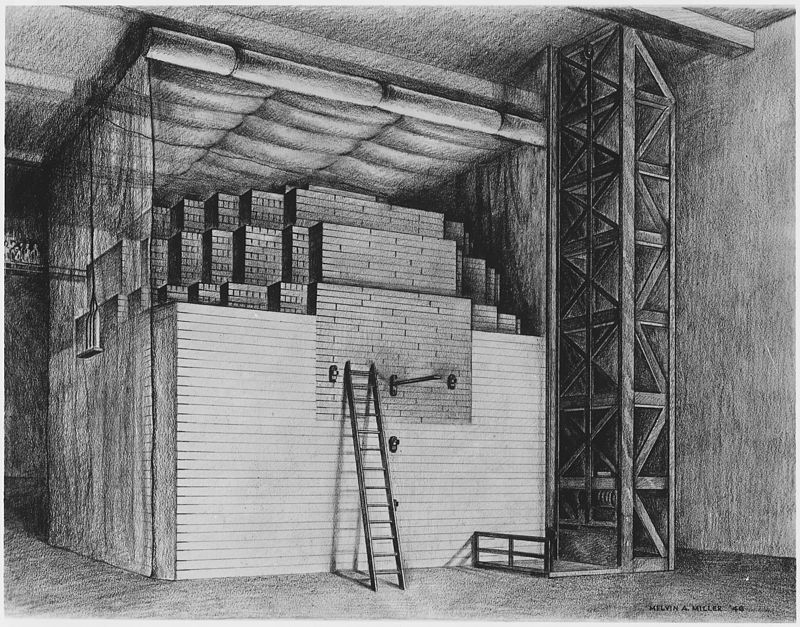
Drawing of Chicago Pile 1 circa 1942 courtesy https://en.wikipedia.org/wiki/Chicago_Pile-1#/media/File:Stagg_Field_reactor.jpg.
What do you get when you combine 45,000 graphite blocks, 6 short tons of uranium metal and 50 short tons of uranium oxide? A big reaction. In 1942, Enrico Fermi supervised the first man made, self sustaining nuclear chain reaction, describing the apparatus as "a crude pile of black bricks and wooden timbers." Chicago Pile 1 was the world's first nuclear reactor.
No stranger to success in the scientific field, Fermi had won the 1938 Nobel Prize in Physics for the discovery of nuclear reactions caused by slow neutrons. Fermi taught at the University of CHicago all the while contributing to the nuclear experiments, all part of the Manhattan Project which would produce the atomic bomb in 1945.
Enrico Fermi passed away in 1954, but other scientists, such as his manhattan Project colleague Robert Wilson, took up his cause. It was Wilson who made sure that Fermilab took on the name of his late colleague. Dedicated in 1974, Enrico's widow, Laura Fermi, who had fled Fascist Italy in 1939 with her husband, was present at the ceremony. Comparing particle accelerators to Egypt's pyramids Laura Fermi explained: "Both were tangible victories of men over the brute power of nature."
Note: For more information visit Einstein's Letter to FDR sparks Manhattan Project at http://alinefromlinda.blogspot.ca/2015/09/einsteins-letter-to-fdr-sparks.html.
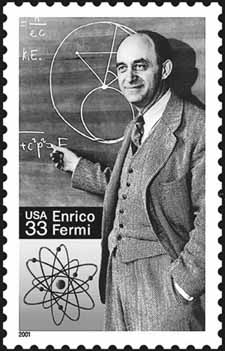
Enrico Fermi explains a model of the carbon atom circa 1948 on the 100th anniversary of Fermi's birth courtesy https://www.fnal.gov/pub/ferminews/ferminews01-02-02/p3.html.


