Sunday, 6 September 2015

Jackie Robinson Pens Protest Letter to Eisenhower

"I was sitting in the audience at the Summit Meeting of Negro leaders yesterday when you said we must have patience.  On hearing you say this, I felt like standing up and saying:  'Oh no!  Not again.'
I respectfully remind you sir that we have been the most patient of all people." (Jackie Robinson)


It was 1958 -- eleven years since the first black man officially played in the National Baseball League; four years since the ruling in Brown vs. Board of Education; three years since Rosa Parks refused to give up her seat on an Alabama bus; and one year since the National Guard escorted nine students to Little Rock High.  

Yet, America was still a long way from fulling integrating blacks into white society.  Jackie Robinson, who had integrated professional baseball, had just hung up his number 42 jersey.  He penned a letter to President Eisenhower indicating his frustration with the civil rights movement, which, after making giant strides, had seemed to stall.  

"I was sitting in the audience at the Summit meeting of negro leaders yesterday when you said we must have patience.  On hearing you say this, I felt like standing up and saying:  'Oh no!  Not again.' (www.archives.gov/exhibits/featured_documents/jackie_robinson_letter/).  I respectfully remind you sir that we have been the most patient of all people."  He pointed out that Negroes were striving to attain goals that Whites had already been granted over 150 years before.

"17 million Negroes cannot do as you suggest and wait for the hearts of men to change," implored Robinson.  In 1958, Negroes represented about 10 percent of the American population, a significant amount.  Robinson wanted actions, not words, for the Civil Rights Movement to move forward.  

Robinson saw President Eisenhower's attitude of forbearance as encouraging, not discouraging, the segregationists.  He reminded the President about Governor Faubus, who, the previous year, had blocked the school entry of the Little Rock Nine.  

The baseball legend drove his point home by stating:  "would let it be known that America is determined to provide -- in the near future -- for Negroes -- the freedoms we are entitled to under the Constitution."

Note:  For more information about Jackie Robinson, read "You Give Me the Number, I'll Give You the Guts!" at http://alinefromlinda.blogspot.ca/2013/04/april-15.html.


Jackie Robinson (right) meets Martin Luther King Jr. and other civil rights leaders circa 1950's courtesy http://iipdigital.usembassy.gov/st/english/publication/2009/01/20090106142542jmnamdeirf0.8552515.html#axzz3l0Ucr18M.


Saturday, 5 September 2015

When Helen Keller Confronted the Nazis

"History has taught you nothing if you think you can kill ideas.  Tyrants have tried to do that often before, and the ideas have risen up to their might and destroyed them." (Helen Keller)


In May of 1933, students gathered in Berlin and held a giant bonfire with some of the most influential books of the 20th century as tinder.  Authors like Albert Einstein, Sigmund Freud, Victor Hugo, Ernest Hemingway and Leo Tolstoy were all in the pile, as well as a book by Helen Keller.  

The latter, rendered deaf and blind by a childhood disease, attended the Perkins Institute and learned how to speak, read and write.  After graduating from Radcliffe College, Keller started to write books and take on political causes.  She joined the socialist Party in 1909.  During the Great War, she penned a book called How I Became a Socialist, donating the royalties from her book to soldiers rendered blind on the battlefield.

Mark Twain described Helen Keller as "one of the two most interesting characters of the nineteenth century" (https://www.questia.com/magazine/1G1-91659890/how-i-became-a-socialist).  It is appropriate that the other interesting character was Napoleon, a dictator.  It was another dictator, Hitler, whom Keller took exception to when she found out that her book was burned in Berlin in 1933.

The authoress took out her typewriter and pounded out a letter addressed to Adolf Hitler, Berlin, Germany (http://www.afb.org/blog/afb-blog/helen-kellers-words-80-years-later…-still-as-powerful/1)

"History has taught you nothing if you think you can kill ideas.  Tyrants have tried to do that often before, and the ideas have risen up to their might and destroyed them.  

You can burn my books and the books of the best minds in Europe, but the ideas in them have seeped through a million channels, and will continue to quicken other minds.  I gave all the rights to my books to the soldiers blinded in the world war with no thought in my heart but love and compassion.  

Do not imagine that your barbarities to the Jews are unknown.  God sleepeth not and He will visit his judgment upon you as surely as upon the wicked kings of Judea who defied His Word.  Better would it if you have a millstone hung around your neck and sink into the sea than to be hated and despised by all men." 

Helen Keller

It would take a little girl from Alabama, deafened and blinded by Scarlet Fever, to stand up to Adolf Hitler.  If only we all had such inner strength.


Helen Keller at Radcliffe College courtesy www.kellerfoundation.org.


Friday, 4 September 2015

The Cute Story Behind Abraham Lincoln's Whiskers

"I am a little girl only 11 years old, but want you to be President of the United States very much so I hope you won't think me very bold to write to such a great man as you are...I have yet got four brothers and part of them will vote for you any way and if you let your whiskers grow I will try and get the rest of them to vote for you..." (Grace Bedell) 


It's part of his trademark:  the full dark beard.  Yet, only a few months before he was elected, he was clean-shaven.  Why did Abraham Lincoln grow a beard?  It all started with a letter.

Eleven year old Grace Bedell was one of Abraham Lincoln's youngest fans.  Her father, a Republican, had visited the fair in Westfield, New York in the fall of 1860.  Upon returning home, he showed his young daughter two photographs, one of Lincoln and one of his running mate, Hamlin. Grace studied the photo of the former and decided to write a letter to the presidential hopeful, dated October 15, 1860:

"I am a little girl only 11 years old, but want you to be President of the United States very much so I hope you won't think me very bold to write to such a great man as you are...I have yet got four brothers and part of them will vote for you any way and if you let your whiskers grow I will try and get the rest of them to vote for you you would look a great deal better for your face is so thin." (https://en.wikipedia.org/wiki/Grace_Bedell)

Within four days, she received a response in which Lincoln suggested people might think it was a "silly affection" if he grew a beard.  Grace likely thought the matter was closed.

Lincoln was elected President of the United States the following month.  In February 1861, he boarded a train for his inaugural journey from Illinois to Washington D.C.  The train stopped in Westfield, New York where Lincoln requested a meeting with the little girl who had penned the letter.

"He climbed down with me on the edge of the station platform," she recalled.  'Gracie,' he said, 'look at my whiskers.  I have been growing them for you.'  Then he kissed me.  I never saw him again."


Statue of Lincoln & Bedell in Westfield, New York courtesy https://en.wikipedia.org/wiki/Grace_Bedell#/media/File:Lincoln_Bedell_statue.jpg


Thursday, 3 September 2015

Einstein's Letter to FDR Sparks the Manhattan Project

"In the course of the last four months, it has been made probable -- through the work of Joliet in France as well as Fermi and Szilard in America -- that it may be possible to set up a nuclear chain reaction in a large mass of uranium, by which vast amounts of power and large quantities of new radium like elements would be generated." (Albert Einstein)


It was the summer of 1939.  America seemed years away from war.  Its population was slowly coming out of the Depression and war was the last thing on its mind.  But war was brewing in Europe.  One European immigrant, with dishevelled white hair and a thick moustache, felt compelled to warn the President about a new invention, a possible weapon of war that was in the works.

Inventor Albert Einstein was lounging on his boat off of Long Island, when he was approached by fellow inventor Leo Szilard.  Szilard pleaded with Einstein to speak to government officials about the rising threat of an atomic bomb, given the recent discovery of uranium fission six months before.  Szilard had discussion the possibility of atomic energy with Alex Sachs, an unofficial adviser to President Franklin D. Roosevelt who suggested that he draft a letter to the President.

While Einstein was a life long pacifist, he agreed to help Szilard, wanting to keep such a weapon out of the hands of Nazi Germany.  Szilard wrote a four-page draft which he had Einstein proofread.  In turn, Einstein wrote a two page letter in German, which he had Szilard translate into English.  It was the second letter which Sachs delivered personally to Roosevelt on August 2, 1939.  

In the meantime, the storm clouds of war opened up over Europe that September.  Back in America that October, Sachs was given a private audience with the President.  America was still very much isolationist and had no interest in entering the Second World War.  However, Roosevelt did agree to form the Uranium Committee which was given $6,000 to research atomic energy, a drop in the bucket.  Roosevelt and his followers remained skeptical until December 6, 1941, the day before Pearl Harbor was bombed when an official atomic energy committee was set up.  It became the Manhattan Project in 1942.  

The atomic bomb, of course, was dropped on August 6, 1945 on Hiroshima, Japan, six years almost to the day after Einstein first sent his letter to President Roosevelt.  Nazi Germany never did get the atomic bomb.  Many of its great scientists, like Einstein, immigrated to America, some of whom helped with the Manhattan Project.  

Note:  For a copy of the letter, visit https://www.pinterest.com/pin/233483561906617124/.


einstein and roosevelt


Wednesday, 2 September 2015

Vernher Von Braun Writes Letter to Rocket Boy

"The first time I every saw Verhner Von Braun was on a black and white television set in my living room in Coalwood, West Virginia, the mining town where I was raised.  He was on the Disneyland show and he was talking with Walt Disney about the possibility of rockets going into space." 
(Homer Hickam Jr.)


It was in 1957 that "Rocket Boy" Homer Hickam first saw the satellite Sputnik arc across the ink- stained October sky, a sight that led to the dream of going to the moon.  But Homer's dream would not be realized as easily as he thought.  His father, the head miner in the town of Coalwood, Virginia, thought that his son should spend his time in the mine shaft, not building rockets that blew up his wife's rose garden fence.  Homer Hickam Sr. was not alone:  most of Coalwood thought the same way http://blog.al.com/huntsville-times-business/2012/03/homer_hickam_wernher_von_braun.html.

It would take a fellow dreamer to launch Homer's dream.  The Rocket Boy's mother spent her spare time painting a mural of Myrtle Beach on their kitchen wall, hoping to trade the black dust of Coalwood for the sea spray of the Atlantic.  When she discovered that her youngest son, Homer, wanted to build rockets for a living, she wrote a letter to his hero, Vernher Von Braun.  

Homer was shocked when he received a letter from the German rocket scientist.  Included with the letter was a photograph autographed by Von Braun.  It was all the inspiration that Homer needed. With the image of the photograph in his head, and the encouragement of his teacher Miss Riley, Homer made a rocket for the state science fair and won.  He brought the same rocket to the national science fair -- and captured first prize again.  

The same boy who blew up his mother's rose garden fence would go on to put a man on the moon only 12 years later as part of the NASA space program.  Hickam just missed meeting his hero, Von Braun, at the national science fair.  The rocket scientist did see Homer's rockets on display and reportedly said that they were "some of the best rockets he'd seen this side of Cape Canaveral".  

For more information:

1.  Read my post  http://alinefromlinda.blogspot.ca/2011/10/october-sky.html.
2.  Watch the movie October Sky (1999).
3.  Read Rocket Boys (1998) by Homer Hickam.


Vernher Von Braun talking to Walt Disney about launching rockets into space on the "Man in Space" episode circa 1950's courtesy http://familypedia.wikia.com/wiki/Wernher_von_Braun_(1912-1977).


Tuesday, 1 September 2015

"J'Accuse"

In high school history class, my teacher taught us about a famous letter "J'Accuse" written by Emile Zola for the French paper L'Aurore, dated January 13, 1898.  There was something about a crumpled up piece of paper in a garbage can used as evidence to convict Alfred Dreyfus of treason against the French government.  Zola accused the government of framing Dreyfus simply because he was Jewish.  The real traitor, Ferdinand Esterhazy was later tried and acquitted.  Dreyfus was exiled to Elba where he wasted away.  Thanks to Zola's letter, pressure was mounted against the French government and Dreyfus was eventually released.  However, the damage was done; Dreyfus died shortly thereafter.  The event became known as "L'Affaire Dreyfus" and the term "J'Accuse" has since been used to denote outrage.

Here is an excerpt from J'Accuse:

"Here, then Mr. President, are the facts which explain how a miscarriage of justice could be made; and the moral evidence, the financial circumstances of Dreyfus, the absence of reason, his continual cry of innocence, completes its demonstration as a victim of the extraordinary imaginations of Commander du Paty de Clam, of the clerical medium in which it was found, of the hunting for the "dirty Jews", which dishonours our time."


Monday, 31 August 2015

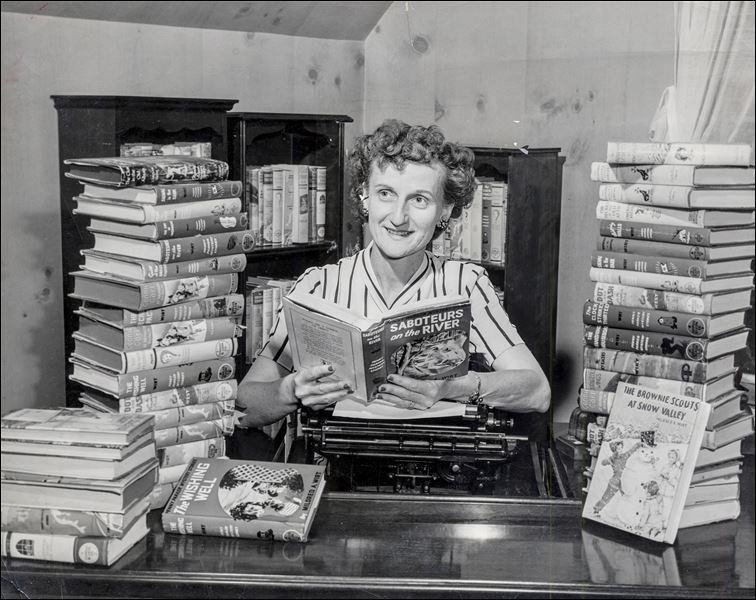
Nancy Drew Stories Written by Toledo Reporter

"I sort of liked the character from the beginning.  Now, that kind of woman is common, but [back] then it was a new concept, though not to me.  I just naturally thought that girls could do things boys did." (Mildred Augustine Wirt Bentley)


Her Underwood typewriter sits in the Smithsonian Institution, the one that typed 135 children's stories, including 23 of the first 25 Nancy Drew mysteries.  Her name is Mildred Augustine Wirt Bentley, the real Nancy Drew.

Born in 1905, Mildred attended the University of Iowa, the university's first woman to graduate with a Masters in Journalism.  Mildred liked to do things that other women didn't even think of at the time:  she explored Central American archeological sites in a dugout canoe.  She took flying lessons at the ripe old age of 59.  And she wrote for a newspaper, largely a man's profession at the time.  In the testosterone and smoke filled newsroom of the Toledo Times, she pounded out stories about the courts and city hall (http://www.post-gazette.com/life/my-generation/2007/06/18/Holy-Toledo-The-real-Nancy-Drew-was-an-Ohio-reporter/stories/200706180150).

In 1929, Mildred was approached by a book syndicator with a plot line and character sketch, to create a sleuth.  Under the pen name Carolyn Keene, she created Nancy Drew, a strawberry blonde who drove around in her convertible and solved mysteries.  Nancy Drew was no cheer leader:  she liked to do things more typical of a man. She was not easily scared or deterred, just like her real life counterpart.  Mildred's favourite story was The Hidden Staircase, the second in the series.

Although Mildred carved out the character of Nancy Drew, and wrote a large portion of the series, she was never paid more than $500 per book.  No one will every forget the famous sleuth who solved mysteries.  She passed away from lung cancer in 2002, perhaps the result of all those years in the smoke filled newsroom.