Showing posts with label Helen Keller. Show all posts

Wednesday, 13 July 2016

The Appalachian Exposition

"Set in the idyllic foothills of the Applachian Mountains the fair site combined easy road access with picturesque lakefront villas where 'one could rest and read the bulletins'." (http://trace.tennessee.edu/cgi/viewcontent.cgi?article=3875&context=utk_gradthes)


Philadelphia held the Centennial International Exhibition in 1876.  Chicago had the World's Fair, a resounding success, in 1893.  Buffalo held the Pan American Exposition in 1901, also a triumph.  In an effort to dispel the myth that Southerners were "unprogressive and backwards", Knoxville, Tennessee invited the world to the Applachian Exhibition in 1913 (http://www.easttnhistory.org/exhibits/first-fair-its-kind).

 The opening ceremonies included a speech by President Woodrow Wilson.  Over 33,000 guests came through the fair gates on opening day.  Famous visitors on subsequent days included Helen Keller, William Jennings Bryan and Booker T. Washington.  


The fair was was to be the salvation of the South:  it preached "economic prosperity and cultural enrichment".  It was in Knoxville that beautiful art, music and literature were shared with the fair guests, along with natural treasures collected from mines, fields and forests in the area.  Local painters Lloyd Branson, Adelia Armstrong Lutz and Charles Krutch exhibited their pieces. 

Conservation exhibits were an important part of the fair.  Several citizens involved with these exhibits were later instrumental in creating the Great Smoky Mountains National Park.

Buildings featured at the Exhibition included:

  • Child Welfare Building
  • East Tennessee Building
  • Land Building
  • Machinery & Liberal Arts Building
  • Southern States Building
  • Negro Building
  • Fine Art Building
  • Coal Building
Entertainment at the fair included a mock coal mine explosion, moving pictures and a Herd of Trained Elephants.  Lizzie Crozier French (pro) and Annie Riley Hale (anti) held a debate on Women's Suffrage.  


The U.S. Post Office issued a stamp to commemorate the Appalachian Exhibition courtesy http://www.usphila.com/us/stamp/price/scott-375-page-1.

Saturday, 5 September 2015

When Helen Keller Confronted the Nazis

"History has taught you nothing if you think you can kill ideas.  Tyrants have tried to do that often before, and the ideas have risen up to their might and destroyed them." (Helen Keller)


In May of 1933, students gathered in Berlin and held a giant bonfire with some of the most influential books of the 20th century as tinder.  Authors like Albert Einstein, Sigmund Freud, Victor Hugo, Ernest Hemingway and Leo Tolstoy were all in the pile, as well as a book by Helen Keller.  

The latter, rendered deaf and blind by a childhood disease, attended the Perkins Institute and learned how to speak, read and write.  After graduating from Radcliffe College, Keller started to write books and take on political causes.  She joined the socialist Party in 1909.  During the Great War, she penned a book called How I Became a Socialist, donating the royalties from her book to soldiers rendered blind on the battlefield.

Mark Twain described Helen Keller as "one of the two most interesting characters of the nineteenth century" (https://www.questia.com/magazine/1G1-91659890/how-i-became-a-socialist).  It is appropriate that the other interesting character was Napoleon, a dictator.  It was another dictator, Hitler, whom Keller took exception to when she found out that her book was burned in Berlin in 1933.

The authoress took out her typewriter and pounded out a letter addressed to Adolf Hitler, Berlin, Germany (http://www.afb.org/blog/afb-blog/helen-kellers-words-80-years-later…-still-as-powerful/1)

"History has taught you nothing if you think you can kill ideas.  Tyrants have tried to do that often before, and the ideas have risen up to their might and destroyed them.  

You can burn my books and the books of the best minds in Europe, but the ideas in them have seeped through a million channels, and will continue to quicken other minds.  I gave all the rights to my books to the soldiers blinded in the world war with no thought in my heart but love and compassion.  

Do not imagine that your barbarities to the Jews are unknown.  God sleepeth not and He will visit his judgment upon you as surely as upon the wicked kings of Judea who defied His Word.  Better would it if you have a millstone hung around your neck and sink into the sea than to be hated and despised by all men." 

Helen Keller

It would take a little girl from Alabama, deafened and blinded by Scarlet Fever, to stand up to Adolf Hitler.  If only we all had such inner strength.


Helen Keller at Radcliffe College courtesy www.kellerfoundation.org.


Monday, 13 July 2015

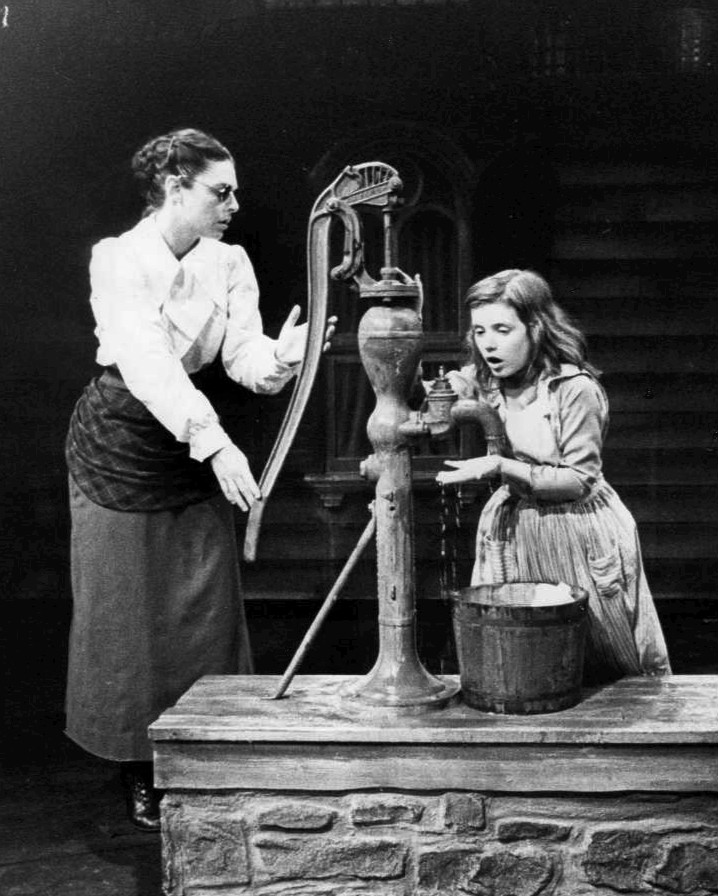
William Gibson's "The Miracle Worker"

"As Helen, little Miss Duke is altogether superb, a plain, sullen, explosive, miniature monster whose destructive behavior makes sympathy for her afflictions impossible, but whose independence and vitality are nevertheless admirable." (New York Times review of The Miracle Worker at http://graphics8.nytimes.com/packages/pdf/theater/Miracle-Worker.pdf)


On October 19, 1959, William Gibson's play The Miracle Worker premiered at the Playhouse Theatre on Broadway.  Based on The Story of My Life, by Helen Keller, the play ran for almost two years, closing on July 1, 1961.

Tuscumbia, Alabama native Helen Keller went deaf and blind at 18 months of age when she was afflicted with Scarlet Fever.  Her parents felt such pity for her that they overindulged her and by six years old, she was a "wild, angry, tantrum-throwing" little girl en.wikipedia.org/wiki/The_Miracle_Worker_(play).

Desperate to get their little girl back, the Keller's called on the Perkins Institute to help their child.  Alexander Graham Bell, who worked with the deaf, recommended a woman named Annie Sullivan.  Miss Sullivan agreed to work with Helen and, thanks to her consistency and perseverance, performed a "miracle" in the life of little Helen, teaching her how to communicate.

Helen Keller's autobiography, The Story of My Life, was based on her years with her beloved teacher.  She dedicated it to Alexander Graham Bell.  For more information on the relationship between the two, read my post http://alinefromlinda.blogspot.ca/2013/08/helen-annie-alec.html.

The Broadway play starred Anne Bancroft as Anne Sullivan, Patty Duke as Helen Keller, Torin Thatcher as Captain Keller and Patricia Neal as Kate Keller.  The production won five Tony Awards and ran for 719 performances.  The movie version, which premiered in 1962, starred much of the same cast.