Showing posts with label New York. Show all posts

Friday, 23 September 2016

Welsh Immigrant Randall Peat

"God gave me every inch of the United States of America to live in.  And I have lived here now eighty two years.  I wouldn't want to live no place else." (Randall Peat)


Postcard of Colwyn Bay where wealthy English tourists used to vacation circa 1900 courtesy http://www.simplonpc.co.uk/Wales-Piers.html


Born and raised in Colwyn Bay, Wales on the Irish Sea, Randall Peat was the son of a miner.  When he was only one year old, his father was crushed to death in an avalanche of limestones in the mine. His mother became a live in maid at one of the mansions in town.  Little Randall was raised by his grandparents. His grandfather worked on a farm where he raised cows, pigs and horses and grew barley and wheat.  "[He] didn't live to make money; [he] lived to exist."

Randall's grandfather rented the land at one English pound per acre.  The area in which he lived had originally been owned by the farmers; however, the British government later took it and gave it to the wealthy who in turn rented it out to the same farmers.  Surprisingly, no bitterness existed between the tenants and the landowners according to Randall.  The latter knew that they depended on the former for a livelihood.  "That's why I'm in the United States...'with Liberty and justice for all,' explained Randall, referring to Britain's class system.

  
Randall worked on the farm sowing seeds by hand and pulling a team of horses to bury the seed.  Often, he and his siblings would eat bread crusts doused in pig's fat for flavour or an egg with tea for supper.  Randall would wear his brother's hand me down shirts which his grandmother patched up  At school, Welsh was forbidden; only English was spoken.  If you misspelled a word, you were flogged with a big stick.  "Despite this, we only had one one to live and that was happy."

To Randall, three things were important;  home, work and church.  The English only recognized one church, the Episcopalian or Anglican Church.  The Welsh in the area belonged to the Baptist church which was taxed heavily by the English.  "The practice of it was very hushed up, secretive."  Marriages in the Baptist church were not recognized by the English.  

It was at church that Randall first got the idea to immigrate to America.  He met a teenage boy who had just returned from New York where he had earned good money as a stable hand.  With only twenty pounds to his name, Randall didn't think he had enough money for his passage but the other boy said yes.  He recommended second rather than third class (steerage) ticket so that at Ellis Island, they would be questioned on board the ship rather than in the immigration station.  "It's worth the extra five pounds," he explained.

In 1914, Randall and his new friend, Dave, took a train from Colwyn Bay to Liverpool where they boarded the S.S. Baltic.  They were joined by immigrants from Czechoslovakia, Yugoslavia, Ethiopia, Egypt and Germany.  Overcome by seasickness, Randall just wanted to jump into the water.  Dave recommended a dose of whisky which seemed to do the trick.  At Ellis Island, officials boarded the ship and inquired if Randall and Dave had money in their pockets once they reached the mainland:  "You're not going to live on no relief."

Randall and Dave arrived in New York City where they took the Delaware and Lackawanna Railroad to Utica, New York.  Randall rode in an automobile for the first time when Dave's uncle picked them up at the train station.  Randall was hired immediately to work at Borden's Condensery in Waterville where he shovelled coal.  Later he was promoted to the milk plant where he capped bottles.

Randall's boss gave him Sunday off so he could attend church, informing him about a Welsh congregation nearby.  When Randall arrived at the church, a friendly man introduced himself.  The minister was absent that Sunday and before Randall knew it, he was up at the front leading the congregation in a hymn.  Urged to continue, he read a chapter of Pilgrim's Progress to the congregation in Welsh.  Afterwards, people rushed up to shake his hand.  

A young girl from Colwyn Bay followed Randall to America.  Within six months they were married. They had a daughter and lived together for sixty two years.  To this day, Randall gets called upon to deliver a sermon once in a while.  He often recites the 23rd Psalm at funerals.  "The Lord is my shepherd I shall not want..."


Monday, 19 October 2015

George Eastman: Camera Magnate was Methodical Self-Educator

"The progress of the world depends almost entirely upon education.  I selected a limited number of recipients because I wanted to cover certain kinds of education and I felt that I could get results with those named quicker and more directly than if the money were spread." (George Eastman)


Millionaire businessman George Eastman was not born with a silver spoon in his mouth.  He lost his father at 7 and was forced to become the man of the household.  His adversity, however, seemed to drive him forward.  He amassed a fortune with the Eastman Kodak Company, which rather than spending on himself, he chose to invest in education.

George Eastman's parents were both born and raised in abolitionist households.  They believed in the importance of education.  Eastman's father founded a college which would serve as a prototype for America's first business schools.  Tragedy struck when he died, leaving his seven year old son to be the head of the household.  George's mother took in boarders, but he felt badly that she had to cook and clean for these strangers.  Tragedy struck again when George's sister fell ill with polio and died at 16.  

At 13, George quit school to start making money to support his family.  He worked both as a messenger boy and as an insurance salesman.  Following in his father's footsteps, he took a job at a bank where he would work all day, six days a week.  Evenings he spent tinkering with his new purchase, a camera.  George would work well into the night, experimenting with photo emulsions.  He would take catnaps, waking himself at regular intervals to stir the emulsions.  George was constantly trying to educate himself.  

George opened a camera and photography supply business which dominated the market by the turn of the last century.  He amassed a fortune which simply sat in a bank account, accumulating pennies for interest.  George decided to donate his money to the cause of education.  He built one of the best music schools in the world, the Eastman School of Music in Rochester, New York.  He donated upwards of $20 million to the Massachusetts Institute of Technology and more than $50 million to the University of Rochester.  And in keeping with his abolitionist roots, he supported the cause of black education, donating to the Tuskegee Institute and Hampton Institute.  These donations were often done anonymously as George was not one for self-aggrandizement. 


Eastman relaxing in his library courtesy http://www.kodak.com/ek/US/en/George_Eastman.htm.

Thursday, 10 September 2015

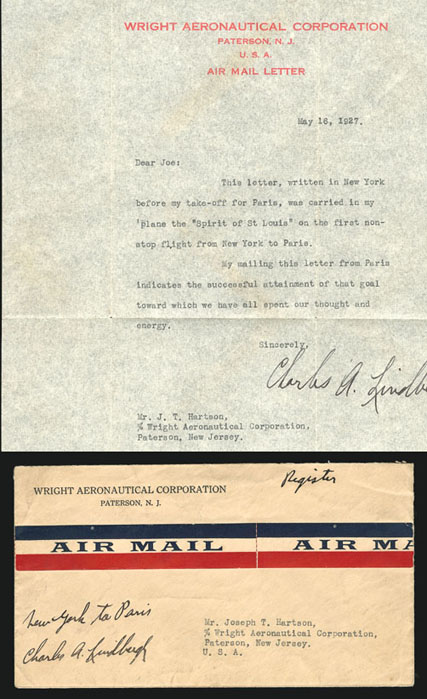
Lindbergh Delivers First Air Mail Across Atlantic

He was a barnstormer, delivering mail from town to town, across the state.  No one, other than those in aviation circles, had ever heard of him.  That was all about to change.

In May of 1927, Charles Lindbergh had a special destination for his plane, the Spirit of St. Louis:  Paris, France.  But on this trip he would not carry a mail sac the size of Santa's; he had to keep his weight limit down.  He was about to make the first flight across the Atlantic Ocean.

Lindbergh drafted a letter to the Wright Aeronautical Corporation in Paterson, New Jersey.

"This letter, written in New York before my takeoff for Paris, war carried in my plane, the Spirit of St. Louis, on the first nonstop flight from New York to Paris.  My mailing this letter from Paris indicates the successful attainment of that goal toward which we have all spent our thought and energy."
http://www.charleslindbergh.com/images/365.jpg

While it may have been sprayed with salt water, while it might have had crumbs on it from the sandwiches Lindbergh ate en route, the letter made it to its destination.  And Lindbergh made history.

Today, the Spirit of St Louis sits in the Smithsonian Institute in Washington DC.  The letter was put up for auction in 2002.  For more information about Charles Lindbergh's famous flight, visit http://alinefromlinda.blogspot.ca/2011/05/3-sandwiches-2-canteens-of-water-451.html.


Friday, 4 September 2015

The Cute Story Behind Abraham Lincoln's Whiskers

"I am a little girl only 11 years old, but want you to be President of the United States very much so I hope you won't think me very bold to write to such a great man as you are...I have yet got four brothers and part of them will vote for you any way and if you let your whiskers grow I will try and get the rest of them to vote for you..." (Grace Bedell) 


It's part of his trademark:  the full dark beard.  Yet, only a few months before he was elected, he was clean-shaven.  Why did Abraham Lincoln grow a beard?  It all started with a letter.

Eleven year old Grace Bedell was one of Abraham Lincoln's youngest fans.  Her father, a Republican, had visited the fair in Westfield, New York in the fall of 1860.  Upon returning home, he showed his young daughter two photographs, one of Lincoln and one of his running mate, Hamlin. Grace studied the photo of the former and decided to write a letter to the presidential hopeful, dated October 15, 1860:

"I am a little girl only 11 years old, but want you to be President of the United States very much so I hope you won't think me very bold to write to such a great man as you are...I have yet got four brothers and part of them will vote for you any way and if you let your whiskers grow I will try and get the rest of them to vote for you you would look a great deal better for your face is so thin." (https://en.wikipedia.org/wiki/Grace_Bedell)

Within four days, she received a response in which Lincoln suggested people might think it was a "silly affection" if he grew a beard.  Grace likely thought the matter was closed.

Lincoln was elected President of the United States the following month.  In February 1861, he boarded a train for his inaugural journey from Illinois to Washington D.C.  The train stopped in Westfield, New York where Lincoln requested a meeting with the little girl who had penned the letter.

"He climbed down with me on the edge of the station platform," she recalled.  'Gracie,' he said, 'look at my whiskers.  I have been growing them for you.'  Then he kissed me.  I never saw him again."


Statue of Lincoln & Bedell in Westfield, New York courtesy https://en.wikipedia.org/wiki/Grace_Bedell#/media/File:Lincoln_Bedell_statue.jpg


Wednesday, 29 October 2014

The Boston Tea Party

Here are ten facts you may not know about the Boston Tea Party.

1.  On December 16, 1773, dozens of Colonists boarded three ships and threw 342 crates of tea overboard into the Boston Harbor in an act of political protest.

2.  The Tea Act of 1773 left the three pence per pound duty on tea.  It irked the Colonists that they had no say in creating the Act.

3.  The Tea Act was really an attempt to bail out the fledgling East India Tea Company and gave them a monopoly on the tea market.

4.  George Washington condemned the Boston Tea Party and thought the perpetrators should compensate the East India Tea Company for damages.

5.  For decades, the identity of the Boston Tea Party participants was shrouded in secrecy.

6.  The event was not called the Boston Tea Party until a newspaper account of 1826.  Until then, it was referred to as "the destruction of the tea".

7.  Three months later, there was a sequel to the Boston Tea Party; however, this time only 30 crates of tea were thrown overboard.

8.  Subsequent tea parties were held in New York, Annapolis and Charleston, South Carolina.

9.  It is estimated that the perpetrators poured 92,000 pounds of tea overboard, enough to fill 18.5 million tea bags.  The present day value of the destroyed tea is $1 million.

10.  One man, John Crane, was knocked unconscious by a falling crate of tea.  Thought to be dead, he was hidden by his fellow saboteurs and woke up hours later.


Boston Tea Party courtesy