Tuesday, 14 October 2014

Murdoch Mysteries


A man murdered at a dinner at Toronto's Queen's Hotel.  A woman found floating in Toronto Harbour.  A brawl between dockworkers and the Toronto Constabulary.  A protest staged by new suffragettes at Queen's Park.

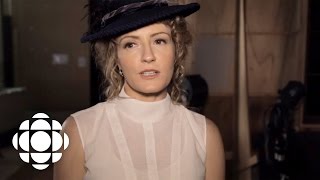
Today I watched my first episode of Murdoch Mysteries.  I wondered why I didn't start watching it in Season 1 rather than Season 8.  While I usually don't like murder shows, Murdoch focuses more on the mystery.  It is chock full of Canadian history.  Set at the turn of the last century, the Canadian TV series is based on a police detective named William Murdoch who solves crimes in Toronto.  He is engaged to a female doctor, surely one of the province's first, named Julia Ogden.  He is straitlaced and proper, indicative of Victorian times.  Crossing himself when he finds a dead body, Murdoch is a staunch Roman Catholic, something that might preclude him from a top position in the Toronto Constabulary, which is full of Protestants.  

Murdoch's Canada is still a young country, not divided the way the country is today.  You couldn't find British Columbia or Newfoundland on Murdoch's map, but you could find Assiniboine and Athabasca.  It is still very British, the Union Jack flying outside its public institutions.  Murdoch's Canada still enjoys an innocence; it hasn't participated in the First World War.  At the same time, the gang activity down by the Toronto docks shows the dark side of its second biggest city.

I was pleased to discover that much of the Murdoch Mysteries episodes I watched, "On the Waterfront:  Parts I & II", were filmed in my hometown of Hamilton.  The directors found an old warehouse on Sherman Avenue North which served as the sight for much of the drama.  Queen's Park in Toronto, of course, served as a location for the suffragettes' protest.  The old stone building remains much the same as it did in 1893 when it was built.

I am excited about watching more episodes of Murdoch Mysteries.  The 100th episode, due to be aired on October 27, will include a short scene with my friend Marlena Kaesler.  I am grateful to her for letting me know about her guest appearance.  Otherwise, I might never have discovered how interesting the show is.  So, tune in Mondays at 8 pm on CBC.


Monday, 13 October 2014

Ten Things You Didn't Know About Thanksgiving

1.  Algonquian Indians were among the first to harvest wild cranberries.  They used them as food, medicine and a symbol of peace.

2.  Although pumpkin pies are a staple of North American Thanksgivings, they did not become popular until the early 19th Century.

3.  Oktoberfest, which is celebrated in Kitchener, Ontario, originated in Germany in 1810 after King Ludwig I married Therese.

4.  Canadians purchased 3 million turkeys in 2011 which accounts for 32% of yearly sales.

5.  Thanksgiving is a statutory holiday in most Canadian provinces with the exception of Newfoundland, Nova Scotia, New Brunswick and P.E.I.

6.  Martin Frobisher held the first Canadian Thanksgiving in 1578 to celebrate his safe arrival to the new land.

7.  In 1953, Swanson, after overestimating the need for Thanksgiving dinner, had 260 tons of frozen turkeys to get rid of.  They ordered 5000 aluminum plates with separated sections and filled them with turkey, cornbread dressing, sweet potatoes and peas, creating the first TV dinners.

8.  Only about half of the 102 people aboard the Mayflower that sailed to America in 1620 were actually Pilgrims.  The other half were "Strangers", simply people wanting to come to the New World.

9.  The average weight of turkeys purchased for Thanksgiving dinner is 15 pounds.  Turkeys will have 3500 feathers at maturity.

10.  The first Thanksgiving, celebrated by the Pilgrims at Plymouth, Massachusetts, lasted three days.


http://www.centralpark.com/news/636/start-making-your-thanksgiving-day-parade-plans-with-jw-marriott-essex-house


Sunday, 12 October 2014

Thanksgiving Blessings

Thanksgiving Sunday dawned sunny and warm, not a cloud in the sky, not a whisper of wind in the air.  Rob, Thomas, Jacqueline and I piled into the van to go to church.  Rob and Thomas sat in the sanctuary for the service while Jacqueline and I taught Sunday school.  We met our class of Senior Kindergarten students for the first time.  Their cute faces, their Sunday dresses, their legs dangling from the chairs, were a welcome sight.  Jacqueline was thrilled that her reading buddy from school was in the class.  So was her reading buddy!  We sang "The B-I-B-L-E" a song that I learned in Sunday School 40 years ago.  I read a story about Adam, Eve and the Garden of Eden.  Jacqueline drew a picture of a pink and green snake on the board, much appreciated by a teacher lacking artistic talent.  The kids stared at it with wide eyes.  Afterwards, Jacqueline collected the books, Rob stacked the chairs and we rushed home to prepare the Thanksgiving dinner.

Jacqueline set the dining room table with my Royal Doulton china plates, most of which were wedding gifts.  She placed a Thanksgiving serviette on each plate.  I set out the crystal glasses, also wedding gifts, above each plate.  To complement the chrysanthemum flowers in a black vase which served as a centerpiece, Jacqueline added two cinnamon candles.

I stuffed the Butterball turkey and placed it in my new roasting pan.  The old one was really meant for a roast, not a turkey.  I put the sour cream mashed potato casserole in the microwave to warm up. Julie tossed her Seven Layer Salad, always a hit in our family.  I unthawed Laurie's turnip and carrots along with her homemade turkey gravy.

As the turkey roasted to a golden brown, its smell wafting through the house, I thought I could escape from the kitchen for a few minutes.  I went outside in the backyard to watch Rob and Bill play soccer with Thomas and Jacqueline.  I soaked in the sun which bathed the patio in warmth.  Once again, we were enjoying an Indian summer for Thanksgiving.  My reverie was interrupted by sudden shouts from Rob who had scored or missed a shot.

Inside the house, my nephews Bo and Mason played with the 40 year old Fischer Price toys.  Bo chose everyone's favourite, the castle, dropping the men down the trap door.  The adults sat upstairs in the living room chatting.

Finally, we sat down to eat the Thanksgiving feast.  We said a prayer, each thanking God for one of our blessings.  Just when we thought we couldn't eat another bite, I brought out the apple pie and pumpkin pie dessert topped off with spoonfuls of whipped cream.  The food was tasty, the company pleasant, the weather gorgeous.  May the peace of Thanksgiving be in everyone's heart today and always!


Saturday, 11 October 2014

The Lancaster Bomber: The Heart of the Museum

What a beautiful day for a wedding!  Rob and I were invited to his cousin Peter's daughter's wedding in Dundas at a beautiful old church with stain glass windows and ornate archways.  The wedding couple, Crystal and A.J., held their reception in a unique place:  the Canadian Warplane Heritage Museum.  The guest of honour was Vera.  Vera is not a person, but a plane, one of two airworthy Lancaster bombers left in the world.  Here is her story.


Victory Aircraft Ltd where the Avro Lancaster was built courtesy www.bombercommandmuseum.ca


VeRA, named after her call letters V-RA, was one of hundreds of Lancasters built in Canada. Made of 55,000 separate parts, she was designed and built by AVRO in Malton, Ontario.  The four engine Lancaster had been "the best night bomber of the Second World War" according to a Luftwaffe commander.  In 156,000 sorties. the Lancaster dropped two-thirds of the bombs on Europe during World War II.  In fact, my father in law, Albert Jonasson, remembers hiding in his basement in Germany as the Lancasters zoomed overhead on their way to bomb Hamburg.  The Lancaster was nicknamed "The Workhorse" of D-Day in 1944.  Therefore, the Royal Air Force was intending to fly Lancasters, including VeRA, in the proposed invasion of Japan, named Operation Tiger Force, in 1945.


A Lancaster bomber over Hamburg, Germany courtesy
http://ww2db.com/image.php?image_id=3232.


However, after the atom bomb was dropped on Japan, the country surrendered and the Lancaster was no longer needed for combat. Instead,  What happened to the other Lancasters?  Three thousand two hundred and forty nine of the bombers were lost during the Second World War.  Many of those that survived were sold to Canadian farmers for a few hundred dollars.  Still others were used to train air force crews and for search and rescue missions.  VeRA fell into the latter category.


Lancaster bombers over England circa 1944 courtesy media.winnipegfreepress.com.


For fourteen years, VeRA had no purpose.  Then, in 1977, she was purchased for $10,000 by the Canadian Warplane Museum in Hamilton, Ontario.  My husband's cousin, Peter Jonasson, who used to put together model airplanes as a kid, and whose father fought in the Second World War, found out about the purchase of the Lancaster bomber.  He introduced himself to the crew that intended to restore the airplane.  They loved his enthusiasm and appreciated his knowledge of wiring, and welcomed him aboard to help with Vera's restoration.

In 1988, the bomber was fully restored and ready to fly.  Some people expected about 200 specatators on the day of its first flight.  Instead, 20,000 spectators, including Peter Jonasson, lined the runway at Hamilton Airport the day that if first flew after 25 years of sitting on the tarmac.  VeRA took its place in the Warplane Heritage Museum, "the heart of the museum".  She was mounted as a World War II memorial outside the Canadian Legion in Goderich.


Lancaster bomber at Canadian Warplane Heritage Museum courtesy upload.wikimedia.org.


Today, VeRA remains only one of two airworthy Lancaster bombers in the world.  This past summer, VeRA was reunited with the other Lancaster for a seven week airshow in Britain.  She came home, just in time for Peter's daughter's wedding to take her place behind the head table.  Congratulations, Crystal and A.J.!  May your marriage be as strong and as enduring as the Lancaster bomber!


Friday, 10 October 2014

Nukel, Lachen & Washlappen

My husband Rob, the son of German immigrants, spoke only German until he attended school at 5 years of age.  He also attended German school every Saturday morning until he was in Grade 7. Although his parents have long since learned English and he no longer speaks German on any consistent basis, he has retained much of the vocabulary.  Occasionally a German words slips past his lips, words that the rest of us have adopted.

When Thomas and Jacqueline were babies they sucked on a "nukel".  While the official German word for a soother is "schnuller", "nukel" is the company that makes soothers.  It is the equivalent of English speaking North Americans using the term Kleenex rather than tissue.

When we go to the beach at Long Point, we wear "lachen".  We can never find "lachen" big enough for Rob's feet, though, so he usually wears a pair that are one size too small.  

When we wash the dishes, we use a "washlappen".  In my house, we called it a J-cloth, but the term "washlappen" sounds so much more fun.  The "washlappen" literally laps up the water.

When someone seems to thrive on chaos in his or her life, he exhibits "schweinerei" or "a pig's mess".

Jacqueline's giant stuffed green animal is a "frosch".  Jacqueline chose Mr. Froggo, out of her giant stuffie pile, to travel to Boston with us a couple of weekends ago.

The furry black creature named Midnight that lives in our house is a "katze",  Rob's mom used to refer to their pet as a "katze" and we kept the tradition going.  Midnight eats "katze tuna" and drinks "katze milk".

At Christmas time, our kids open an "Adventskalendar" or Advent calendar; the original version, without the chocolate, was started by German Lutherans.

When I tuck Jacqueline in each night I say:  Guten nacht"  "Schlaff gut!  (Good night!  Sleep well!) This is a holdover from when Rob used to say goodnight to me in the Teacher's College dorm.  I was on the 4th floor, he was on the 1st.

It goes to show you that what you learn as a child often stays with you for the rest of your life. Maybe our children will pass some of these German word on to their children.


Thursday, 9 October 2014

In Search of the Big Bird

This morning I dropped the kids off at school and headed straight for Food Basics to do my Thanksgiving shopping.  The store had only opened half an hour before I arrived and the workers were stocking the shelves.  I took my time in the produce section, thinking there was no rush.  Then I made my way to the meat section:  only one Butterball turkey left!  I love Butterballs; they always turn out so tasty and juicy.  As I held the bird in my hand, an elderly lady approached me.  "Is that the last Butterball?" she asked.  "I think so," I replied.  I examined it, wondering if it was big enough for my whole family.  The elderly lady said:  "Oh, that's too bad.  I wanted a Butterball.  And that's a small one, just right for me.  I'm only cooking for two.  My husband passed away.  He was a veteran." I'm holding the turkey, thinking:  How can I take this knowing that the other lady will have to choose one of the other turkeys.  Her husband was a veteran.  That would be cruel.  I'm thinking maybe I should give her the Butterball and head to the other Food Basics to search for one.

But a solution arrives with one of the workers.  I ask:  "Is this the last Butterball turkey?"  She walks around the corner and finds one more in another bin.  It happens to be $3.00 more.  It's a bit bigger -- perfect for my family.  I hand the elderly lady the smaller turkey.  She's thrilled!  "Merry Christmas!" she exclaims, putting the smaller turkey in her cart.  I thank God for everything at my age," she adds, making sure that I know she knows it's not Christmas.  I put the bigger turkey in my cart.  I ask the worker where the stuffing is.  The elderly lady and I, with the last two Butterballs in the store, follow her to the bread section.  I help the lady read the directions on the blue stuffing box.  It's Paxo, my mom's favourite.  The lady buys one box while I buy two.  She declares:  "I'm glad I came early this morning.  If I'd come later, I wouldn't have met you, and I wouldn't have got the big bird.  I thank God for everything at my age."  I certainly didn't do much for the lady.  But some people count their blessings, no matter how small. I can learn from the lady with the big bird.  She has thanksgiving in her heart all year round.  May God bless her!


Wednesday, 8 October 2014

Paula Deen's Sweet Potato Pie

Ingredients
2 cups cooked sweet potatoes
1 1/4 cups sugar
1/2 stick melted butter
2 eggs
1 tsp vanilla extract or 1 to 2 tbsp bourbon
1/4 tsp salt
1/4 tsp ground cinnamon
1/4 tsp ground ginger
1 cup milk
9 inch unbaked pie crust
3 egg whites

Directions
Preheat oven to 350 F.  For the filling, using an electric mixture, combine potatoes, sugar, butter, eggs, vanilla, salt and spices.  Mix thouroughly.  Add milk and continue to mix.  Pour filling into the pie crust and bake for 35 to 45 minutes or until a knife inserted comes out clean.  Place pie on rack and cool to room temperature before covering with meringue.

For the meringue, beat the egg whites until soft peaks form.  Beat in the remaining 1/4 cup of sugar, one tablespoon at a time.  Continue beating until sugar dissolves and mixture is glossy and stiff, not dry.  With a rubber spatula, spoon the meringue onto the pie, forming peaks.  Make sure the meringue touches the crust all around.  Sprinkle with pinch of granulated sugar.  Bake for 10 to 12 minutes or until delicately browned.  Cool and serve.


Old-Fashioned Sweet Potato Pie