Friday, 7 April 2017

Cleveland: Part of the City Beautiful Movement


Daniel Burnham, who designed the World's Columbian Exposition in 1893, also designed a plan for the city of Cleveland in 1903.  The plan was part of the City Beautiful Movement of the early 1900's which believed that "beautification, personified by ample park space and grand, dignified buildings, would instill civic and moral virtue in city residents and revitalize urban areas that were increasingly perceived by the wealthy as undesirable places to work and live."(https://clevelandhistorical.org/items/show/56#.WOfHmGnyuM8)

Following the Roman Classicism School of Beaux Arts, Burnham sketched out six buildings clustered around a Mall, similar to the Washington Mall.  The buildings included:


  • the Federal Building of 1910 (now the Howard Metzenbaum US Courthouse
  • the Cuyahoga County Courthouse (1911)
  • City Hall (1916)
  • Public Auditorium (1922)
  • Cleveland Public Library (1926)
  • The Board of Education Building (1930)
  • a 7th building, the Cuyahoga Administration Building (1957) was torn down in 2014 to make way for a Hilton Hotel
While Cleveland has lost much of its former glory and population after the decline of the steel industry, all six buildings from the original city plan remain intact.  For more information about Cleveland, visit http://alinefromlinda.blogspot.ca/2013/09/cleveland-mistake-on-lake-vs-best.html.


Thursday, 6 April 2017

The Chicago Plan: Paris of the Prairie

"The lakefront belongs to the people.  Not a foot of its shores should be appropriated to the exclusion of its people." (Daniel Burnham)


The World's Columbian Exposition of 1893 held in Chicago helped spark America's City Beautiful Movement.  Architect Daniel Burnham planned the Exposition grounds, featuring the White City, and known for its grand boulevards, classical building facades, monuments and lush gardens.  His style, Classicism, was adopted for the next 15 years in cities like Washington D.C., Cleveland and San Francisco.  For more information about The World's Columbian Exposition, visit http://alinefromlinda.blogspot.ca/2014/07/july-1.html.


World's Columbian Exposition in Chicago circa 1893 courtesy https://www.pinterest.com/oasispam/meet-mythamerica-1893-columbian-exposition/.


Daniel Burnham, who studied cities in Europe, co-designed the 1909 Chicago Plan, a sort of "Paris on the Prairie".  Burnham, whose motto was "Make no little plans", called for:  lakefront improvements, a regional highway system, railway terminal improvements, new outer parks, systemic arrangement of streets and civic or cultural centres. (https://en.wikipedia.org/wiki/Burnham_Plan_of_Chicago)


Chicago's Museum of Science & Industry, the former Palace of Fine Arts from the World's Columbian Exposition circa 1893 courtesy 


The Chicago Plan recommended using landfill to expand its lakefront, a plan which was implemented.  Today, only 4 miles out of the 29 lakefront miles are not public parkland.  Locals and tourists walk or cycle along the lakefront.  Sailboats anchor offshore.  Chicago's lakefront is one of its best features.


Chicago's lakefront courtesy 


As for the systemic arrangement of Chicago's streets, many of the planned recommendations were followed.  The city widened and extended Michigan Ave, the famous shopping boulevard.  Roosevelt Road was also widened.  Wacker Drive and Congress Parkway were created.

Burnham proposed a cultural centre in Grant Park, a plan that was shot down due to a Supreme Court decision not to build any further in the Park.  However, Burnham's partner, Edward Bennett, designed the Buckingham Fountain in Grant Park, influenced by a similar fountain at the Palace of Versailles in France.  The rococo wedding cake style fountain was the biggest in the world at the time of its construction in 1927.  For more information about Grant Park, visit http://alinefromlinda.blogspot.ca/2014/07/july-12.html.


Wednesday, 5 April 2017

Detroit Rises From The Ashes

While about one third of Detroit's abandonned buildings have been scheduled for demolition, some have been restored.  The once glorious city was the site of architectural marvels.  At its peak in 1950, the Motor City had 2 million people.  Immediately after the Detroit Riot in 1967, 140,000 whites left the city.  Thousands more followed in the following years.  Today, the city has less than 700,000 people.  President Obama set aside federal funds to help Detroit get back on its feet.  Here is the evidence that initiative.

1.  The Kendrick Manufacturing Co.


2.  Grand Army of the Republic Building

Grand Army of the Republic Building Then

Grand Army of the Republic Building Now


3.  Hotel Shelby Ballroom

Hotel Fort Shelby Ballroom Then

Hotel Fort Shelby Ballroom Now


4.  The Book Cadillac Hotel Dining Room

The Book-Cadillac Hotel Dining Room Then

The Book-Cadillac Hotel Dining Room Now


5.  Orchestra Hall

Orchestra Hall Then

Orchestra Hall Now


6.  Studebaker Plant

Studebaker Plant Then

Studebaker Plant Now


7.  David Whitney Building


8.  Fisher Building


Tuesday, 4 April 2017

Bette Midler's New York Restoration Project

"These are a few of Bette Midler's unfavorite things:  litter on sidewalks; cars idling curbside; mattresses dumped along woodland trails; a grocery bag snagged in the branch of an elm.  It is things like these that make Bette Midler indignant." (http://www.travelandleisure.com/articles/bette-midlers-park-restoration-project)


It all started on a stretch of littered roadside in the Bronx in 1995.  Bette Midler, intent on effecting change, adopted a highway.  The singer and actress had fled southern California in the mid-1990's after a series of natural and man-made calamities:  "There were floods, wildfires, riots, the Northridge earthquake and then O.J.  I decided, 'I'm done.'"  The entertainer decided to move to New York City with her husband and daughter.  In the five boroughs of New York, she discovered so many problems she didn't know where to start.  She began with the basic task of picking up garbage and then branched out.  Midler noticed that garbage seemed to be a symptom of a much bigger problem.  A cleaner city could affect the city's psyche.

Before she knew it, Midler was planting trees and flowers in an effort to beautify the Big Apple.  The New York Restoration Project was born.  The project's current goals are to plant one million trees by 2017 (a goal achieved in 2015), revitalize the 52 New York City gardens owned by NYRP and bring back to life under-resourced parks and they are well on their way to achieving these aims.  The million trees were already planted by late 2015 and the city's parks and gardens are being transformed, one at a time.  Midler, who is not afraid to get her hands dirty, has remained committed to the project.


McCleod Community Garden after restoration courtesy 


Monday, 3 April 2017

Keep America Beautiful


Keep America Beautiful ad circa 1970 courtesy https://www.flickr.com/photos/29069717@N02/23111986642.


I assumed that the Keep America Beautiful moniker came from Lady Bird Johnson, who championed the cause to clean up, first Washington D.C., and later other American cities.  However, today I discovered that the group was started in 1953 by some American businessmen.  "Keep America Beautiful is the largest community improvement organization with over 560 affiliates."  The strongest supporters of the Keep America Beautiful campaign are Coke, Pepsi and National Soft Drink Association.  In 1965, when the First Lady took up the cause of conservation, Keep America Beautiful came into the limelight.  In 1971, with the debut of Earth Day, the cause was furthered again.  In the 1980's with the advent of blue boxes, the campaign broke new ground.

According to Wikipedia circa 2004, Keep America Beautiful was responsible for (https://www.learningtogive.org/resources/keep-america-beautiful):

CLEAN UPS

  • litter and debris collected:  150 million pounds
  • roads, streets and highways cleaned:  97,000 miles
  • railroad tracks cleaned:  900 miles
  • areas of parks cleaned:  32, 300 acres
  • hiking/biking/nature trails cleaned:  2,000 miles
  • playgrounds and community recreation areas cleaned/restored/constructed:  4,000
  • rivers, lakes, shorelines cleaned:  6,500 miles
  • underwater cleanups:  80
  • wetlands restored:  8,200 acres
  • illegal dumpsites cleaned:  2,600
  • junk cars removed:  7,200
REDUCE/REUSE/RECYCLE

  • clothing collected for reuse:  5,800,000 pounds
  • bags of aluminum/steel recycled:  645,000
  • bags of newspaper recycled:  691,000
  • tires collected for recycling:  1,220,000
  • batteries collected for recycling:  21,000
BEAUTIFICATION:

  • trees planted:  131,000
  • flowers & bulbs planted:  5 million
  • homes & commercial buildings painted:  1,300
  • graffiti sites abated:  6,000


Keep America Beautiful billboard courtesy 


Sunday, 2 April 2017

Lady Bird Johnson's Highway Beautification Project

"The biggest decision of all concerns our highways, the greatest public works program of any civilization... our challenge is to see that these highways are not only superbly functional, but also in harmony with our landscape and a pleasant asset to our lives.  After all, this is a civilization where our favorite recreation is driving for pleasure." (Lady Bird Johnson)


With the construction of the Interstate Highway system overseen by President Eisenhower came the growth of the billboard industry, a force more powerful in the United States than any other save the Rifle Association.  The highways had become peppered with junkyards and billboards to the detriment of nature. Lady Bird Johnson, who accompanied her husband President Johnson on road trips from their Texas ranch to the White House, was tired of seeing the endless ads on the nation's highways.  President Johnson explained:  "We have placed a wall of civilization between us and the beauty of our countryside."

She mounted a campaign to curb the billboards amid fierce opposition.  Senator Robert Dole sarcastically called it "Lady Bird's Bill" and motioned that the word "Secretary of Commerce" be replaced in the Act with "Lady Bird", a motion that lost by only one voice vote.  But President Johnson would not be deterred, telling his staff:  "You know I love that woman and she wants that Beautification Act...and by God we're going to get it for her."  The act finally passed, after much debate, on October 22 at 1 am.

Decades later, there are mixed emotions about the Lady Bird's Bill.  Some say that while the goal of eliminating junkyards along the highways was achieved, the goal of eliminating billboards failed. Today, billboards are twice as big as they were in the 1960's.  The number of billboards has increased rather than decreased (450,000 today versus 330,000 in 1965).  Seventy thousand of the "non-conforming billboards" still stand today according to the New York Times.  Some of them which were knocked down by Hurricane Katrina. The billboard industry lobbied fiercely to get them rebuilt. (http://www.nytimes.com/2007/07/20/opinion/20wright.html).  

When new billboards are built, often trees are cut down.  Twenty of the most common birds have lost half their population in the past 50 years since Lady Bird's Bill first was signed.  But the billboard industry can take nothing away from Lady Bird's initiative.  Her heart was in the right place.


image


Saturday, 1 April 2017

Lady Bird Johnson's Beautification Project

"When I go into a neighborhood, I look for the flash of color -- a geranium in a coffee can, a window box set against the scaling side of a tenement, a border of roses struggling in a tiny patch of open ground.  Where flowers bloom, so does hope -- and hope is the precious, indispensable ingredient without which the war on poverty can never be won." (Lady Bird Johnson)


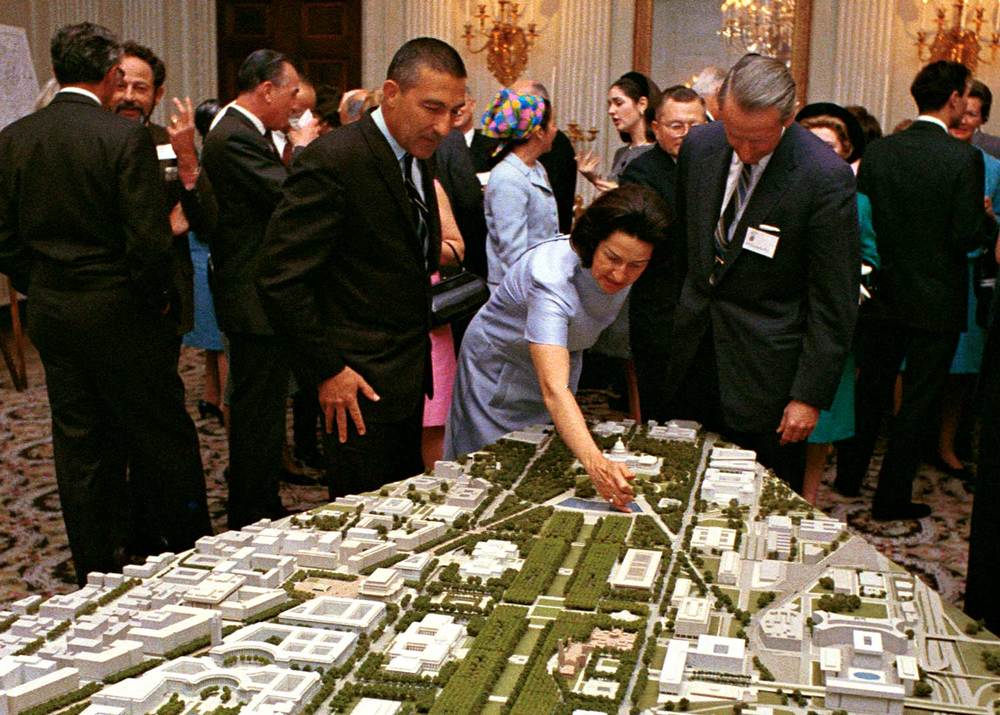
Foreground L-R: Sec. Stewart Udall, Lady Bird Johnson and Laurance Rockefeller look at an architectural model of the Washington, D.C. in 1967. LBJ Library photo by Robert Knudsen.

Lady Bird Johnson and Laurence Rockefeller study model of Washington D.C. circa 1967 courtesy http://www.ladybirdjohnson.org/biography/.


Since Earth Day falls in the month of April, I thought I would blog about Lady Bird Johnson's Beautification Project.  Mrs. Johnson first took on the role of First Lady in the 1960's at a time of urban renewal.  She pointed out that 75% of the American population lived on 1% of the land.  The nation's cities were not only crowded but also run down, particularly, Washington D.C., the nation's capital.  Lady Bird maintained that there should be a way for the natural and man-made components of the city could live in harmony.  She believed that the nation's physical beauty affected the nation's psyche.

Lady Bird started with a grassy triangle of land at the corner of 3rd and Independence Ave where she broke land and planted the first azalea in March of 1965.  The First Lady relied heavily on donations from private donors including $100,000 from the Rockefeller Foundation, 10,000 azaleas, 4,000 cherry trees along with dogwoods and daffodils.


Hains Point circa 1935 courtesy 


Lady Bird's goal was to create "functional, attractive surroundings", for a more beautiful Capital.  She took a cruise down the Potomac River to spot areas of concern.  Hains Point received attention as many cherry trees were planted there.  The First Lady took a ferry to Columbia Island, in the middle of the Potomac, for a daffodil bulb planting ceremony.  She hosted a planting at the White House for Arbor Day.


Lady Bird's efforts didn't just pertain to the flowers and trees, but also the buildings or lack thereof.  Farrell School was a drab, two story building with broken windows.  She championed an effort to get a playground for the children.  Buchanan School soon received a similar playground.

In an effort to attract more people to the downtown, the First Lady suggested that F Street be transformed into a shopping mall, one of two malls to be built.


Lady Bird focussed on Sherman Square, Farragut Square and Twining Square.  Trees were planted in Hobart Place Park and Lafayette Park.  She revitalized Pennsylvania Avenue and Rock Creek Parkway.


Washington Circle post beautification courtesy 


The First Lady was concerned about Washington's ghettos:  the urban decay, the graffiti, the garbage, the rats.  She enlisted youth to clean up the Shaw section of the capital which led to the formation of Project Pride, a group of Harvard University students and high school students to clean up other cities.

In May 1966 Lady Bird was front and centre at the White House Conference on Natural Beauty which encouraged conservation and anti litter campaigns.  Just before Lyndon Johnson left office, Columbia Island in the Potomac was renamed Lady Bird Johnson Island.  The First Lady's efforts, part of the "Keep America Beautiful" campaign, would bloom for years to come.


Lady Bird plants a cherry tree courtesy http://davesgarden.com/guides/articles/view/3473#b.

For more information, watch Showcase for the Nation:  The Beautification Project at https://www.youtube.com/watch?v=Cd2t2MsOMnc.