Showing posts with label daffodils. Show all posts

Tuesday, 18 April 2017

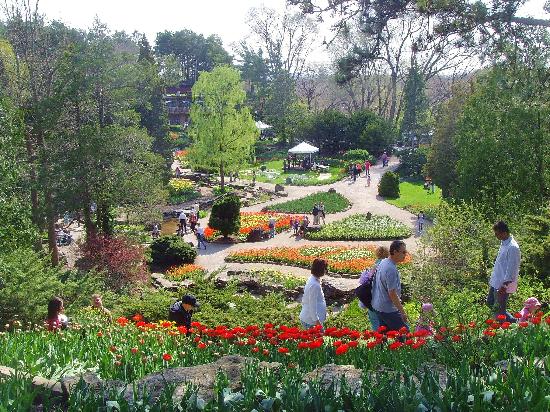
Hamilton's Depression Era Rock Quarry Became Rock Garden

'Hamilton's Royal Botanical Gardens puts nature's beauty on display, but it isn't a park system.  It teaches but it isn't a school.  It protects and preserves forest and marsh but it isn't a conservation authority.  It collects and propagates botanical knowledge and plant life, but it is not a library, museum or laboratory.  It is all those things and more than their sum." (Dr. Leslie Laking)


Patterned after Kew Gardens in England, Hamilton's Royal Botanical Gardens were the inspiration of conservationist Thomas Baker McQuesten.  The Gardens, consisting of 400 acres of displays, not only benefit the thousands of tourists and locals who visit each year, but also protect the 2300 acres of "environmentally sensitive lands and diverse ecosystems that connect that Niagara Escarpment to Lake Ontario" (https://www.rbg.ca/rbghistory).

In 1932, depression-era Hamilton was looking for a make work project to employ unemployed workers. They came upon an abandonned rock quarry which had supplied much of the building materials for Hamilton. Ten thousand tons of limestone from the Niagara Escarpment were shipped in to shore up the walls of the bowl shaped quarry. One hundred thousand tulips and daffodil bulbs were planted.  And a garden bloomed.  The bowl shaped rock garden is considered by many to be the birthplace of the Royal Botanical Gardens.

Today, the Royal Botanical Gardens serves as a gateway to the cities of Hamilton and Burlington. A total of 100,000 tulips and daffodils, planted in the fall, bloom there every spring.  Royal Botanical Gardens boasts 2,411 species of plants, 277 species of birds and 37 species of mammals.  Brides and grooms, for a fee, take their photos at the Gardens.

In 2016, the Royal Botanical Gardens received a face lift.  Five hundred tons of new limestone were carted in from Wiarton, Ontario.  A new generation of Hamiltonians can enjoy an old garden in re-bloom (http://www.theglobeandmail.com/report-on-business/industry-news/property-report/in-hamilton-a-depression-era-garden-reblooms/article29752303/).


Saturday, 1 April 2017

Lady Bird Johnson's Beautification Project

"When I go into a neighborhood, I look for the flash of color -- a geranium in a coffee can, a window box set against the scaling side of a tenement, a border of roses struggling in a tiny patch of open ground.  Where flowers bloom, so does hope -- and hope is the precious, indispensable ingredient without which the war on poverty can never be won." (Lady Bird Johnson)


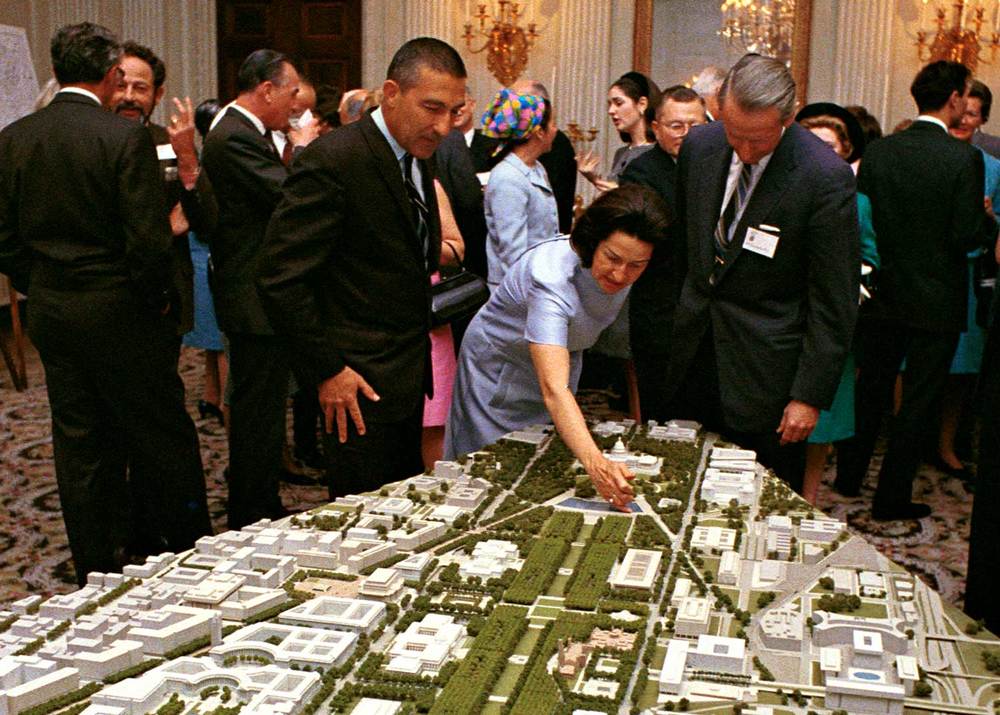
Foreground L-R: Sec. Stewart Udall, Lady Bird Johnson and Laurance Rockefeller look at an architectural model of the Washington, D.C. in 1967. LBJ Library photo by Robert Knudsen.

Lady Bird Johnson and Laurence Rockefeller study model of Washington D.C. circa 1967 courtesy http://www.ladybirdjohnson.org/biography/.


Since Earth Day falls in the month of April, I thought I would blog about Lady Bird Johnson's Beautification Project.  Mrs. Johnson first took on the role of First Lady in the 1960's at a time of urban renewal.  She pointed out that 75% of the American population lived on 1% of the land.  The nation's cities were not only crowded but also run down, particularly, Washington D.C., the nation's capital.  Lady Bird maintained that there should be a way for the natural and man-made components of the city could live in harmony.  She believed that the nation's physical beauty affected the nation's psyche.

Lady Bird started with a grassy triangle of land at the corner of 3rd and Independence Ave where she broke land and planted the first azalea in March of 1965.  The First Lady relied heavily on donations from private donors including $100,000 from the Rockefeller Foundation, 10,000 azaleas, 4,000 cherry trees along with dogwoods and daffodils.


Hains Point circa 1935 courtesy 


Lady Bird's goal was to create "functional, attractive surroundings", for a more beautiful Capital.  She took a cruise down the Potomac River to spot areas of concern.  Hains Point received attention as many cherry trees were planted there.  The First Lady took a ferry to Columbia Island, in the middle of the Potomac, for a daffodil bulb planting ceremony.  She hosted a planting at the White House for Arbor Day.


Lady Bird's efforts didn't just pertain to the flowers and trees, but also the buildings or lack thereof.  Farrell School was a drab, two story building with broken windows.  She championed an effort to get a playground for the children.  Buchanan School soon received a similar playground.

In an effort to attract more people to the downtown, the First Lady suggested that F Street be transformed into a shopping mall, one of two malls to be built.


Lady Bird focussed on Sherman Square, Farragut Square and Twining Square.  Trees were planted in Hobart Place Park and Lafayette Park.  She revitalized Pennsylvania Avenue and Rock Creek Parkway.


Washington Circle post beautification courtesy 


The First Lady was concerned about Washington's ghettos:  the urban decay, the graffiti, the garbage, the rats.  She enlisted youth to clean up the Shaw section of the capital which led to the formation of Project Pride, a group of Harvard University students and high school students to clean up other cities.

In May 1966 Lady Bird was front and centre at the White House Conference on Natural Beauty which encouraged conservation and anti litter campaigns.  Just before Lyndon Johnson left office, Columbia Island in the Potomac was renamed Lady Bird Johnson Island.  The First Lady's efforts, part of the "Keep America Beautiful" campaign, would bloom for years to come.


Lady Bird plants a cherry tree courtesy http://davesgarden.com/guides/articles/view/3473#b.

For more information, watch Showcase for the Nation:  The Beautification Project at https://www.youtube.com/watch?v=Cd2t2MsOMnc.