Friday, 14 October 2016

Before the Shot

"Norman couldn't help but being nice to people, especially children." (Dr. Donald Campbell)


If you lived in the same neighbourhood as Norman Rockwell, there was a good chance that you would end up on one of the 321 covers he painted for The Saturday Evening Post.  The painter lived across the street from a doctor named Donald Campbell.  In 1958, Rockwell asked the doctor to pose for his latest painting, Before the Shot.  He recruited the boy from the Runaway to act as the patient.  As the doctor prepares the shot, the little boy stands bent over, his pants slightly pulled down, examining the doctor's credentials hanging on the wall.

Children are often the subject of Rockwell's paintings.  "Norman couldn't help but being nice to people, especially children," explained Dr. Campbell.  The doctor relayed the incident of his daughter, Betsy, being chased on her bike by a dog.  She fell off her bike and sat on the ground, crying.  It was Rockwell who found her, scooped her up and carried her home.  Then he proceeded to draw a series of sketches with Betsy and the errant dog.  The last caption read:  "See. The nice little dog only wanted to play with you."


Before the Shot circa 1958 courtesy 

Thursday, 13 October 2016

Roadblock: A Canine Commotion

"Rockwell was a true master at telling a story in one frame." (George Lucas)


One dog is holding up twenty people.  A truck is making its way through an alleyway when a bulldog jumps out in front of it.  Everyone directs their attention towards the hound:  "the artist's pointed brush, a window washer's downward glance, the pet owner's distraught expression on the balcony, a bicyclist and postman on standby, neighbourhood kids facing forward and the delayed driver's urgent pleas..."  Even a cat has stops to watch the canine commotion, accompanied by a pigeon on the clothesline.

Norman Rockwell had only a moment to catch the public's attention with his artwork on the cover of magazines.  As George Lucas said, "Rockwell was a true master at telling a story in one frame."  He brought new meaning to the phrase "A picture is worth a thousand words."  With each stroke of a brush, Rockwell's story unfolded.  Roadblock appeared on the cover of The Saturday Evening Post on July 9, 1949.  


A truck drive tries to coax a dog to move away from his vehicle.


Wednesday, 12 October 2016

Boy in Dining Car Calculates Tip

Norman Rockwell was searching for a train car for his latest painting.  The New York Central's Lakeshore Limited Railroad offered him one, the Twentieth Century Limited.  However, the artist thought it looked too modern for his painting.  A week later, an older car arrived, more appropriate for Rockwell's picture. 

Rockwell interviewed three models to play the Pullman porter, but none sufficed.  However, along with the new car came a black Pullman porter, a twenty eight year veteran.  Many Blacks served as Pullman porters after the Great Migration to the northern cities of the United States.  Rockwell also interviewed four boys to play the role of the passenger, settling on his own son, Peter. Peter sat in his seat, hunched over the table, trying to figure out the tip for the Pullman porter.

Leaning against the wall of the train car is a railroad postcard, an attempt by the artist to acknowledge the railroad's generosity in lending him a car.  The gesture was the equivalent of $10,000 worth of free publicity for the New York Central Railroad.  Boy in Dining Car appeared on the cover of The Saturday Evening Post on December 7, 1946. 


Boy In Dining Car by Norman Rockwell

Tuesday, 11 October 2016

Shuffleton's Barbershop: It's All in the Details

"There were details, accidents of light, which I'd missed when I'd been able to make only quick sketches of a setting...where Rob hung his combs,his rusty old clippers, the way the light fell across the magazine rack, his moth-eaten push broom leaning against the display cases of candy and ammunition, the cracked leather seat of the barber chair with the stuffing pointing through along the edges over the nickel-plated frame." (Norman Rockwell, My Adventures as an Illustrator, 1960)


Photograph on which Rockwell based his painting Shuffleton's Barbershop courtesy https://www.visualnews.com/2012/10/04/the-photographs-behind-norman-rockwells-iconic-paintings/.


Norman Rockwell painted Shuffleton's Barbershop in East Arlington, Vermont in 1950 for the cover of The Saturday Evening Post.  Rockwell left nothing to chance in his preparation for the painting.  He called on his assistant Gene Pelham to take photographs of the barbershop.

"There were details, accidents of light, which I'd missed when I'd been able to make only quick sketches of a setting...where Rob hung his combs,his rusty old clippers, the way the light fell across the magazine rack, his moth-eaten push broom leaning against the display cases of candy and ammunition, the cracked leather seat of the barber chair with the stuffing pointing through along the edges over the nickel-plated frame." 

One blogger points out more details from Shuffleton's Barbershop (http://www.best-norman-rockwell-art.com/1950-shuffletons-barbershop.html):

  • paint and putty peeling on the windowsill
  • crack in the window pane
  • red hot coals in the wood burning stove
  • a comic book stand
  • the cat listening to Shuffleton and his cohorts
Note that classical musicians are playing in the back of the barbershop.  At one time, barbershops were far more than places to get a haircut.  Entertainment was a big part of the barbershop, the birthplace of the barbershop quartet.

Even though Shuffleton's Barbershop was the painter's 233rd piece for The Saturday Evening Post, when Rockwell first unveiled the painting, it only costs 15 cents.  Today, Rockwell's paintings have soared in value.  Just three years ago, three Rockwell paintings fetched 57.8 million dollars at a Sotheby's auction in Manhattan. Americans (and art connaisseurs) are still seeking the old time values that Rockwell portrayed so well in his paintings.


Monday, 10 October 2016

The Runaway

"No details were overlooked by Rockwell:  stools, countertop, coffee pot, cup, sugar dispenser -- even the radio mounted on its shelf on the wall." 


The Howard Johnson's in Pittsfield, Massachusetts served as the setting for Norman Rockwell's painting The Runaway, completed in 1958.  It features a waitor, his hair slicked back, smoking a cigarette.  Facing him are two individuals, a policeman and a little boy. l The policeman, dressed in the standard blue uniform, also has a pistol, pouch and handcuff pouch and citation book.  He is leaning over and looking directly into the eyes of the little boy.  The little boy, dressed in blue jeans and a yellow t-shirt with a jacket on his lap, appears as if he's just run away.  He appears calm enough, likely still seeing his plan as an adventure rather than a dilemma.

Thirty year old Massachusetts state trooper Richard J. Clemens served as the model for the policeman.  Eight year old Eddie Locke serves as the model for the runaway.  It appears as if the two individuals are competing in a staring contest.  "No details were overlooked by Rockwell:  stools, countertop, coffee pot, cup, sugar dispenser -- even the radio mounted on its shelf on the wall."  Today's special is spaghetti with meatballs.  Homemade pies sit calling the customers' names.

The question remains:  "Will the policeman make the boy return home?  Will he feed the boy first?  Will the boy eat again as soon as he walks in the door?"  Finally, "What will his mother say?"


Sunday, 9 October 2016

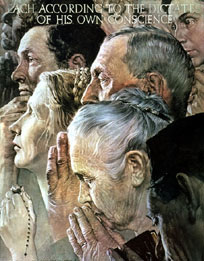
The Four Freedoms

"As men do not live by bread alone, they do not fight by armaments alone." (Franklin D. Roosevelt)


In January of 1941, President Franklin D. Roosevelt delivered a State of the Union Address called The Four Freedoms.  The world was at war and President Roosevelt was drafting his Lend Lease bill which would help the Allies in their fight against the Nazis.  

"Every realist knows that the democratic way of life is at this moment being directly assailed in every part of the world... the need of the moment is that our actions and our policy should be devoted primarily -- almost exclusively -- to meeting this foreign peril..." (https://en.wikipedia.org/wiki/Four_Freedoms)

While Roosevelt was convinced that the world needed America's help, Congress was not convinced. As the war raged on in Europe, America held an isolationist stance.  Anti-war advocates argued that Roosevelt's Four Freedom's message was just rhetoric to prop up his New Deal reforms.  


Freedom of Speech.jpg


Congress remained unconvinced until December 7, 1941, when the Japanese attacked Pearl Harbor and decimated the United States naval fleet.  The following day, President Roosevelt made his famous speech to Congress "A Date Which Will Live in Infamy". (http://alinefromlinda.blogspot.ca/2015/11/franklin-d-roosevelts-great-arsenal-of.html)


"With confidence in our armed forces, with the unbounding determination of our people we will gain the inevitable triumph, so help us God.  I ask that Congress declare that since the unprovoked and dastardly attack by Japan on Sunday, December 7, 1941, a state of war has existed between the United States and the Japanese empire."


The Four Freedoms were warmly received by the American public.  The Four Freedoms Monument, commissioned by President Roosevelt and sculpted by Walter Russell, was erected before Pearl Harbor.  It was commissioned at Madison Square Garden in 1943.  The Four Freedoms were encapsulated in the minds of Americans by Norman Rockwell series of paintings by the same name, published in the Saturday Evening Post in 1943.


  A large family gathered at a table for a holiday meal as the Turkey arrives at the table.


Saturday, 8 October 2016

Mother Tucking Children Into Bed


Norman Rockwell used his wife, Irene, as the model for his painting Mother Tucking Children Into Bed.  Originally painted as a cover for Literary Digest in 1921, the painting features a mother tucking her two rosy-cheeked cherubs into bed.  Norman Rockwell painted a total of 48 covers for the Literary Digest.