Friday, 2 September 2016

Ellis Island by Numbers


Here are ten things you may not know about Ellis Island:

1.  Ellis Island was originally called Gibbet Island after a gang of pirates was hung by gibbets (aka gallows) there.

2.  Officials posed 29 questions to the immigrants which they had to answer correctly.  
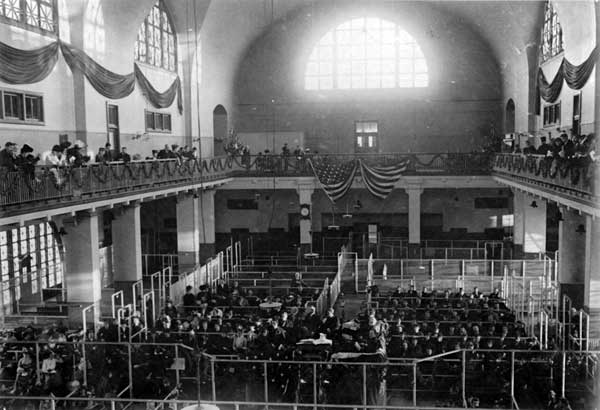


Augustus F. Sherman photo of the REgistry Room circa 1910 courtesy https://www.nps.gov/elis/planyourvisit/second-floor.htm.


3.  Two percent of immigrants were turned down due to disease, criminal records or other undesirable responses.


Undesirables awaiting deportation courtesy 

4.  The immigration station dining room was capable of housing 1,000 people at a time.

5.  The immigration station processed its last group of immigrants on November 12, 1954.


An endless queue circa 1892 courtesy 

6.  During World War I, with immigration at an all time low, Ellis Island was used as a way station for the U.S. Army and Navy.

7.  A kitchen fire in 1897 destroyed the entire immigration station, originally built of wood.  A new brick structure was opened in 1900.

8.  At its peak in 1907, a record 1.25 million immigrants were processed.  In a single day, 11, 747 immigrants were processed.


Immigrants arrive at Ellis Island circa 1908 courtesy 

9.  A total of 11,000 Germans and German-Americans were detained during the Second World War, some at Ellis Island.

10.  Lee Iacocca spearheaded a fundraising campaign to restore both Ellis Island and the Statue of Liberty.  The former was reopened to the public in 1990 and now receives about 3 million visitors per year.


"Snow covered corridor" courtesy https://www.pinterest.com/pin/491947959266281290/.

Thursday, 1 September 2016

Ellis Island: Portrait of America

"Remember, remember always, that all of us, and you and I especially, are descended from immigrants and revolutionists." (Franklin D. Roosevelt)


Ellis Island courtesy ic.galegroup.com.


At least 100 million Americans can trace their roots to an ancestor who came to America via Ellis Island.  At the station's peak, 3,000 to 5,000 new immigrants arrived daily.   Augustus F. Sherman, who worked at the immigration station from 1892 to 1925, photographed at least 100 of these immigrants.   While most of the recent arrivals came through the immigration relatively quickly, the subjects of Sherman's photographs were usually detainees, "waiting for money, travel tickets, or someone to collect the from the island."  

While Sherman was a registry clerk and not a professional photographer, in his free time he would get out his old box camera, perch it atop a giant tripod and start snapping photographs of the immigrants.  Highly gifted, Sherman asked many of them to pose for portraits, in which he encouraged them to wear their national dress, giving us a flavour of their culture.  While 98% were accepted and remained in the United States, 2% were rejected, due to medical reasons or otherwise, and were deported back to their country of origin.  

These photographs were published in National Geographic in 1907 and were also displayed in the Lower Manhattan headquarters of the Federal Immigration Service. 

Note:  For more information, read "The Ghosts of Ellis Island" at http://alinefromlinda.blogspot.ca/2012/08/august-10.html.


Russian family arrives at Ellis Island courtesy 


Wednesday, 31 August 2016

Barbara Frum: Prime Ministers, Political Prisoners & The Vulcan Nerve Pinch


Barbara Rosberg, born and raised in Niagara Falls, Ontario in 1937, was the daughter of a Polish Jewish immigrant father and New York City bred mother.  She attended the University of Toronto where she graduated with a BA in 1959.  Married to dentist Murray Frum, the couple had two children and adopted a third.

After graduation, Barbara Frum worked as a freelance writer for the Toronto Star, focussing on social issue pieces.  In 1973, she was hired by CBC Radio to host As It Happens, a newsmagazine program which conducted live interviews.  Frum started to develop a reputation as a "tough, incisive, well informed interviewer" (https://en.wikipedia.org/wiki/Barbara_Frum).


\


In 1981, Frum debuted on The Journal, a TV show following The National which delved deeper into the feature stories.  Frum interviewed major political figures such as British Prime Minister Margaret Thatcher and Canadian Prime Minister Pierre Trudeau.  In 1969, Leonard Nimoy explained the vulcan nerve pinch to the Canadian broadcaster and in 1990, South African political prisoner Nelson Mandela granted her an interview on the very day he was released in 1990 (https://www.thestar.com/news/world/2013/12/06/nelson_mandela_remembering_one_of_first_surreal_interviews_after_prison_release_burman.html).

Frum was diagnosed with a form of chronic leukemia in 1974.  Eighteen years later she succumbed to the disease.  A predominantly Jewish area of Toronto named its library after Barbara Frum as well as a CBC Toronto atrium.


Tuesday, 30 August 2016

Le Reve de Rosa-Anna Vachon

beauce - La Maison J.-A. Vachon, fierté des Beaucerons!

Rosa-Anna Vachon in front of her wood stove courtesy http://fr.canoe.ca/voyages/sechapper/archives/2010/04/20100430-154657.html.


In 1923, Joseph Vachon and Rosa Anna Giroux, who had worked a Quebec farm for 25 years, purchased LeBlond Bakery.  Rosa Anna hoped that the family business would be the incentive to bring her four sons home, who had left for the United States to find work.  Within a year, J.A. Vachon et Fils was a true family business.

In 1932, the Jos Louis, a famous round white cake covered in chocolate icing, debuted.  Within four years, nearly all of Quebec enjoyed Rosa Anna's little cakes.  In 1937, Vachon expanded into Ontario as well as the Maritimes, flying in the face of the Great Depression.  The next year, Joseph Vachon passed away and it fell to Rosa Anna to run the business with her sons.


L’usine Vachon avec un premier groupe d’employés


By 1940, with the business boasting 125 employees and 30 trucks, it stopped making bread and focused exclusively on the cakes.  During the Second World War, these cakes were supplied to military bases in Halifax, Vancouver, Nanaimo and even England.  At war's end, Rosa-Anna retired and her sons took over the business.  By 1947, Vachon had expanded to 250 employees and 70 trucks.

In 1960, J.A. Vachon & Fils changed its name to Vachon Inc. and by the end of the decade, it purchased Lido Biscuits.  Twelve hundred employees baked the famous cakes which were delivered in 425 vehicles.


1983


In 1980, the Jos. Louis was joined by Alouette and the Flaky.  Three years later, Vachon produced its 10 billionth cake.

In the 1990's, Roger Lacasse wrote Le Reve de Rosa Anna Vachon based on the early years of the Vachon family.  In 1999, Vachon merged with Saputo, still producing the same tasty cakes.


Monday, 29 August 2016

Adelaide Hoodless: Domestic Crusader

Adelaide Hunter Hoodless, Canadian Advocate for Women and Children.tif


In 1857, Adelaide Hunter was born on a farm in St. George, Ontario, north of Brantford, the youngest of twelve children. Her father passed away only a few months later and her mother struggled to raise her family on her own.  Adelaide grew up and married John Hoodless, a furniture manufacturer, and became a Hamilton socialite.  The couple had four healthy children.  Tragedy struck in 1889 when her infant son died after drinking impure milk at a time when dairy practices were questionable:  milk was often left uncovered and unrefrigerated, leaving it ripe for contamination.

From that moment on, Hoodless would crusade for children to prevent more senseless deaths like that of her son.  She championed the cause for pasteurized milk, still an emerging science, and embraced the cause of better education for young mothers.  The Hamilton socialite campaigned for Domestic Science classes and wrote a textbook, Public School Domestic Science (1898) to be used in such classes.  By 1902, Domestic Science had become a mandatory course in Ontario classrooms.  But Adelaide did not stop there.  With the financial aid of a Montreal businessman, she established Domestic Science classes in Canadian universities, too.  Mrs. Hoodless travelled the province speaking about her passion:  "Is it of greater importance that a farmer should know more about the scientific care of his sheep and cattle, than a farmer's wife should know how to care for her family?"


On February 12, 1897, Mr Erland Lee asked Mrs. Hoodless to speak at his Farmer's Institute Ladies Night.  Over 100 women turned out to hear her speak and that group became the first chapter of the Women's Institute.  Within a decade, the Institute had over 500 branches.  With Lady Aberdeen, she helped establish the National Council for Women, the Victorian Order of Nurses, and the Young Women's Christian Association (YWCA).  

Adelaide Hoodless passed away from a cerebral hemorrhage only one day shy of her 53rd birthday. The Hoodless homestead in St. George was acquired by the Federated Women's Institute of Canada in 1959 and now serves as a museum.  A roadside plaque in Stoney Creek, Ontario marks the location of the first Women's Institute meeting well over a century ago.  


Image result for adelaide hoodless stamp

Canada Post stamp issued in 1993 courtesy http://www.adelaidehoodless.ca/history/adelaides-legacy/


Wednesday, 24 August 2016

Louis Vallee Photographs Old Quebec

Basse-ville de Quebec - Louis-Prudent Vallee vers 1880.jpg


In 1839, Louis DaGuerre succeeded in capturing a unique image on a copper plate, named the daguerrotype.  People called it "a mirror with a memory".  The Quebec Gazette, the Toronto Patriot, and the Halifax Colonial Pearl reported on the daguerrotype and itinerant daguerrotypists set up shop in hotel rooms and stores, eager to capitalize on the new technology.  However, the process was slow and was eventually replaced with photography.

In the 1860's, Louis Prudent Vallee opened a studio in Quebec City and soon became known for his photographs of his hometown.  Vallee captured the capital before the departure of British troops in 1871 and after the demolition of military installations.  Old Quebec's walls remind us of how the city used to serve as a fort.  Vallee also documented the urban development at the end of the 1800's.  Vallee's Catalogue of Photographic Views of Quebec City and Vicinity, published in 1899, served as a good record of local history in the latter half of the 19th Century.


Louis-Prudent Vallée: His work is a record of the 19th century in Quebec City. “The photograph on the stamp was taken circa 1894.”

A Quebec City street circa 1894

Tuesday, 23 August 2016

The Cunard Line


The Aquitania leaves Liverpool on her maiden voyage circa 1914 courtesy http://www.liverpoolecho.co.uk/news/liverpool-news/reflecting-one-greatest-ocean-liners-7233961.


Samuel Cunard, raised in Halifax, was the son of a German Quaker and an Irish Roman Catholic who fled the United States during the American Revolution, part of a large group of United Empire Loyalists.  During the War of 1812, Cunard fought on the British side with the second battalion of the Halifax Regiment.  The young man was a highly successful entrepreneur who was one of 12 people to greatly influence the affairs of Halifax.

In 1830, Cunard founded the Halifax Steamboat Company which ran a steamship between Halifax and Quebec.  Seven years later, Cunard travelled to the United Kingdom where he made a successful bid to run a trans-Atlantic mail service.  The result was Cunard Steamships Limited.  In 1840, the company's first steamship, the Britannia, sailed from Liverpool to Halifax and then on to Boston.  Cunard's ships soon earned a reputation for speed and safety.  However, that reputation came with a hefty cost; Cunard fled creditors in Halifax by 1843, unable to pay his bills.  By the following year, however, the entrepreneur started to turn a profit.

The Cunard Line has owned several famous ships over the decades.  The Carpathia (1901) came to the rescue of the Titanic when it sank in 1912.  The Lusitania (1906) was torpedoed by German U-boats and sunk in 1915.  The Aquitania (1914) served in both World War I and World War II.  The Queen Mary (1936) transported royalty, movie stars and war brides across the Atlantic.


Britannia sails from Liverpool to Halifax circa 1840 courtesy http://postalhistorycorner.blogspot.ca/2014/02/canadian-letter-rates-to-united-kingdom.html.