Showing posts with label War of 1812. Show all posts

Tuesday, 23 August 2016

The Cunard Line


The Aquitania leaves Liverpool on her maiden voyage circa 1914 courtesy http://www.liverpoolecho.co.uk/news/liverpool-news/reflecting-one-greatest-ocean-liners-7233961.


Samuel Cunard, raised in Halifax, was the son of a German Quaker and an Irish Roman Catholic who fled the United States during the American Revolution, part of a large group of United Empire Loyalists.  During the War of 1812, Cunard fought on the British side with the second battalion of the Halifax Regiment.  The young man was a highly successful entrepreneur who was one of 12 people to greatly influence the affairs of Halifax.

In 1830, Cunard founded the Halifax Steamboat Company which ran a steamship between Halifax and Quebec.  Seven years later, Cunard travelled to the United Kingdom where he made a successful bid to run a trans-Atlantic mail service.  The result was Cunard Steamships Limited.  In 1840, the company's first steamship, the Britannia, sailed from Liverpool to Halifax and then on to Boston.  Cunard's ships soon earned a reputation for speed and safety.  However, that reputation came with a hefty cost; Cunard fled creditors in Halifax by 1843, unable to pay his bills.  By the following year, however, the entrepreneur started to turn a profit.

The Cunard Line has owned several famous ships over the decades.  The Carpathia (1901) came to the rescue of the Titanic when it sank in 1912.  The Lusitania (1906) was torpedoed by German U-boats and sunk in 1915.  The Aquitania (1914) served in both World War I and World War II.  The Queen Mary (1936) transported royalty, movie stars and war brides across the Atlantic.


Britannia sails from Liverpool to Halifax circa 1840 courtesy http://postalhistorycorner.blogspot.ca/2014/02/canadian-letter-rates-to-united-kingdom.html.


Monday, 4 July 2016

Francis Scott Key and The Star Spangled Banner

"It seemed as though mother earth had opened and was vomiting shot and shell in a sheet of fire and brimstone." (Francis Scott Key)


Only weeks before the British had set fire to the White House.  Now, they were relentlessly pounding Fort McHenry in Baltimore Harbor.  Francis Scott Key watched helplessly from his vessel eight miles away, guarded by the British due to his knowledge of the Battle of Baltimore.  

Key wrote:  "It seemed as though mother earth had opened and was vomiting shot and shell in a sheet of fire and brimstone."  Given the scale of the attack, Key expected the British to win:  the barrage continued for 25 hours.  However, "in the dawn's early light", once the smoke cleared, he saw the American flag flying over Fort McHenry.  He took out his pen and composed a poem reflecting his love for his country.  

Key's brother in law read his poem and had it distributed under the name "Defence of Fort McHenry".  The Baltimore Patriot soon printed it and within a short time, it was shared with other newspapers across the country.  Put to music, it became known as "The Star Spangled Banner".

The tune was recognized by the United States Navy in 1889, by President Woodrow Wilson in 1916 and by Congress in 1931.  The flag which inspired Francis Scott Key to write the poem now sits in the Smithsonian Institute.


star-spangled-banner-large.jpg


Sunday, 3 July 2016

The Battle of New Orleans


The Battle of New Orleans. January 1815. Copy of engraving by H. B. Hall after W. Momberger., ca. 1900 - 1982 - NARA - 531091.tif


Engraving of the Battle of New Orleans by Henry Bryan Hall courtesy https://research.archives.gov/id/531091.


The War of 1812 was fought between Britain and the United States from 1812 to 1814, much of which was fought around the Great Lakes.  However, the Battle of New Orleans took place in early 1815, the reason being that word had not yet reached the Deep South that the Treaty of Ghent had been signed on Christmas Eve 1814.

A British fleet under the command of Sir Alexander Cochrane, had anchored in the Gulf of Mexico tot he east of Lake Pontchartrain.  The British, with a force of 11,000 men took on the Americans, under the command of General Andrew Jackson, a force of only 4,732.  The Americans, however, suffered only 62 casualties and losses as opposed to Britain's total of 2,034.

The victory, considered by French Quarter residents, was attributed to divine intervention.  The night before the battle, Ursuline nuns, along with New Orleans' faithful, gathered at the Ursuline Convent and prayed in front of the Virgin Mary statue for the American troops.  The next morning, as the Vical General conducted mass at the same chapel, a courier interrupted with the news that the British had been defeated.  General Jackson, personally paid the nuns a visit after the battle to say thank you:  "By the blessing of heaven, directing the valor of the troops under my command, one of the most brilliant victories in the annals of war was obtained."  Fourteen years later, Jackson became the seventh President of the United States.


Battle of New Orleans Limited Edition Forever stamp

U.S. Stamp issued on the 200th Anniversary of the Battle of New Orleans courtesy http://about.usps.com/news/national-releases/2015/pr15_003.htm.


Monday, 20 June 2016

Laura Secord: More Than Just a Chocolate

"For the growing good of the world is partly dependent on unhistoric acts; and that things are not so ill with you or me as they might have been is half owing to the number who lived faithfully a hidden life and rest in unvisited tombs." (George Eliot Middlemarch, 1871)


Most of us know about the chocolates with the cameo logo.  But how many know the story of the housewife turned heroine who, in 1813, made a dangerous 19 kilometre trek to warn the British that the Americans were coming, thereby helping the Redcoats regain control of the Niagara Peninsula?  

Laura Secord was an American whose father fought for the Thirteen Colonies in the American Revolution.  She married the son of a United Empire Loyalist and settled in Queenston, Ontario.  Her husband, called to serve in the War of 1812, was wounded at the Battle of Queenston Heights, along with General Isaac Brock.  Most housewives, when their husbands did not return from battle, would have waited to hear news.  But Laura acted:  "[She] picked her way through the red and blue uniformed figures on the ground until at last she found her husband."  Discovering that he had been wounded in the chest by a musket ball, she torn a strip of cloth from her petticoat and applied pressure to his wound.  For months, she nursed him back to health.

In the meantime, Laura was forced to billet American soldiers in her home, generals who plotted their next move.  Laura overheard their strategy and formed a plan of her own.  Dressed in a brown house dress and cotton sunbonnet, the 38 year old housewife set out on foot, saying she was going to visit her brother and his wife in nearby St. David.  However, it would be the start of a 19-kilometre trek over the Black Swamp, across Ten Mile Creek and up the Niagara Escarpment, to warn the British that the Americans were coming.  After an eighteen hour journey, Laura came by chance upon a group of Native Indians from Brantford, who directed her towards Lieutenant Fitzgibbons' camp.

With their preparedness, the British were able to mount a good counterattack at Beaver Dams, even though they were outnumbered 542 to 150.  The Iroquois regiment, which fought alongside the British, marched back and forth, back and forth, all the while shouting war cries, giving the illusion of more men.  Within  three hours, the Americans withdrew.  The British regained a foothold in the Niagara Peninsula, helping them to secure a victory in the War of 1812.

Years later, the Brock monument was erected at Queenston Heights honouring the British general who fought in the war.  Laura Secord, struggling to make ends meet as a widow, offered to be a tour guide at the new monument.  However, in a political move, she failed to get the job.  She would go down in history as an unsung hero.  For more information, read http://alinefromlinda.blogspot.ca/2015/09/laura-secord-housewife-turned-heroine.html.

Note:  My Dad told me an interesting fact.  Laura Secord Chocolates, which originated in 1912 on the centennial of the War of 1812, are sold in the United States, but under a different name.  


Laura Secord Canadian stamp courtesy http://www.biographi.ca/en/bio/ingersoll_laura_9E.html.

Saturday, 10 October 2015

Thomas Jefferson: "I Cannot Live Without Books"

"I cannot live without books." (Thomas Jefferson to John Adams)


Before Monticello, the domed house that Thomas Jefferson designed and built in Virginia, there was Shadwell, the birthplace of the third president of the United States.  Shadwell burned in 1779, taking with it Jefferson's beloved collection of books.  

Jefferson spent the rest of his life trying to replenish his personal library.  By 1773, he owned 1250 books, and by 1815, over 6500 titles.  That year, the British Army burned both the White House and the Capitol, destroying the 3000 volumes inside.  The retired president, despite the fact that he loved his books, sold the collection to the Library of Congress for $23, 950.  The books were transported from Monticello to Washington D.C. in ten wagons.  

On May 8, 1815, after the packing and shipping of his collection of books, Jefferson penned a letter to Samuel Smith, stating:  "an interesting treasure is added to your city now become the depository of unquestionably the choicest collection of books in the U.S. and I hope it will not be without some general effect on the literature of our country." (http://www.loc.gov/exhibits/jefferson/jefflib.html)

Once again, Jefferson rebuilt his library.  Although he had debts to pay, he continued to collect a plethora of books on every subject.  Upon his death, his books were sold to pay off outstanding debts. Today, the Library of Congress is the largest library in the world.


Friday, 11 September 2015

Laura Secord: Housewife Turned Heroine

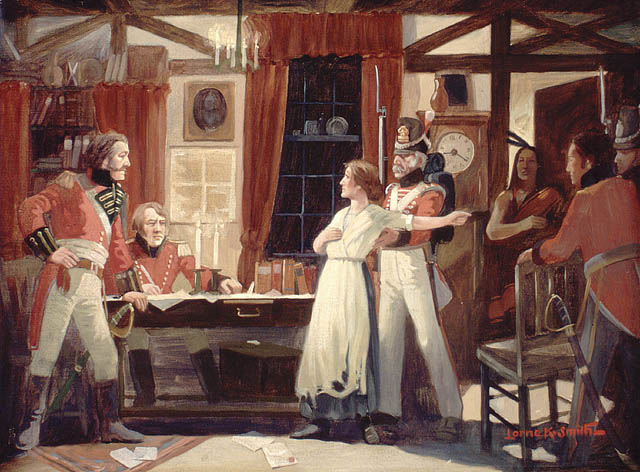
Painting of Laura Secord warning British commander James FitzGibbon of an impending American attack at Beaver Dams


She is the Canadian Paul Revere.  Just as Revere made the ride from Boston to Lexington to warn the Americans that the British were coming in 1775, Laura Secord made an historic trek from Queenston to Beaver Dams to warn the British that the Americans were coming in 1813.  Yet almost 50 years would pass before she was officially recognized for her heroism, thanks in part to a letter from Lieutenant James Fitzgibbon.

Laura Secord, nee Ingersoll, was born in the Massachusetts Bay Colony the year that Paul Revere made his famous ride.  Her parents were United Empire Loyalists who moved to Upper Canada after the Revolutionary War.  Laura married and had six daughters and one son.  Her husband, James, was wounded in the Battle of Queenston Heights during the War of 1812, the same battle in which General Isaac Brock was killed.

In June of 1813, James was still recuperating from his war wound when a group of American soldiers was billeted at the Secord house.  Laura overheard the soldiers discussing their plans to surprise the British at Beaver Dams.  Knowing her husband was still incapacitated, Laura planned her next move.

At the age of 38, considered old at the time, she set on on foot to St. David's.  There, she met up with her cousin, Elizabeth, who joined her on the trek.  The two women battled fatigue, heat, snakes and swamp-like conditions as they made their way along Twelve Mile Creek.  At Shipman's Creek, present day St. Catharines, Elizabeth could go no further.  Laura continued on her own, crossing over the river on a fallen log and climbing the rocks of the Niagara Escarpment.


Finally, she came to a Native encampment.  Not knowing whether they were friendly or not, she approached them hesitantly.  The Natives, who happened to be Mohawks from the nearby Grand River settlement, led her to the British encampment.  It had been 18 hours since Laura left Queenston.  She had travelled twenty miles (normally a twelve-mile journey) preferring to take a more circuitous route to avoid American entanglements.

At Decew House, she met Lieutenant Fitzgibbon and alerted him to the American plan to attack the British at nearby Beaver Dams.  Fitzgibbon compiled 50 men, 15 militia and 85 Mohawk warriors.  The Americans gathered 542 soldiers.  It should have been a slaughter.  However, Fitzgibbon ordered his men to march back and forth to give the enemy the illusion that they had more men.  The Mohawks let out bloodcurdling war whoops.  The Americans bought it, surrendered, and were captured by the British, all within three hours.  Beaver Dams was a key battle enabling the British to regain a foothold in the much needed Niagara Peninsula.

Laura Secord, a housewife turned heroine, almost became a footnote in history.  For decades, no one knew who she was.  After her husband passed away, she became a poor war widow.  She came close to getting a job as a tour guide at the Brock Monument which was erected in 1824.  However, at the last minute the job was given to someone else in a political move.

In 1820, Lieutenant Fitzgibbon wrote a letter vouching for the heroism of Laura Secord. He explained that Laura had alerted him to an "intended attack to be made by the enemy" and that she had "arrived at [his] station at sunset, on an exceptionally warm day after having walked twelve miles".  Fitzgibbon's letter planted the seed in the minds of Canadians.

But it was not until 1860, nearly five decades after her historic trek, that the seed germinated and Laura Secord was officially recognized for her heroism.  The Prince of Wales, visiting from Britain, thanked the war widow for her role in the War of 1812 and awarded her 100 pounds.

In 1913, the Laura Secord Chocolate Company opened, commemorating Secord on the centennial of her famous walk.

Today, you can visit Laura Secord's house at Queenston Heights, not far from Niagara Falls.  While it once housed American soldiers, it now hosts visitors from both sides of the border, a border that might not be there if not for this housewife turned heroine.

For more information, visit http://laurasecordhistory.blogspot.ca/.


Project:1812 - Queenston (The Heights)

Laura Secord house at Queenston courtesy http://www.alexluyckx.com/blog/2012/07/project1812-laura-secord/.