Showing posts with label voice. Show all posts

Tuesday, 9 June 2015

Gay Talese's "Frank Sinatra Has a Cold"

"Sinatra with a cold is like Picasso without paint, Ferrari without fuel -- only worse." (Gay Talese)


It is one of the most famous pieces of magazine journalism ever.  Gay Talese, who had worked for the New York Times, wanted to try his hand at magazines.  His task?  To write six stories in the space of one year for Esquire magazine, the Vanity Fair of the 1960's.  With suitcase in hand, he flew to Los Angeles to interview the music legend, Frank Sinatra.  The problem was, the 50-year-old Sinatra was bound and determined not to speak to reporters:  he was tired of the relentless questions about his current love, a 20-year-old named Mia Farrow; he was tired of the endless queries about his Mafia connections; he was tired of the movie he was shooting; and to top it all off, he had a cold.  

But Gay Talese was up for a challenge.  For the next three months, he followed Sinatra to every corner of Hollywood and Las Vegas.  He pursued the singer's entourage of 75, gaining glimpses into the private man.  He did what needed to be done to get the scoop.  The result was a brilliant essay written in the "New Journalism" style.  Esquire called it "a work of rigorously faithful fact enlivened with the kind of vivid storytelling that had previously been reserved for fiction".  Blogger Maria Henson explained:  "The 15,000 word story is as finely crafted as Sinatra's (and Talese's) custom-tailored suits."  Here is an excerpt from the article that everyone was talking about in April of 1966:

"Sinatra with a cold is Picasso without paint, Ferrari without fuel -- only worse.  For the common cold robs Sinatra of that uninsurable jewel, his voice, cutting into the core of his confidence, and it affects not only his psyche but also seems to cause a kind of psychosomatic nasal drip within dozens of people who work for him, love him, depend on him for their own welfare and stability.  A Sinatra with a cold, can, in a small way, send vibrations through the entertainment industry and beyond as surely as a President of the United States, suddenly sick, can shake the national economy."  


Esquire magazine cover for April of 1966 courtesy http://en.wikipedia.org/wiki/Frank_Sinatra_Has_a_Cold.


Note:  For more about this style of essay writing, read Tom Wolfe's The New Journalism (http://www.amazon.com/The-New-Journalism-Tom-Wolfe/dp/0060471832).


Thursday, 23 April 2015

How to Write a Query That Sizzles

"The main objective of a query is simple:  Make the agent care enough about your protagonist and your plot that she wants to read more." (Mary Kole)


The query is your first, and maybe your only, chance to get the attention of an agent or publisher. Make it count.  Remember your book is a marketable commodity.  Make sure your manuscript is polished and ready to go before you submit your query letter.  Author Jane Friedman offers some excellent suggestions for anyone drafting a query for a novel (http://janefriedman.com/2014/04/11/query-letters/).

She recommends that you mention how you came upon the agency or publisher you are querying. For instance, you may know another client of the agent or another author of the publisher. Mention that in your first paragraph.  Perhaps you heard him or her speak at a conference.  Include this information as well.  

Include any impressive credentials you may hold; for example, maybe you have a MFA from a university from which the agent is known to recruit authors.  Perhaps you won a national writing competition or you have written for prestigious journals or New York publishers.  

Ms. Friedman says that good salespeople develop a rapport with customers and understand their needs.  You have to do the same with your agent or publisher.  Make sure you personalize your letter. Include information that sets it apart from the hundreds of other queries sitting in the slush pile on a publisher's desk.

Your hook is what grabs the reader's attention from the get go.  Make sure you include your protagonist's name and what conflict he or she is involved in.  List the choices the protagonist has made in response to this conflict.  Ms. Friedman says the hook should have "sizzle".  Give examples of how your novel is filled with "strong actions, strong ramifications and and lots of emotion tied to each."  Agents eat this stuff up, according to Mary Kole (http://www.writersdigest.com/online-editor/how-to-write-the-perfect-query-letter).  You might also mention the setting or time period, especially if it is historical fiction.

Your hook needs a certain "je ne sais quoi" says Jane Friedman.  It should not seem flat:  inject your writing with "life, voice and personality".  However, at the same time, don't ramble on.  Brevity is also key:  limit your explanation to under 200 words.  The more you explain, the more you might "squeeze the life out of the story," says Ms. Friedman.  

Refrain from revealing the ending of your story.  Reserve that for the synopsis.  Mention no more than three or four characters.  Avoid mentioning minor plot points.  Avoid editorializing your story.

Here is a successful query for a mystery novel by Robert K. Lewis called Untold Damage:

"Mark Mallen has been a great cop before he succumbed to the needle.  Driven from the narcotics division and run off the force Mallen's been surviving day to the day in the gritty world of San Francisco's Tenderloin district.  But just as if it looks like his life will end in addiction, his upstairs neighbour comes to him begging for help in finding her daughter's murderer.  The man hidden deep inside the addict is prompted to action as Mallen sees an opportunity to redeem himself and re-emerge."

After writing your hook and a some plot points, it's time to write your bio.  Make it meaningful and charming.  Again, it should stand out to the agent or publisher who is reading it.

Next come your writing credentials.  Make sure they are specific; for example, if you have written for magazine, mention their titles.  If you have no fiction experience, include non-fiction credits.  It shows you have worked with an editor.  Popular online journals and blogs also count.  Only mention self-published books if they are relevant or if you have sold an incredible number of copies.  Include your line of work if it relates to your story; for example, if you are a teacher writing a children's book, that's useful information to share.  List your writing degrees?  Mention if you belong to any professional writing organizations (ex. RWA, MWA, SCBWI) or attended any major writer's retreats or workshops.  You can include your website or blog, especially if you have 100,000 plus followers. 

Here is an example of a bio included in a successful query letter for the novel Finny by Justin Kramon:

"Let me tell you a bit about myself.  I'm 27 years old, a 2004 graduate of the Workshop with an MFA in fiction.  The collection I've finished was awarded the Michener-Copernicus Society of America Award and I've received several other fellowship awards including a Sun Valley Writers Fellowship and a Book Hampton Fellowship.  I've published about half the stories in my collection in literary magazines including Glimmer, Train, Fence, Story Quarterly, and Boulevard.  A story published last year ("Shel" in Glimmer Train) was selected by the most recent Best American Short Stories as one of their "100 Distinguished Stories". (http://www.writersdigest.com/editor-blogs/guide-to-literary-agents/successful-queries-agent-ayesha-pande-and-justin-kramons-finny)

Include any special research you conducted for your book; for example, you spent a year as a missionary in the Congo; you lived in a commune in Israel; you climbed Mount Kilimanjaro (like Eric Walters did for his middle grade novel Between Heaven and Earth).

Jane Friedman reminds you to limit your query letter to one page.  The standard debut novel length is 80,000 words.  Avoid bragging about your work.  At the same time, avoid criticizing your story.  Do not overuse adjectives and adverbs.  Let your query speak for itself.  Last, but not least, don't forget to thank the agent or publisher for his or her time!   

Note:  To read several successful query letters, visit http://www.adweek.com/galleycat/23-literary-agent-query-letters-that-worked/77310.

For more information, read Query Letters That Rock by Linda Formichelli.


Tuesday, 24 March 2015

Editing Your Article: Get Ready to Roll Up Your Sleeves

"When you have the first draft of your article done, then revision begins.  Get ready to roll up your sleeves, because this is the real work, and often, the real fun." (Michelle Ruberg)


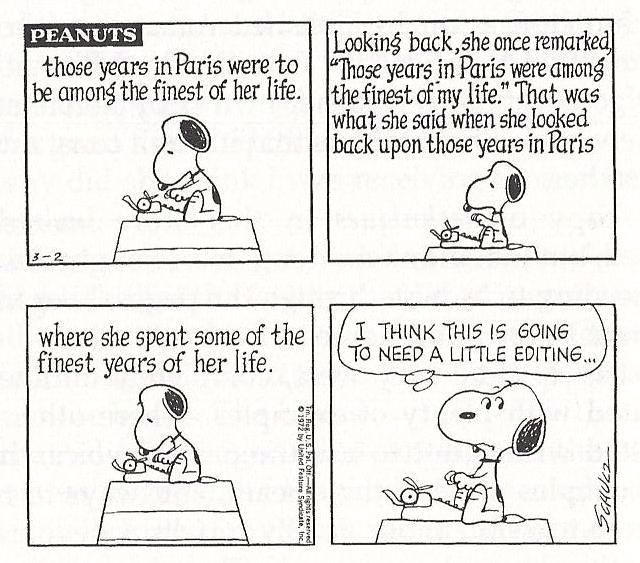
Michelle Ruberg cites the example of Marge Simpson who sets out to write a story.  She writes the first paragraph and then clicks spell check.  That is her first mistake:  writers should separate the writing process from the editing process.  When writing that first draft, "Let it flow; get everything on the page," says Ms. Ruberg.  If you listen to your inner critic at this stage, you will stifle your voice and your creativity.  

With the first draft complete, take a break for a day or two.  Let it digest.  Work on another writing project or putter in the garden.  Come at if from a fresh perspective, with new eyes.  Pretend you are looking at your writing for the first time.  Critically re-read your piece with a fine tooth comb.  It's not a once over, it's a process.  Ms. Ruberg separates the process into four parts:  focus, organization, style and grammar.

1.  Focus

What is the major impression you want to make on the reader?  Summarize your theme in one or two sentences.  If you can't, it must not be strong enough.  As you re-read your article, make sure that everything points towards that central theme.  If not, take it out or rewrite it.

2.  Organization

Does your article flow?  Are your points presented in a logical sequence?  Do you link your points with easy transitions?  Do you repeat the same points or words?  Have you left some paragraphs sparse?  Re-read your piece twice.  Print it out and read it aloud, giving you more of an "outside reader" perspective.

3.  Style

Is your style interesting and easy to read?  Do you use your own voice?  Does it shine through?  Does your lead ex. quote, anecdote hook the reader in?  Do your paragraphs flow?  Have you tied your ending to your beginning?  Have you left the reader satisfied or have you left him or her hanging?  Is your content style and tone reflective of the current market?  Is your word count under the maximum amount?

4.  Grammar

Have you peppered your piece with strong verbs?  According to Ms. Ruberg, "strong verbs equals strong writing".  "To be" is one of the weakest verbs; replace it with a more interesting choice. Change the passive voice to the active voice.  Again, this makes your piece more convincing. Change nouns to verbs, especially those that end in "ing" (gerunds).  Eliminate adverbs and replace them with stronger verbs.  Replace noun/adjective combinations with stronger nouns when possible. Ms. Ruberg says this will strengthen your writing and lower your word count.  Make sure your tense is consistent as well as your point of view.  Use a good grammar reference to check punctuation. Make a checklist of your most common mistakes.  Finally, re-read your article backwards to find errors you missed.  Here is a chance to catch repetitions and overused words.

Happy Editing!

Note:  For more information, read Writer's Digest Handbook of Magazine Article Writing (Michelle Ruberg).


Snoopy is breaking the first commandment of editing:  "Thou shalt not combine thy writing and thy editing" courtesy http://arnoldzwicky.s3.amazonaws.com/PeanutsEditing.jpg.