Showing posts with label Focus. Show all posts

Tuesday, 24 March 2015

Editing Your Article: Get Ready to Roll Up Your Sleeves

"When you have the first draft of your article done, then revision begins.  Get ready to roll up your sleeves, because this is the real work, and often, the real fun." (Michelle Ruberg)


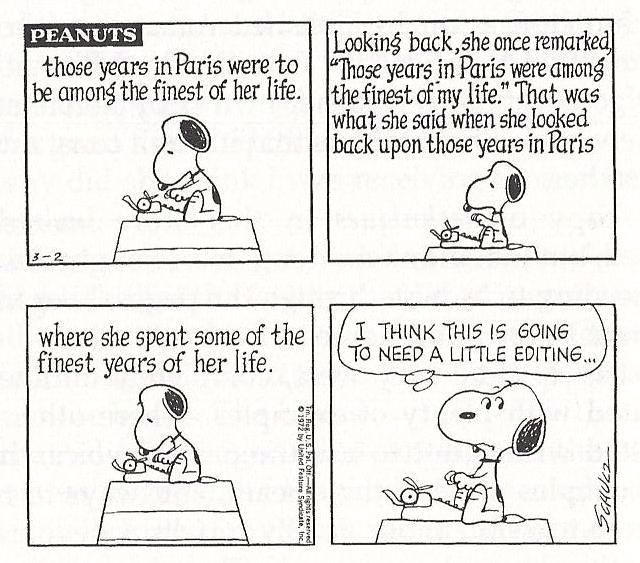
Michelle Ruberg cites the example of Marge Simpson who sets out to write a story.  She writes the first paragraph and then clicks spell check.  That is her first mistake:  writers should separate the writing process from the editing process.  When writing that first draft, "Let it flow; get everything on the page," says Ms. Ruberg.  If you listen to your inner critic at this stage, you will stifle your voice and your creativity.  

With the first draft complete, take a break for a day or two.  Let it digest.  Work on another writing project or putter in the garden.  Come at if from a fresh perspective, with new eyes.  Pretend you are looking at your writing for the first time.  Critically re-read your piece with a fine tooth comb.  It's not a once over, it's a process.  Ms. Ruberg separates the process into four parts:  focus, organization, style and grammar.

1.  Focus

What is the major impression you want to make on the reader?  Summarize your theme in one or two sentences.  If you can't, it must not be strong enough.  As you re-read your article, make sure that everything points towards that central theme.  If not, take it out or rewrite it.

2.  Organization

Does your article flow?  Are your points presented in a logical sequence?  Do you link your points with easy transitions?  Do you repeat the same points or words?  Have you left some paragraphs sparse?  Re-read your piece twice.  Print it out and read it aloud, giving you more of an "outside reader" perspective.

3.  Style

Is your style interesting and easy to read?  Do you use your own voice?  Does it shine through?  Does your lead ex. quote, anecdote hook the reader in?  Do your paragraphs flow?  Have you tied your ending to your beginning?  Have you left the reader satisfied or have you left him or her hanging?  Is your content style and tone reflective of the current market?  Is your word count under the maximum amount?

4.  Grammar

Have you peppered your piece with strong verbs?  According to Ms. Ruberg, "strong verbs equals strong writing".  "To be" is one of the weakest verbs; replace it with a more interesting choice. Change the passive voice to the active voice.  Again, this makes your piece more convincing. Change nouns to verbs, especially those that end in "ing" (gerunds).  Eliminate adverbs and replace them with stronger verbs.  Replace noun/adjective combinations with stronger nouns when possible. Ms. Ruberg says this will strengthen your writing and lower your word count.  Make sure your tense is consistent as well as your point of view.  Use a good grammar reference to check punctuation. Make a checklist of your most common mistakes.  Finally, re-read your article backwards to find errors you missed.  Here is a chance to catch repetitions and overused words.

Happy Editing!

Note:  For more information, read Writer's Digest Handbook of Magazine Article Writing (Michelle Ruberg).


Snoopy is breaking the first commandment of editing:  "Thou shalt not combine thy writing and thy editing" courtesy http://arnoldzwicky.s3.amazonaws.com/PeanutsEditing.jpg.


Thursday, 22 January 2015

Be Accountable

"The more you publicly commit to an attitude, the better able you are to resist any attempts to change it and this is largely due to those increases in confidence and perceived importance." (blogs.scientificamerica.com)


In this social media society, many people announce their New Year's resolutions on Facebook. Declaring your intentions can make you feel one step closer to your goal.  Also, committing publicly to a plan makes you accountable to your family and friends.  Others might jump in the boat with you, offering their support.  Some might cheer you on privately.  Making your plans public is also a good way to connect with like-minded people.  

There could be a down side to sharing your resolutions with the public.  Such an announcement could invite comments from naysayers, people who are negative or simply jealous of the thought of you accomplishing something that they haven't.  I read online that some studies show that when you tell others about your plans, you are less likely to achieve them because in the act of telling, you think you've already performed the task.  Don't mistake the act of commitment for progress.  

If you prefer not to announce your goals to the world, just tell your best friend.  Make periodic reports on your progress.  At the very least, if you prefer to tell no one, have a reward system if you stick to your plan and a deterrent system if you stray from your plan.  Accountability helps you stay focussed on the task at hand.  

For more information, read Done and Done:  The Power of Accountability Partnering for Reaching Your Goals by Annette Lyon and Luisa Perkins (2014) at http://www.amazon.com/Done-Power-Accountability-Partnering-Reaching/dp/1497443261.


pinimg.com


Tuesday, 4 November 2014

Thomas' First Driving Lesson

It seems like just yesterday that I attended my first in class driving lesson.  It was February of 1983.  I remember that my brother Bill had brought home chicken pox from school and given them to me. But I was bound and determined not to miss any of my driving lessons.  So I went anyway.  Luckily, I had a moderate case.  By April, my sister Lisa took me for my first in car driving lesson.  I drove around the parking lot of Limeridge Mall in our family station wagon.  

Now it is Thomas' turn.  Sunday morning I took him to Lynden Park Mall and he drove our Focus around the back parking lot three times.  He was so proud of himself that he didn't make any mistakes.  Tonight, I drove him downtown for his first in class lesson.  Mike, a nice man with a cowboy hat, registered Thomas.  I peeked into the classroom -- it was packed!  Most of Thomas' classmates are boys.  I don't know whether that's a coincidence or not.

So, he's officially started down the road to his licence.  I don't know whether I'm ready for the questions:  "Mom, can I have the car for school?"  "Mom, can I have the car for a date?"  I don't know if I'm ready to sit in the passenger seat, pressing on an imaginary brake as Thomas narrowly misses a curb.  I don't know if I'm ready for the worrying, the staying up late waiting for him to come home.

But getting your licence is a rite of passage.  All of my siblings and I started at 16.  We loved it!  And the younger you learn to drive, the easier you pick it up.  I know too many people who started later in life and turned out to be nervous drivers.  So,buckle up, Brantford, Thomas is coming!

Note:  Visit http://fatherhood.about.com/od/dadsandteens/a/teach_driving.htm for tips about teaching your teenager how to drive.