Showing posts with label word count. Show all posts

Thursday, 26 March 2015

How to Flavour Your Article with Anecdotes

"Anecdotes are like raisins in oatmeal cookies.  Sure, you can eat the cookies without them, but you'll miss out on the added flavour, contrasting texture and enhanced nutrition." 
(Michelle Ruberg in Writer's Digest Handbook of Magazine Article Writing)


Anecdotes don't just fall out of the sky onto your page like "manna", according to Michelle Ruberg. As a writer, you must search for them during your research and interviews.  While you are recording your names, dates and places, don't forget to include an anecdote or two.

Michelle Ruberg suggests that you draw them out of your subject by asking open-ended questions ex. "Tell me what happened when..." or "Describe what you saw when..."  Ideally, a face to face interview is the most productive.  Much of what we say is non-verbal, conveyed by our gestures and facial expressions; these are thing you can't pick up in a telephone conversation.  Don't forget to look for cultural distinctions and nuances as well.

As part of your research, documents can be a good source for anecdotes.  Eric Freedman, author of Pioneering Michigan, used a letter written by Jefferson Gage Thurber to his New England family to illustrate the panic following the 1832 cholera epidemic in Detroit.

"The panic at the time exceeded anything I ever imagined.  The timidity of our border settlers from sudden incursions of the Indians forms but a faint comparison.  I have no doubt from what little experience and observation I have had that fear has killed as many as the cholera." 

Where does an anecdote go in the article?  According to Michelle Ruberg, anywhere that it fits.  Steve Wilson's Folio magazine profile started with an Evel Knievel anecdote.

"One evening in 1973...Bob Bitchin pulled his chopper up to a stoplight on the Sunset Strip in Los Angeles.  He made eye contact with a man in a fur coat behind the wheel of a Ferrari.  When the light turned green, they raced.  The driver (who won) turned out to be Evel Knievel, and their late night of partying and entanglement with the law later made it into a Rolling Stone article."

Immediately upon reading this anecdote, your interest is piqued.  It pulls you in and makes you want to keep reading.

You can also put an anecdote at the heart of your piece as William Goldman did in his New York magazine article about wrestler turned film star Andre the Giant.  After being treated to several meals by Andre the Giant, Arnold Schwarznegger invited him out to dinner.

"...late in the meal, he snuck into the kitchen to give his credit card to the maitre d'.  As he was about to do this, he felt himself being lifted up into the air.  'When he had me up in the air, he turned me so I was facing him and he said:  'I pay.'  Then he carried me back to the table and set me down like a little boy.'  Oh yes, Andre was very strong."

The image I have of Andre the Giant lifting up former body builder Arnold Schwarznegger like a little boy is a powerful one.

An article can also end with an anecdote to drive a point home.  Douglas Preston included one in his National Geographic article about Cambodia.  He touched an ancestor stone, then:

"ran my finger through the cool grove of a lotus tree.  Here, broken soldiers from an Angkor temple had been put in the service of an even more ancient religion.  One of our soldiers, a skinny, barefoot teenager with an AK-47 slung over his shoulder, stopped at the shrine,placed his hands together and bowed deeply in an act of veneration.  A gecko called twice, and then the forest fell silent in the stifling noon day heat.  Life went on in this strange, timeless land."

Note the sharp words and vivid imagery Mr. Preston uses, just as you would see in a fiction piece.

Michelle Ruberg reminds you to write tightly when including anecdotes.  "An overly long and wordy anecdote detours readers".  If your word count is 1000, and you include an anecdote of 350 words, that only leaves you 750 words for the rest of your article.  However, if your word count is double that, you might have room for such an anecdote.

Think like a fiction writer.  Use devices like plot, dialogue, characterization, sharp words and description when writing an anecdote.  Remember, your anecdote should bolster your point; it should be more than just "window dressing".  If you have too many to fit in your piece, save the remaining anecdotes for future writing assignments.

Note:  For more information, visit http://resources.writersonlineworkshops.com/resources/using-anecdotes-to-flavor-your-articles/.




Wednesday, 25 March 2015

When an Editor Wants a Rewrite

"Editors are frantically busy -- single-working-mother-with-eight-kids busy -- they don't have time to make every piece into exactly what they want it to be.  By delivering a rewrite and otherwise leaving the editor alone, you turn your editor's time poverty to your advantage."  (http://www.helpingwriters.com/newsletter-archives/when-an-editor-wants-a-rewrite)


When an editor requests a rewrite of an article, it's usually a minor rewrite, where the bulk of the piece can be saved.  While it's frustrating to have to rewrite your work, keep in mind that an editor is trying to anticipate the needs of the magazine.  It doesn't necessarily mean that your writing is poor; it might just mean that you and the editor are coming at the piece from a different angle.

Keep in mind what Online Health editor Kathleen Donnelly advises:  "Writers who are intractable and fight with us probably won't get another assignment".  Unless you are Pierre Berton, who flew in the face of editors, you have to have at least some respect for the process.

What steps should you take to rewrite your article?  Michelle Ruberg suggests these steps.  First, re-read your query to see what you promised the editor.  Second, re-read your assignment to see what the editor requested of you.  Third, re-read your article and look for the following.  Did you do one of the following?

-overshoot/undershoot your word count?
-write news that already appears elsewhere in the newspaper or magazine?
-cite too few sources?
-conduct garbage in/garbage out interviews?
-write a piece that is too close to what the competition is publishing?
-come at the article from the wrong angle?
-under/overwrite the piece for the target audience?
-use too many qualifiers, digressions or prepositional phrases?
-use too many quotes regarding a point already made?

What happens if you rewrite the piece and the editor still doesn't like it?  Michelle Ruberg recommends asking the editor to rework one of your paragraphs.  You follow the model for the other paragraphs.  Use the three P's:  patience, persistence and adherence to procedure.  Don't focus just on the structure of the writing.  Brian Smith of Indianapolis Monthly warns:  "Some writers worry so much about getting individual facts straight that they don't hear the flow and what it does to the cadence of the story."

Michelle Ruberg says that any extra calls or extra trips on behalf of the magazine should be compensated.  Request to see the galley of your piece before it goes to print.  That way you're not attaching your name to something that you don't agree with.  Stop at three rewrites.  Enough is enough!

Blogger Scott Edelstein recommends that you don't mindlessly follow the editor's suggestions. Make changes that seem reasonable, but at the same time, do what's best for the piece.  "Editors are frantically busy -- single-working-mother-with-eight-kids busy -- they don't have time to make every piece exactly what they want it to be.  By delivering a rewrite and otherwise leaving the editor alone, you turn your editor's time poverty to your advantage." 

Note:  For more information, read Writer's Digest Handbook of Magazine Article Writing (Michelle Ruberg).


Tuesday, 24 March 2015

Editing Your Article: Get Ready to Roll Up Your Sleeves

"When you have the first draft of your article done, then revision begins.  Get ready to roll up your sleeves, because this is the real work, and often, the real fun." (Michelle Ruberg)


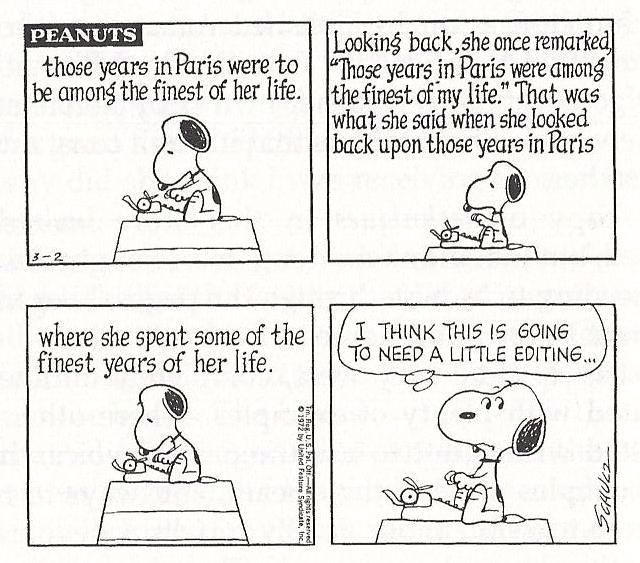
Michelle Ruberg cites the example of Marge Simpson who sets out to write a story.  She writes the first paragraph and then clicks spell check.  That is her first mistake:  writers should separate the writing process from the editing process.  When writing that first draft, "Let it flow; get everything on the page," says Ms. Ruberg.  If you listen to your inner critic at this stage, you will stifle your voice and your creativity.  

With the first draft complete, take a break for a day or two.  Let it digest.  Work on another writing project or putter in the garden.  Come at if from a fresh perspective, with new eyes.  Pretend you are looking at your writing for the first time.  Critically re-read your piece with a fine tooth comb.  It's not a once over, it's a process.  Ms. Ruberg separates the process into four parts:  focus, organization, style and grammar.

1.  Focus

What is the major impression you want to make on the reader?  Summarize your theme in one or two sentences.  If you can't, it must not be strong enough.  As you re-read your article, make sure that everything points towards that central theme.  If not, take it out or rewrite it.

2.  Organization

Does your article flow?  Are your points presented in a logical sequence?  Do you link your points with easy transitions?  Do you repeat the same points or words?  Have you left some paragraphs sparse?  Re-read your piece twice.  Print it out and read it aloud, giving you more of an "outside reader" perspective.

3.  Style

Is your style interesting and easy to read?  Do you use your own voice?  Does it shine through?  Does your lead ex. quote, anecdote hook the reader in?  Do your paragraphs flow?  Have you tied your ending to your beginning?  Have you left the reader satisfied or have you left him or her hanging?  Is your content style and tone reflective of the current market?  Is your word count under the maximum amount?

4.  Grammar

Have you peppered your piece with strong verbs?  According to Ms. Ruberg, "strong verbs equals strong writing".  "To be" is one of the weakest verbs; replace it with a more interesting choice. Change the passive voice to the active voice.  Again, this makes your piece more convincing. Change nouns to verbs, especially those that end in "ing" (gerunds).  Eliminate adverbs and replace them with stronger verbs.  Replace noun/adjective combinations with stronger nouns when possible. Ms. Ruberg says this will strengthen your writing and lower your word count.  Make sure your tense is consistent as well as your point of view.  Use a good grammar reference to check punctuation. Make a checklist of your most common mistakes.  Finally, re-read your article backwards to find errors you missed.  Here is a chance to catch repetitions and overused words.

Happy Editing!

Note:  For more information, read Writer's Digest Handbook of Magazine Article Writing (Michelle Ruberg).


Snoopy is breaking the first commandment of editing:  "Thou shalt not combine thy writing and thy editing" courtesy http://arnoldzwicky.s3.amazonaws.com/PeanutsEditing.jpg.