Showing posts with label format. Show all posts

Tuesday, 17 February 2015

What is the Magic Number for a Blog Post?

When I first started blogging, I was told that 500 words was the ideal length for a post, just enough substance for the reader to bite his teeth into but not so long that he doesn't read until the end. However, recently I have heard that longer posts are the way to go.  How long, then, is the ideal blog post?

Is there a minimum length for a post?  Bloggers recommend that posts be at least 250 words in length to optimize your search engine results.  On the other hand, if a post exceed 1000 words, some bloggers recommend that it be broken up into a series of posts.

Most bloggers seem to agree that the each post should be written succinctly.  Headings help break up the text and make the post more scannable for the reader.  Short paragraphs are preferable to longer ones.

Blogger Neil Patel outlines several factors which affect the length of a post.  They are:

1.  Substance:  What does your topic require?  If it is fun and lighthearted many a short post is best.  However, if it is a serious subject, or a controversial one, it likely requires more substance.

2.  Style:  What is your writing style ex. short and brief versus long and conversational?

3.  Frequency:  If you post rarely, chances are each post will be lengthy and well thought out.  If you most every day, your posts are likely to be shorter.

4.  Format:  Do you use subheadings and short paragraphs?  These techniques help break up a long post.

5.  Purpose:  If you run a business blog, you might be pitching a product.  If your blog is personal, you might be telling a story or trying to spark a conversation.

6.  Audience:  What are the needs, interest, passions or problems of your audience?

7.  Medium:  Do you include infographics, videos or podcasts?  If so, your word count is less relevant.


According to Neil Patel, long blog posts perform better than short ones on all levels.  There are over 200 factors which determine how your content ranks in SERP (Search Engines Results Page).  The more content you have, the better chance you will achieve a top position in Google search results. Therefore, more readers will see your post.  According to one blogger, the ideal length for a blog post is 1600 words -- the magic number (https://blog.bufferapp.com/optimal-length-social-media).


blogspot.com

P.S.  In case you're wondering, this post is only 400 words.  

Monday, 9 February 2015

Designing Your Blog Layout

You only have a few seconds to catch a web surfer's interest with your blog.  You want to make your blog design attractive, to get the reader's attention, and easy to navigate, to get the reader to stay. Susan Getgood, in Professional Blogging for Dummies, (http://www.goodreads.com/book/show/7947250-professional-blogging-for-dummies) outlines a few points to remember when designing your blog.

Masthead

Your masthead, which includes your title, tagline and/or a graphic, is the first thing that readers see. It doesn't hurt to devote some time and effort to it.  Consider which colour scheme you would like. Should it match an already existing website?  My blog masthead does not have a photo or picture per se, but my background does include a world map.


Talbert Talks Travel incorporates a beautiful photo above its masthead at www.miamibeach411.com.


Logo

If you decide to include a logo, you have the option of making it yourself or hiring a professional. You can go to www.istockphoto.com to find free photos.  Similarly, you can obtain a Creative Commons license to have access to free graphics.  If you have your heart set on a unique, professional look, hire a graphic artist to design your logo ($500-$1500).


Kitchen Girl has a professional looking logo at www.tastydays.com.


Other Imagery

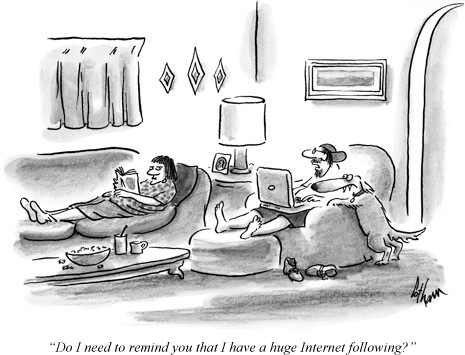
If your blog is a business one, you will want to include product photos, graphics and logos.  If you have a humorous blog, you might include cartoons.


A little humour never hurts courtesy wordpress.com.


Format

How many columns do you want?  Where will you place your main post:  to the left, to the right or in the centre of the blog?  My blog home page shows my blogroll at the top left, my top five posts at the bottom left.  To the right, I have a blog counter and my blog followers under which I have my blog archives.


This Beauty Blog has a neat, easy to scan layout at advicesacademy.netdna-cdn.com.


Widgets, Buttons, Badges

Buttons are the small, clickable graphics that link to web content.  Badges are bigger buttons which are used as promotional tools.  Widgets have functionality ex. search features, blogrolls, recent visitors, Twitter posts, RSS feeds.


Good use of widgets, buttons & badges at May Dreams Gardens at 


Advertising/Sponsors

Decide whether or not you would like to provide advertisements on your blog.  You can advertise through Google Adsense.  What types of advertising would you like and what size will the ads be? You have to remember:  how will ads affect the overall look of your blog?  Typically, the blogs that I read seem to have two or three ads running at a time.  Too many can crowd out the blog posts and turn readers off.


Bakerella incorporates ads into its blog nicely at www.bakerella.com


Surf the Internet and look for blogs that you find attractive and that you find easy to navigate.  Try to imitate their designs.

For more information, visit http://www.successfulblogging.com/16-rules-of-blog-writing-which-ones-are-you-breaking/.

For a blog setup tutorial with Wordpress. Visit https://www.siteground.com/tutorials/blog/wordpress.htm.