Showing posts with label Tuskegee Institute. Show all posts

Saturday, 30 July 2016

C. Alfred Anderson: The Father of Black Aviation

His first flight was in a Velie Monocoupe in 1929.  He flew over the Atlantic.  And he flew with First Lady Eleanor Roosevelt in 1941.  He was The Father of Black Aviation.


Born and raised in Bryn Mawr, Pennsylvania, C. Alfred Anderson was always fascinated with flight.  He saved his money and at 20, had enough to take flying lessons.  However, because of his race, no one would teach him how to fly.  Anderson realized the only way he would learn was if he bought his own airplane.  With his savings and loans from friends, he purchased a Velie Monocoupe, which he taxied up and down the runway of the local airport, eventually going fast enough to take off.  He taught himself how to land successfully.  Even so, no one would give him formal lessons.


Local flying club member and experienced pilot Russell Thaw needed an airplane to visit his Mom on weekends in Atlantic City.  Anderson needed lessons.  Thaw rented and flew Andersons' plane in exchange for lessons; he earned his sought after pilot's licence in 1929.  Not stopping there, Anderson sought to obtain his air transport licence.  With race again an obstacle, it was "The Flying Dutchman" who came to his aid when German pilot Ernst Buehl was asked to open transcontinental airmail routes in the United States.  By 1932, Anderson became the first black to obtain an air transport licence.


In 1940, the Tuskegee Institute debuted a new program to train black pilots and hired Anderson as its Chief Civilian Flight Instructor.  The following year, First Lady Eleanor Roosevelt toured the Tuskegee Institute Hospital, and knowing of the new air program, asked to meet its flight instructor.  Eleanor Roosevelt told Anderson that when she was growing up, she had heard that "colored people couldn't fly".  Despite her security detail's reservations, the First Lady requested a flight with Anderson and he obliged, shattering the racial stereotype and confirming what she already suspected.
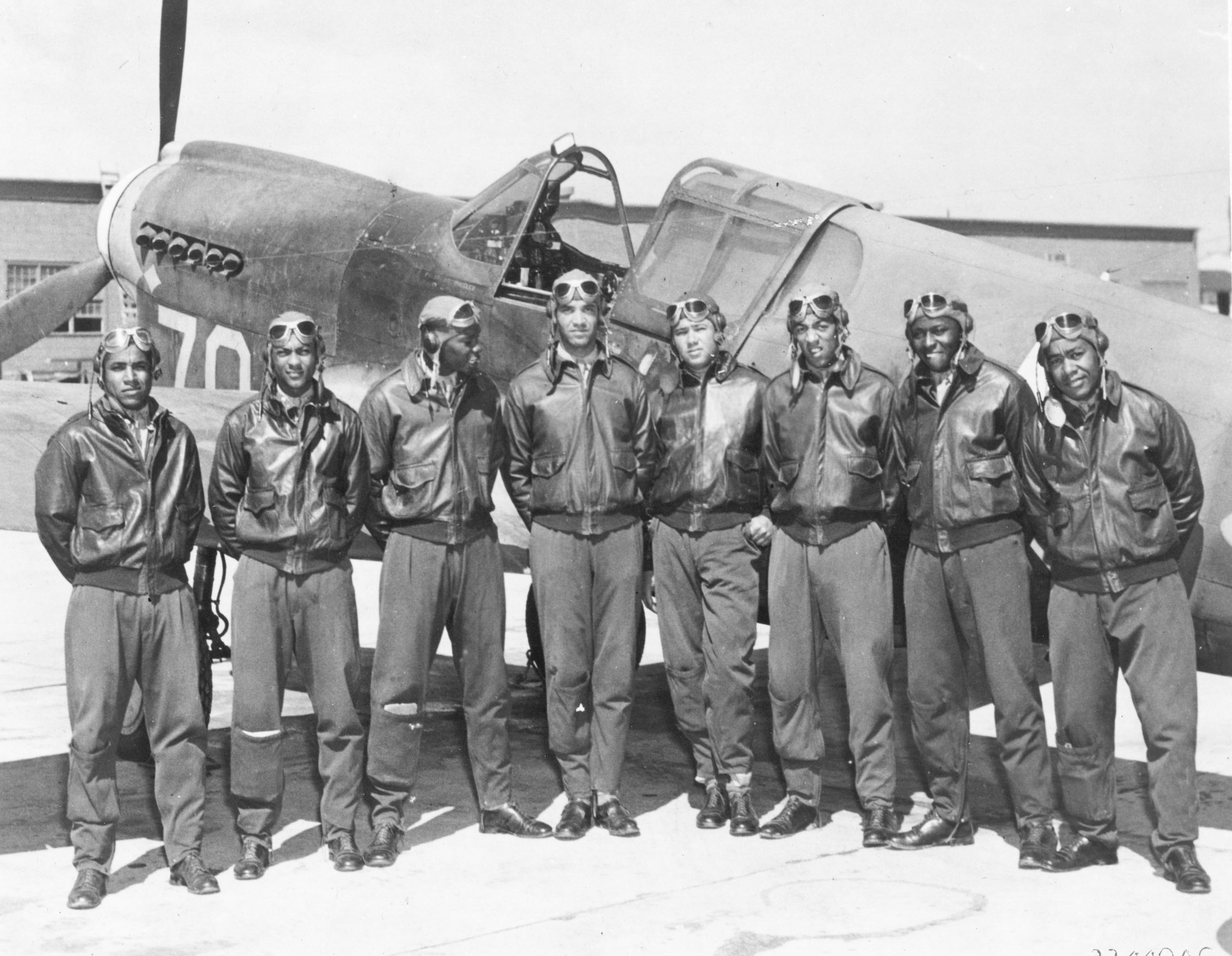


Anderson went on to instruct the 99th Air Squadron, the first all black fighter squadron.  Joining three other black squadrons, the Tuskegee Airmen flew 1378 combat missions, destroyed 260 enemy planes and earned over 150 Flying Crosses.
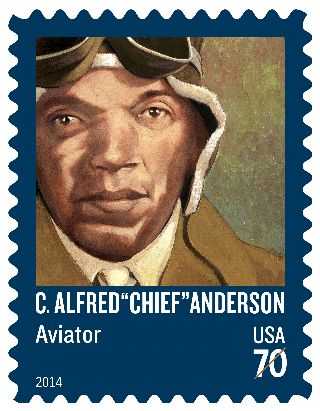


C. Alfred "Chief" Anderson Stamp


For more information, read The Tuskegee Airmen:  An Illustrated History 1939-1949 at http://www.newsouthbooks.com/bkpgs/detailtitle.php?isbn_solid=1588382443.

Monday, 19 October 2015

George Eastman: Camera Magnate was Methodical Self-Educator

"The progress of the world depends almost entirely upon education.  I selected a limited number of recipients because I wanted to cover certain kinds of education and I felt that I could get results with those named quicker and more directly than if the money were spread." (George Eastman)


Millionaire businessman George Eastman was not born with a silver spoon in his mouth.  He lost his father at 7 and was forced to become the man of the household.  His adversity, however, seemed to drive him forward.  He amassed a fortune with the Eastman Kodak Company, which rather than spending on himself, he chose to invest in education.

George Eastman's parents were both born and raised in abolitionist households.  They believed in the importance of education.  Eastman's father founded a college which would serve as a prototype for America's first business schools.  Tragedy struck when he died, leaving his seven year old son to be the head of the household.  George's mother took in boarders, but he felt badly that she had to cook and clean for these strangers.  Tragedy struck again when George's sister fell ill with polio and died at 16.  

At 13, George quit school to start making money to support his family.  He worked both as a messenger boy and as an insurance salesman.  Following in his father's footsteps, he took a job at a bank where he would work all day, six days a week.  Evenings he spent tinkering with his new purchase, a camera.  George would work well into the night, experimenting with photo emulsions.  He would take catnaps, waking himself at regular intervals to stir the emulsions.  George was constantly trying to educate himself.  

George opened a camera and photography supply business which dominated the market by the turn of the last century.  He amassed a fortune which simply sat in a bank account, accumulating pennies for interest.  George decided to donate his money to the cause of education.  He built one of the best music schools in the world, the Eastman School of Music in Rochester, New York.  He donated upwards of $20 million to the Massachusetts Institute of Technology and more than $50 million to the University of Rochester.  And in keeping with his abolitionist roots, he supported the cause of black education, donating to the Tuskegee Institute and Hampton Institute.  These donations were often done anonymously as George was not one for self-aggrandizement. 


Eastman relaxing in his library courtesy http://www.kodak.com/ek/US/en/George_Eastman.htm.

Tuesday, 13 October 2015

Booker T. Washington: A Hunger for Learning

"Booker's first exposure to education was from the outside of a school house near the plantation; looking inside, he saw children his age sitting at desks and reading books.  He wanted to do what those children were doing, but he was a slave, and it was illegal to teach slaves how to read and write." (www.biography.com)


Booker T. Washington worked as a slave on a Virginia plantation, clad only in a large t-shirt since his owner refused to buy him pants.  He used to lug 100 pound sacks of grain to the mill on the back of a mule.  If the sack fell off, he would have to wait until someone came along to help him hoist it back onto the mule.  Returning late, his owner would whip him for his tardiness.

"Booker's first exposure to education was from the outside of a school house near the plantation; looking inside, he saw children his age sitting at desks and reading books.  He wanted to do what those children were doing, but he was a slave, and it was illegal to teach slaves how to read and write."  His mother, seeing his interest in learning to read, gave him a book from which he learned the alphabet. (http://www.biography.com/people/booker-t-washington-9524663#tuskegee-normal-and-industrial-institute)

When the Civil War ended, Booker and his mother were freed.  His mother had remarried, and along with his stepfather, he moved to West Virginia.  There, he and his stepfather secured work in a salt mine.  But Booker's heart was not in it.

A nearby plantation owner's wife, Mrs. Ruffner, was looking for a houseboy and gardener.  Rumor had it that Mrs. Ruffner was very particular and had high standards.  Booker was up to the task.  He impressed his employer so much that she gave him books to read.  She taught him proper English, history and math.  She encouraged him to take pride in his work, even if it was physical labour. (http://lookingglassreview.com/books/a-hunger-for-learning-a-story-about-booker-t-washington) 

At 16, Booker wanted to attend university so badly that he walked 500 miles to the Hampton Institute.  There, he took a job as a janitor to finance his school tuition.  His hard work earned him a scholarship.

Upon graduation, he taught for a short time in an elementary school.  Within four years, he was offered a teaching position at his alma mater.  In 1881, the Alabama legislature approved $2000 for a colored school.  Booker headed up the new Tuskegee Institute until his death in 1915.


READ ARTICLE: W.E.B. Du Bois, Booker T. Washington and the Origins of the Civil Rights Movement