
Showing posts with label Christmas Eve. Show all posts
Showing posts with label Christmas Eve. Show all posts
Saturday, 24 December 2016
Remember the Night
Remember the Night is a Christmas film which debuted in 1940. A young woman, played by Barbara Stanwyck, is arrested for shoplifting on Christmas Eve. The district attorney assigned to her case, played by Fred McMurray, pushes to have her trail postponed until after the Christmas vacation. In the meantime, the accused and the lawyer fall in love. In a twist of fate, "love reformed her and corrupted him". A series of events threaten to send the young couple to jail.

Tuesday, 20 December 2016
Holiday Inn
Jim: "Lila's back in New York. I got a letter from her yesterday."
Ted: "What happened to her millionaire?"
Jim: "Slight mistake there. He didn't own millions, he owed them."
Ted: "Poor girl. Always straying to greener pastures and finding spinach."

Bing Crosby sings "White Christmas" courtesy http://basementrejects.com/review/holiday-inn-1942/
Holiday Inn is actually the prequel to the movie White Christmas. The film stars Bing Crosby as Jim Hardy and Fred Astaire as his partner Ted Hanover and Virginia Dale as Lila. The trio runs a musical act in New York City. On Christmas Eve, Jim plans to retire from the act and move to a Connecticut farm with his fiancee, Lila. However, at the last minute Lila says she has fallen in loved with Ted. Jim pursues his plan despite Lila's bombshell.
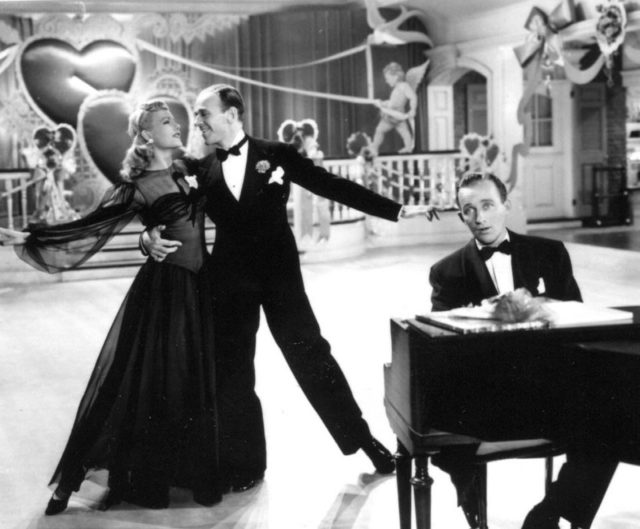
After a year, Jim returns to New York City saying that he has struggled to make ends meet as a farmer and wants to turn his barn into a "holiday inn". He is searching for talent to fill his inn. On Christmas Day singer Linda Mason (Marjorie Reynolds) shows up at the inn. Smitten by her, Jim plays his new tune "White Christmas". In the meantime, Ted is crushed when Lila announces she is leaving him for a Texas millionaire. He meets Linda and discovers that he too is falling in love with the singer. The ensuing year unrolls at the inn with shows staged at the following holidays:
- Lincoln's Birthday (Ted is searching for Linda, but Jim disguises her in his act)
- Valentine's Day (Jim serenades Linda with "Be Careful It's My Heart")
- Washington's Birthday (Ted asks Linda to be his new dance partner)
- Easter (Irving Berlin's Easter Parade is performed)
- Independence Day (Ted & Linda are offered a deal in Hollywood)
- Thanksgiving (irritated that Jim has tried to interfere with her Hollywood offer, she takes the job despite his wishes; Jim, depressed, can't touch his Thanksgiving dinner; Jim's maid implores him to travel to California to win Linda back)
- Christmas Eve (Jim revives his rendition of White Christmas, accompanied by Linda; they live happily ever after at Holiday Inn)

Sunday, 18 December 2016
The Bishop's Wife
"I was praying for a cathedral." (Henry)
"No, Henry you were praying for guidance." (Dudley)

Dudley decorates the Christmas tree courtesy https://www.pinterest.com/pin/92394229825568244/.
The Bishop's Wife, based on a novel of the same name published in 1928, debuted in 1947 in New York City. Bishop Henry Brougham, played by David Niven, is troubled about coming up with the funds for his new cathedral. Praying for divine guidance, God sends him an angel, Dudley, played by Cary Grant. Dudley tries to drum up financial support for the church, all the while convincing a woman to donate money to the poor and even typing one of the bishop's sermons. The angel, sensing that the bishop's wife and young daughter have been neglected while he concerns himself with the new cathedral, steps in. Unexpectedly, Dudley finds himself falling in love with the wife, Julia, played by Loretta Young. Dudley realizes he must take a step back and retreats, observing the bishop delivering the Christmas Eve sermon he had typed on the typewriter. Even though the cathedral hasn't been built, the marriage has been restored. His work is complete.

Cary Grant in New York City courtesy https://www.pinterest.com/pin/542965298796790954/.
Thursday, 15 December 2016
The Shop Around the Corner
.webm/260px-seek%3D15-The_Shop_Around_the_Corner_trailer_(1940).webm.jpg)
Mr. Matuschek's Shop Around the Corner courtesy https://en.wikipedia.org/wiki/The_Shop_Around_the_Corner.
Many movie fans are familiar with the love story You've Got Mail starring Tom Hanks and Meg Ryan. However, many are unfamiliar with its precursor, The Shop Around the Corner. Based on a Hungarian play called Parfumerie, this classic film stars Jimmy Stewart as a shop clerk who starts up a pen pal romance with a dream girl. Little does he know that his dream girl is his annoying co-worker at the shop, Klara.
The two plan to meet for a dinner date in which Alfred is ready to propose marriage if it goes well. However, their boss, Mr. Matuschek, insists that they work late that night. The shopkeeper seems in a miserable mood which the co-workers chalk up to his personality. Later, he fires Alfred for no apparent reason. Later, the delivery boy Pepi arrives at the shop to find Mr. Matuschek ready to commit suicide, despondent that his wife is having an affair. He had suspected Alfred of being the other man, but a private investigator he hired tells him the culprit is another employee.
A second attempt at a dinner date ends with Alfred, realizing that Klara is his mystery woman, claiming that he is at Cafe Nizza to meet someone else. Klara declares that the man whom she waits for is "far superior" to a "little insignificant clerk" like Alfred.
The shopkeeper re-hires Alfred and two weeks later, on Christmas Eve, the shop enjoys record sales. Alfred wants to go out and celebrate but he has no one to join him. Klara reads Alfred a letter from her admirer. Alfred finally admits that he indeed is the admirer.

Christmas Eve at the Shop Around the Corner courtesy http://theredlist.com/wiki-2-17-513-863-820-835-view-comedy-romance-2-profile-1940-bthe-shop-around-the-corner-b.html.
Saturday, 3 December 2016
White Christmas
"Snow! It won't be long before we'll all be there with snow.
Snow! I want to wash my hands and face in snow."
I'll never forget the first time my husband Rob watched the movie "White Christmas"; he would crack up everytime Bing Crosby, Danny Kaye, Rosemary Clooney and Vera-Ellen broke into song. Yes, the movie is corny, but it's the corniness that makes it so endearing: the corny songs, the corny sets, the corny plots. The opening scene takes place during Christmas of 1944 in battle-torn Europe when a building is about to fall on Bing Crosby's character, Bob Wallace, and Danny Kaye's character, Phil Davis, saves him at the last second. Forever after, the former is beholden to the latter and he never lets him forget it.
After the war, Wallace & Davis start a song and dance act and become famous on the radio and on Broadway. They meet a female act in Florida, the sisters of an army buddy named Freckle-Faced Haynes, and listen to their floor show ("Sisters"). After an impromptu dance to "The Best Things Happen While You're Dancing" between Phil and Vera-Ellen's character, Judy, the sisters are charged with damaging their hotel room rug and make a hasty exit, with help from the men.

Matchmaker Phil learns that the women are travelling to Vermont to do a stage show for Christmas and he talks his friend into going along. Boarding the train, the foursome gets to know each other better in the dining car, as they cozy up in a booth and sing "Snow". Arriving in Pine Tree, Vermont, the entertainers are surprised to see greenery everywhere: it has not snowed for weeks. At the inn, Phil and Bob discover that the owner is their old commanding general from the army. General Waverly is sinking into debt after investing all of his money into an inn that has no customers due to the lack of snow. Bob and Phil wrack their brains to find a way to bring patrons into the inn.

Meanwhile, Bob and Betty grow closer by the fire munching a midnight snack, singing "Count Your Blessings". Nosy housekeeper Emma eavesdrops on a conversation between Bob and Ed Harrison, a variety show host, who suggests that they invite all of the soldiers formerly under General Waverly's command to the inn and film the evening, giving Bob and Phil free advertising for their act. Emma fails to hear the rest of the conversation (Bob rejects the host's angle) and blabs to Judy who assumes Bob is just an opportunist.
At a rehearsal party that night, Bob and Betty argue, prompting Phil and Judy to announce a phony engagement, hoping that the news will make Betty realize her baby sister is taken care of and now she is free to settle down. The move backfires and Betty accepts a job offer in New York City. Bob follows her there and sits in the audience listening to a black-velvet gowned Betty sing "Love, You Didn't Do Right By Me". Later, he reveals to her that Phil and Judy's engagement is phony.

In the meantime, Bob asks Ed Harrison to announce on his show that night that all of the soldiers formerly under General Waverly's command should go to the Vermont Inn on Christmas Eve as a show of support to the general and his failing business. Phil fakes an injured ankle to prevent General Waverly from watching "The Ed Harrison Show" that evening. Meanwhile, Betty realizes the real reason that Bob is getting Ed Harrison in on the act and races back to Pine Tree just in time for the show.
Back at the ski lodge, columns of soldiers fall into line as they sing a rousing rendition of "The Old Man" for General Waverly, bringing a tear to his eye. After the song, he gives them an inspection for old times' sake, criticizing them in one breath and then saying what a beautiful sight they are in the next breath. The movie closes with snow falling outside the inn. The two couples, dressed as Mr. and Mrs. Claus, declare their love for each other as they sing: "May your days be merry and bright. And may all your Christmases be white."

Wednesday, 30 December 2015
Peter Warlock's "Bethelehem Down"
When he is King we will give him the King's gifts
Myrrh for its sweetness and gold for a crown
Beautiful robes, said the young girl to Joseph
Fair with her first born on Bethlehem down.
In 1927, journalist and poet Bruce Blunt and composer Peter Warlock were broke and living in the country in Britain. Blunt wrote the poem Bethlehem Down and Warlock composed an accompanying tune. The pair submitted it to a Christmas carol contest run by the Daily Telegraph, winning first prize and financing a night of heavy carousing on Christmas Eve in London town. With a hit on their hands, Blunt land Warlock decided to call themselves Carols Consolidated.
The piece was performed at King's College in Cambridge in 2010. Sting sang the song on one of his albums (https://www.youtube.com/watch?v=kQcoR9T7VTs).


Thursday, 24 December 2015
Joseph Mohr's "Stille Nacht" (Silent Night)
Silent night, holy night
All is calm, all is bright
Round yon virgin mother and child
Holy infant so tender and mild
Sleep in heavenly peace
Sleep in heavenly peace.
It was Christmas Eve of 1818 and Pastor Joseph Mohr of Obendorf, Austria, had a dilemma: his church organ had been destroyed by a recent flooding of the nearby Salzach river. How would he get music for the Christmas service at St. Nicholas Kirche?
Mohr grabbed a poem he had written two years before and headed to the nearest village where the church organist, Franz Gruber, lived. Gruber proceeded to write the hymn Stille Nacht, but with guitar accompaniment.
The hymn was performed many times over the next several decades. John Freeman Young wrote the English version, of three verses rather than the original six, in 1859. Today, the carol has been translated into 140 languages. The Christmas carol was simultaneously sung by German and English soldiers during the Christmas Truce of 1914. To listen to the Mormon Tabernacle Choir sing Silent Night, visit https://www.youtube.com/watch?v=2lJr99EZztU.

Tuesday, 22 December 2015
Placide Cappeau's "Cantique de Noel" (O Holy Night)
O Holy Night!
The stars are brightly shining
It is the night of the dear Saviour's birth!
Long lay the world in sin and error pining
Till he appeared and the soul felt its worth.
A thrill of hope the weary world rejoices
For yonder breaks a new and glorious morn!
Fall on your knees
O hear the angel voices
O night divine
O night when Christ was born
O night divine
O night divine.
Placide Cappeau was a one handed businessman who wrote poems as a hobby. He was also the mayor of the French town of Roquemaure. Cappeau composed a poem, Cantique de Noel, which a friend of a friend, Adolphe Adam, put to music. The tune, sometimes called by its first line "Minuit Chretiens" was first performed at a Christmas Eve midnight mass in Roquemaure in 1847.
Cantique de Noel was translated into English by Sullivan Dwight as O Holy Night and was first broadcast as a violin piece on a Massachusetts radio station on December 24, 1906. The song focusses on the birth of Jesus and the redemption of humanity. Both Cappeau and Dwight were abolitionists and therefore when the latter translated the lines of the second verse, he included: "Chains shall he break for the slave is our brother/And in his name all oppression shall cease."
Minuit Chretiens has been recorded by Mireille Mathieu in 1968 on her Chante Noel album. Celine Dion recorded O Holy Night on her 1998 album These are Special Times (https://www.youtube.com/watch?v=7OZ5MoUXKgc).

Wednesday, 2 December 2015
Phillip Brooks' "O Little Town of Bethlehem"
"O little town of Bethlehem
How still we see thee lie
Above thy deep and dreamless sleep
The silent stars go by."
Phillip Brooks was a 6 foot 6 inch pastor from Philadelphia's Church of the Holy Trinity who could preach 200 words per minute. One year, he travelled to the Holy Land for a visit. On Christmas Eve, he rode on horseback from Jerusalem to Bethlehem, the journey that Mary and Joseph took, to preach at midnight mass. The awesome experience remained etched on his memory.
Three years later, in 1868, the pastor wrote the lyrics to O Little Town of Bethlehem while the church organist, Lewis Redner, wrote the music, to be performed by the children's choir. Nothing earth-shattering happened at first. However, in 1874, Rev. Huntington of All Saints Church in Worcester, Massachusetts had the hymn published in his church hymn book.
While the Christmas song became a popular one in the United States, it was not until 1906 that O Little Town of Bethlehem made it to the shores of England when it was published in an English hymnal. While the original tune is known as St. Louis, a later tune was used called Forest Green. In 1922, the carol was published in Hymns Ancient and Modern.(http://hubpages.com/entertainment/ChristmasCarols)
To listen to O Little Town of Bethlehem, visit https://www.youtube.com/watch?v=cpHY3jU27dc.

Wednesday, 3 December 2014
All I Want for Christmas is a Pair of Skates
"Jean Beliveau in Quebec is like Joe DiMaggio or Mickey Mantle in the United States. When Jean Beliveau walks down the street in Quebec, the women smile, the men shake his hand and the little boys follow him." (New York journalist Leonard Shecter)
Three year old Jean Beliveau wished for a pair of skates for Christmas. And that's exactly what he found under the tree on Christmas Eve. Those skates would lead him to 10 Stanley Cups, an Art Ross Trophy, a Conn Smythe Trophy, two Hart Memorial Trophies and a place in the Hockey Hall of Fame.
Jean Beliveau's family history is the history of many French Canadians. He was born in 1931 in Trois Rivieres, Quebec, the first of eight children. His parents, Roman Catholics, believed in family values, strict religious observance and hard work. Moving to Victoriaville at age 6, Jean used to play shinny on his family's backyard rink, like so many Quebecois children did. At the age of 12, he played his first formal hockey. Jean grew up with the Montreal Canadiens, listening to NHL broadcasts on the family radio.
While he was a Montreal fan, his loyalty remained with Quebec City, where he signed with the Citadelles and later the Aces, despite the recruiting tactics of the Canadiens. By his mid teens, Beliveau was a 6 foot 3 and 200 pounds, a gentle giant. Despite his size, he skated with long, fluid strides. Soon he was pulling in twice the salary of the average NHL player.
The Montreal Canadiens invited him to play in 1950, and he agreed for a short stint. However, his loyalty kept drawing him back to Quebec. Finally, in order to sign him, the Canadiens bought the whole Quebec league. Now he was one of their players and his contract dictated that he had to play for Montreal. Nicknamed "Le Gros Bill" after a French Canadian folkhero, he quickly became one of the strongest players on the team. While Maurice "Rocket" Richard was known for his fiery temper, Jean Beliveau became known for his grace and poise. A natural leader, he wore the 'C' on his bleu, blanc et rouge jersey for 10 years, a Canadiens record.
Beliveau drank champagne from the Stanley Cup ten times during his 20 seasons with the Canadiens. A favourite with the fans, he took pride in answering every piece of fan mail himself, at least until health problems prevented him from doing so in 2012. He remembered his father's words "Loyalty is another form of responsiblity."
Beliveau's loyalty showed both on and off the ice. He and his wife were married for 61 years. After his daughter Helene's husband, a Montreal police officer, committed suicide, Beliveau declined the Prime Minister's offer to be governor general to spend time with Helene and her two young children.
Jean Beliveau passed away yesterday, surrounded by his family. The legend lives on.
For more information, please see the news clip here:
http://www.sportsnet.ca/hockey/nhl/beliveau-obituary/

www.sportsnet.ca
Subscribe to:
Posts (Atom)