Showing posts with label Thomas Edison. Show all posts

Tuesday, 10 January 2017

Embrace Failure Until You Succeed

"Many of life's failures are people who did not realize how close they were to success when they gave up." (Thomas Edison)


  • Einstein's teachers said he would "never amount to anything."
  • Scientist John Gurdon was told by a teacher that it would be "ridiculous" for him to go into science.
  • J. K. Rowling received 12 rejections for her Harry Potter manuscript before it was accepted.
  • Basketball legend Michael Jordan was cut from his high school varsity basketball team.
  • Walt Disney was fired from his job at the Kansas City Star due to "lack of creativity".
  • The inventor of the Xerox (photocopier) machine was rejected 20 times.
  • Peanuts creator Charles Schulz's cartoons were all rejected by his high school yearbook.
  • Thomas Edison failed at least 1000 times when creating inventions.
  • Colonel Sanders was rejected dozens of times for his fried chicken recipe.  He didn't sell one franchise until the age of 65 when he was on Social Security.
  • Fred Astaire was told:  "Can't sing.  Can't act.  Balding.  Can dance a little."  

If any one of these individuals had given up on their goals after failing, we wouldn't recognize their names today.  Too many people see failure as completely bad.  But failure is part of the process.  It's something we encounter on the road to success.    

It's all about perspective.  I have blogged a lot about authors and how they were finally discovered.  One author, rather than seeing her rejection letters as embarrassing, rather than seeing them as something to throw out, saves them all in a manila enveloppe marked "Tickets to the Game".  While she might not have a "yes" yet, she is still much further ahead than the author who doesn't stick her neck out at all.  At least she's in the game (http://alinefromlinda.blogspot.ca/2014/11/tickets-to-game.html).

The concept works in the field of science as well.  When Thomas Edison finally invented the lightbulb, someone asked him how he felt about failing 1000 times.  His response was:  "I never failed 1000 times.  The light bulb was an invention with 1000 steps."  Edison didn't apologize for his many failures.  He didn't make excuses.  He simply refused to give up.  He learned from his mistakes. "Failure is one of life's greatest teachers" (http://www.success.com/article/why-failure-is-good-for-success).

Look at the space race between the United States and the Soviet Union.  Sadly, Apollo 1 never made it off the launch pad and its crew died in a deadly fire.  Apollo 13 made it out into space but as it approached the moon it had a major mechanical failure and had to circle the moon and return home.  But Apollo 11 did reach the moon, making the Americans the winners of the Space Race, and later of the Cold War.  The Space program involved great risk, but it also reaped great rewards.

Author John Maxwell wrote Failing Forward:  Turning Mistakes into Stepping Stones to Success (https://www.amazon.ca/Failing-Forward-Turning-Mistakes-Stepping/dp/1491513136).  He reminds his readers that "great success depends on great risk".  He recommends to his readers to "confidently look the prospect of failure in the eye...to stop failing backwards and start failing forwards."  While society doesn't reward defeat, it does recognize those who turned their mistakes into stepping stones to success, like an author and her rejection slips or Thomas Edison and his lightbulb or the Space Race and its rockets.

Don't shy away from failure.  Embrace it...until you succeed.


Monday, 9 January 2017

Think & Grow Rich: Words of Wisdom for All

"Desire, faith and persistence can propel one to great heights if one an suppress negative thoughts and focus on long term goals." (Napoleon Hill)


Entrepreneur and philanthropist Andrew Carnegie challenged a young Napoleon Hill to interview 500 self-made millionaires (Thomas Edison, Henry Ford) to find out what their secret to success was.  The purpose of the assignment was not so much to find out how these successful businessmen made their money, but what made them tick.  The result was Think and Grow Rich, the entrepreneur's bible, a book which sold 5000 copies in the first six weeks and over 100 million copies as of 2015.  

Here are the principles outlined by Napoleon Hill that all 500 self made millionaires exhibited, summarized  at http://www.businessinsider.com/napoleon-hill-think-and-grow-rich-2015-7:

1.  Burning Desire:  You have to want to achieve your goal more than anything else.

"Wishing will not bring wishes, but desiring wishes with a state of mind that brings an obsession, then planning ways and means to acquire riches, and backing those plans with persistence which does not recognize failure, will bring riches."

When my husband and I decided to adopt a baby, I was on a mission.  Nobody could stop me.  I put blinders on.  I blocked out all of the horror stories I had heard about couples not getting babies and I focussed on the success stories.  I prepared myself by attending workshops and retreats and reading books about the subject.  After seven months on Beginnings Adoption Agency list, we had a bouncing baby boy.  

2.  Faith:  Believe in yourself!

"Riches begin in the form of thought.  The amount is limited only by the person in whose mind the thought is put into motion.  Faith removes limitations!"

As Henry Ford once said:  "Whether you think you can or you think you can't, you're right."  If you don't believe in yourself, no one else will.  When we were waiting for a baby, I saw successful adoptive couples and said:  "If they can do it, so can we!"

3.  Auto-suggestion:  Use affirmations to reach your goal.

"Your ability to use the principle of auto-suggestion will depend, very largely, upon your capacity to concentrate upon a given desire until that desire becomes a burning obsession."

Send your subconscious mind phrases which support your goal.  Repeat aloud positive mantras.  In an effort to find a baby to adopt, I handed out over 400 business cards.  My networking led me to an elderly man at the local pool.  Every time I saw him, he would say:  "Linda, I'm going to show up at your door on Christmas Eve with a bundle of joy in my arms."  That was a daily affirmation.  I'm sure it helped my confidence.  The man at the pool proved to be a prophet:  two days before Christmas Eve, we brought home our baby boy.

4.  Specialized Knowledge:  Gain experience and continue learning.

"Successful men, in all callings, never stop acquiring specialized knowledge related to their major purpose, business or profession.  Those who are not successful usually make the mistake of believing that the knowledge acquiring period ends when one finishes school."

Signing the adoption papers was not the end of our adoption journey.  Rob and I take it one year at a time.  There is no manual about open adoption to follow.  As a baby, Thomas heard the world "adopted".  As a five year old, we told him who his birthparents were.  As a high school graduate, his birthparents came to his ceremony.  Thomas will always have a relationship with his birthparents.

5.  Come up with ideas and visualize your success.

"Whoever you are, wherever you may live, whatever occupation you may be engaged in, just remember in the future, every time you see the words 'Coca-Cola', that its vast empire of wealth and influence grew out of a single idea."

I used to visualize myself holding a baby.  

6.  Organized Planning:  Take Action

"Opportunity has spread its wares before you.  Step up to the front, select what you want, create your plan, put your plan into action, and follow through with persistence."

Friends from our old church were given a baby boy to adopt, only to have the baby taken away after 3 or 4 days once the birthmother changed her mind.  They were devastated.  But they got right back on the horse and soon after adopted a healthy baby girl.

7.  Decision:  Defeat procrastination with decisiveness

"People who fail to accumulate money, without exception, have the habit of reaching decisions, if at all, very slowly, and of changing these decisions very often."

It took me nine months to potty train Thomas.  He was forever in pull ups.  I wasn't messing around with my second child.  Jacqueline went right into underwear and was potty trained within a week.  

8.  Persistence:  Don't stop until you get what you want.
"Riches do not respond to wishes.  They respond only to definite plans. backed by definite desires, through constant persistence."

My sister was required to run a mile in 8 minutes as part of getting a Physed degree at McMaster University.  She was in top physical condition, working at Lady Fitness at the time, but she couldn't run against a clock.  She tried for three years, but failed, and was kicked out of the program.  Two years later, she was offered re-entry into the program if she succeeded.  She trained for six months with a trainer and made the run in 7 minutes, 50 seconds.  Today, she has her B.A. and B.Ed.

9.  Power of the mastermind:  Surround yourself with the best.

"A group of brains, co-ordinated in a spirit of harmony, will provide more thought energy than a single brain, just as a group of electric batteries will provide more energy than a single battery."  

You tend to become like those you surround yourself with.  

10.  The Mystery of Sex Transmutation:  Choose a compatible partner.

"Sex desire is the most powerful of all human desires.  When driven by this desire, men develop keenness of imagination, courage, willpower, persistence and creative ability unknown to them at other times."

Behind every good man is a good woman.

11.  The Subconscious Mind:  Master positivity and dismiss negative emotions

"Positive and negative emotions cannot occupy the mind at the same time.  One or the other must dominate.  It is your responsibility to make sure that positive emotions constitute the dominating influence of your mind."

Read the bestseller The Power of Positive Thinking by Norman Vincent Peale.

12.  The Brain:  Associate with other smart people and learn from them

"Every human brain is capable of picking up vibrations of thought which are being released by other brains."

13.  The Sixth Sense:  Trust your gut.

"No matter who you are, or what your purpose is in reading this book, you can profit by it without understanding the principle described in this chapter."

Always trust your instincts.  They are usually right.


Think and Grow Rich (1937) has sold over 100 million copies courtesy https://en.wikipedia.org/wiki/Think_and_Grow_Rich.


Sunday, 11 October 2015

Thomas Edison Read Every Book in Detroit Library

"[My] mother was the making of me...[because] she was always so true and so sure of me and always made me feel that I had someone to live for and must not disappoint." (Thomas Edison)


Thomas Edison, the son of a Mackenzie rebellion participant and a former schoolteacher, was born in Milan, Ohio.  After young Thomas' teacher said he refused to focus at school, he was home schooled by his mother.  She exposed him to the classics, Shakespeare and Dickens.  Edison's mother gave him an elementary science book.  At age 9, Edison performed every experiment in the book. (http://www.patentdrafting.com/edison.htm)

Later, his family moved to Michigan.  In his early teens, Edison was hired as a newsboy on the Grand Trunk Railway and rode the trains from Port Huron to Detroit and back.  With hours to kill between trains, Edison visited the Detroit Free Library, one of their first patrons.  He worked his way through every title in the library.

Eventually, he turned his focus to the library's science books.  He set up a mini laboratory on the train where he performed experiments, marking his bottles with the word Poison so no one would touch them.  One day, a stick of phosphorous rolled on the floor and ignited.  The conductor booted him off the train, but not before he had learned something. (http://www.thomasedison.com/biography.html)

Edison's curiosity, which led to hundreds of inventions and patents, was peaked by his mother, and his exposure to books.


Edison's childhood home in Milan, Ohio courtesy http://milanarea.com/ma-EdisonHome-72912-hdr8735-7-1440.jpg.


Sunday, 20 September 2015

The Four Vagabonds Take to the Open Road

"Come, Thomas, leave your shop while we have time.  And let's take to the open road for strawberry days!" (John Burroughs)


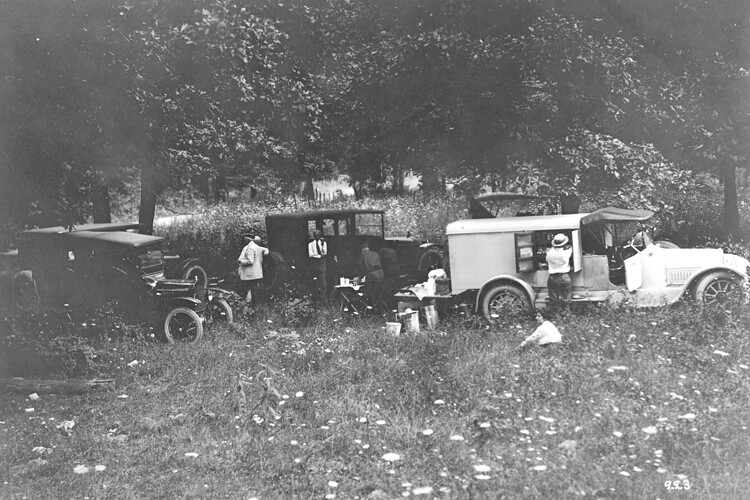
There is a giant photo hanging from the ceiling at Henry Ford Museum in Dearborn, Michigan.  It features four iconic men -- Henry Ford, with his piercing blue eyes, Thomas Edison with his dark, bushy eyebrows, Harvey Firestone, with his moustache and John Burroughs, with his flowing white beard -- lounging on an old mill wheel.  The picture represented an oxymoron:  here were four men, three of whom were millionaires, hanging out on a camping trip like regular guys.  Here is the story of The Vagabonds.  

                                   On an ancient waterwheel in West Virginia in 1918,the Four Vagabonds pose for a cameraman. Left to right are Harvey Firestone, Henry Ford, John Burroughs and Thomas A. Edison.


The old film reel circa 1918 features a caravan of six vehicles, two Fords, two Packards and two trucks, meandering down a dirt road.  Inside are The Vagabonds:  Ford, Edison and Firestone, all industrialists, and the naturalist, Burroughs.  It's a "seize the day" type of trip as Burroughs writes in his letter to Edison:  "Come, Thomas, leave your shop while we have time.  And let's take to the open road for strawberry days!" 


This is no regular camping trip, however.  Inside the vehicles, The Vagabonds have packed enough supplies to outfit an army.  The black and white film shows the industrialists, clothed in suits and ties, eating a hearty meal in a dining tent at a large round table, complete with a lazy susan.


The twelve day trip takes the caravan through six states:  Pennsylvania, West Virginia, Tennessee, Virginia, North Carolina and Maryland.  In Tennessee, they camped in the Great Smoky Mountains.  There the Vagabonds partook in many adventures.  The 81-year-old Burroughs, 71 year old Edison, 55 year old Ford and 50 year old Firestone engaged in rifle shooting, cradling contests (shearing wheat), tree-chopping, tree climbing and sprinting.   Burroughs, the naturalist, won the tree chopping competition.  Firestone and Ford seemed adept at the rifle shooting.


Ready, aim, fire! Ford (left) and Firestone went shooting together during their 12-day road trip


Back at the camp, the foursome built a gigantic campfire and engaged in heart to heart talks.  The black and white film shows Ford leaning over and speaking directly into Edison's ear, likely because he was hard of hearing by this point.  Likely the talk turned to business at some point, as Ford used to be employed by Edison at the Illumination Company.  Firestone supplied Ford with tires for his Model T's.  


But there is something refreshing about seeing the foursome convening with nature.  Ford and Edison even bathed in the creeks that they hiked along.  One black and white photograph shows Ford and Edison, straight razors in hand, shaving outside of their tents.  At night time, the foursome retired, each in a separate tent marked with his name on it.  


Shaving time on a summer morning in 1921 in the Great Smokies. Left to right: Henry Ford, Bishop William F. Anderson, Harvey Firestone (stooping). Thomas A. Edison and President Warren G. Harding. Ford seems to be managing without a mirror, perhaps in deference to the President who is making use of one. Bishop Anderson, fully dressed, apparently was an early riser. Firestone, Edison and the President display a variegated assortment of undershirts.


The camping trip, which became an annual exploration of the country, was inspired by a camping trip that the Ford and Edison families took to the Florida Everglades in 1914.  The elderly Burroughs passed away in 1921, but the three other Vagabonds continued the tradition each year.


Thursday, 17 September 2015

Carnegie's Letter Leads to Hill's Bestseller Think and Grown Rich

"Armed only with a letter of introduction from Carnegie, Hill set out to interview 500 people of the caliber of Henry Ford, Thomas Edison, Alexander Graham Bell, John D. Rockefeller, George Eastman, William Wrigley Jr. and Charles M. Schwab." (Marelisa Fabrega)


The Scottish-American steel magnate Andrew Carnegie challenged the up and comer Napoleon Hill:  interview 500 businessmen and find out their secret to success.  "Armed only with a letter of introduction from Carnegie, Hill set out to interview 500 people of the caliber of Henry Ford, Thomas Edison, Alexander Graham Bell, John D. Rockefeller, George Eastman, William Wrigley Jr. and Charles M. Schwab." (http://daringtolivefully.com/napoleon-hill-success)  It took him 20 years, with many bumps in the road, but Hill reached the finish line; and he came away with the bestseller Think and Grow Rich.

Napoleon Hill was born in a one-room log cabin in the Appalachian Mountains of Virginia in 1883 to a life of poverty and illiteracy.  At 9 years old, his mother passed away.  Young Napoleon was angry.  Enamored with the outlaw Jesse James, Napoleon was known to wear a six shooter in his belt and terrorize the mountainside.  

His father soon remarried and his stepmother saw his potential.  She challenged young Napoleon to use his imagination for writing and spent the next year tutoring her stepson.  The new Mrs.  Hill offered to buy Napoleon a typewriter.  "If you become as good with a typewriter as you are with that gun, you may become rich and famous and known throughout the world." (http://www.success.com/mobile/article/rich-man-poor-man)

Napoleon rose to the challenge.  He found that he had a way with words and by 15 years old, he was a freelance reporter for mountain newspapers.  Soon he was writing for the Bob Taylor magazine where he was challenged to get an interview with Andrew Carnegie.  But it would not be as simple as picking up a telephone and placing a call.  Napoleon wrote not one but 50 letters to the steel magnate.  Finally, tired of seeing the same request, and admiring his persistence, Carnegie granted Hill his request.  The interview changed Hill's life.

Carnegie outlined a plan for Hill to write a book about the secrets to financial success by interviewing successful businessmen.  The steel magnate drafted a letter which gained Hill entrance to the offices of America's most sought after businessmen.  Hill discovered that all of the men he interviewed had several traits in common:  a definiteness of purpose; a strong belief in themselves; and an uncanny ability to bounce back from failure and adversity.

The latter trait served Hill well.  In 1926, he and the editor of the Canton Daily News, had just run an expose revealing Prohibition era gangsters and their operation of bootleg liquor which they had been distributing to local schoolchildren.  In gangster style, the editor was gunned down in cold blood.  The gangsters waited for Hill at his house, but the writer did not make it home after his car broke down. A nervous Hill received an anonymous note telling him to leave town, which he did.

In West Virginia, Hill had to make a clean start.  It was there that he re-committed himself to finishing the project that he had started under the guidance of Carnegie.  He wrote a book, Law of Success, which after many rejections, was published in 1928. 

Almost a decade after his first book came out, Hill secured a publisher for his second book, drawing on his original interviews with businessmen, called The Thirteen Steps to Riches.  Initially rejected, Hill's wife pleaded his case and the publisher relented under the condition that the title be changed to Use Your Noodle to Win More Boodle.  Mercifully, the title was changed later to Think and Grow Rich.  Within three weeks, Hill's new book was sold out.  By the end of the Great Depression, it had sold millions of copies.  By Hill's death in 1970, it had sold 20 million copies.  Today, it has sold over 70 million copies.  It all started with a letter signed by billionaire Andrew Carnegie.


Napoleon Hill circa 1904 courtesy http://www.success.com/mobile/article/rich-man-poor-man.


Monday, 5 January 2015

How to Fail Successfully

"The key to not failing is to fail and fail often."  (Max Londberg)


In his valedictory address, Max Londberg encouraged his fellow graduates to fail.  But shouldn't he be encouraging them to succeed?  He said that when we fail, we get rid of trivialities; we no longer worry about pleasing others.  We focus on the task at hand.  Some teachers and parents believe that children/students learn best when they are allowed to make mistakes, when they are encouraged to explore and to draw their own conclusions.  

One study suggests that children who believe that their intelligence is fixed, and that their success is due to their intelligence, do not react well to mistakes.  In fact, their performance on standardized tests dropped 20% over time.  The other group, who believed that their intelligence was not fixed, that it could grow over time, had a more positive reaction to their errors.  Their test scores increased by 30% over time.  

Look at successful historical figures who learned from their many mistakes and disappointments. Winston Churchill said:  "Success is the ability to go from failure to failure with no loss of enthusiasm."  He would know, given that he didn't even become Prime Minister of Great Britain until the age of 65.  He was well accustomed to failure, but not defeat (remember his "We Shall Never Surrender" speech?).  How about Abraham Lincoln who lost eight elections but was later elected to two terms as President of the United States?  Or how about Thomas Edison who failed 1000 times but created hundreds of successful inventions?  Or Henry Ford who failed and went broke five times before he got his Ford Motor Company up and running in 1903?

Learn the art of failure.  Embrace it.  You could be the next success story.

Note:  To read Max Londberg's graduation speech, click on http://www.huffingtonpost.com/uloop/my-graduation-speech-on-h_b_3365543.html.


Winston Churchill circa 1941 courtesy http://en.wikipedia.org/wiki/Winston_Churchill.

Friday, 2 January 2015

Why Success Often Begins With Failure

"Behind every success story is an embarrassing first effort, a stumble, a setback, a radical change in direction." (Amy Crawford)


Think back to your child's first steps.  I know when Thomas learned to walk, he didn't just decide to take off one day.  He started with rolling over...crawling...pulling himself to a standing position... furniture walking...and then taking off for a Christmas stocking hanging on the door knob.  

It's the same with riding a bike.  When Jacqueline first learned to ride a bike, we took her to the church parking lot.  She rode around it several times on her training wheels.  One day, Thomas took the training wheels off her bicycle and she rode on the grass beyond the parking lot (just in case she wiped out).  After some wobbling, she started to balance on the bicycle.  The next day, she took off across the parking lot.  

Failure is an essential part of success.  And yet we try so hard to avoid it.  Seth Fiegerman discovered this to be true after graduating from New York University, landing a research editor job at Playboy, and promptly being laid off.  While at the magazine, he had discovered archives interviews with celebrities from Marlon Brando to Malcolm X.  The common thread in most of the interviews was how the celebrities turned their failures into successes.  

Seth realized that perseverance, not innate talent, was each celebrities most important asset.  He started a website, OpeningLines.org, illustrating the origin's of famous people's careers.  In the meantime, the unemployed writer was able to secure a job at a tech news website.

Thomas Edison, more than most, knew the value of failure.  Failure was what led to many of his 2,332 inventions including the incandescent light bulb.  The inventor explained that:  "Many of life's failures are people who did not realize how close they were to success when they gave up."  

It seems like the only failure is in giving up, or in not trying in the first place.  Whether your task is something as unusual as inventing a light bulb, or as commonplace as learning how to walk, the key is to embrace failure...until you succeed.


pinimg.com