Wednesday, 14 June 2017

Seven Crows

"One crow, sorrow
Two crows joy
Three crows a letter
Four crows a boy
Five crows silver
Six crows gold
Seven crows a story never to be told."
(William Butler Yeats)


Alex Colville based his 1980 painting Seven Crows on the Yeats poem.  In literature, crows can act as a harbinger of death.  Seven crows lurk over a field by the water as clouds hover overhead.  The birds hang in the air as the unspoken tension hangs in the picture.  Something is about to happen.  Perhaps it's a thunderstorm, perhaps much more.  It's "a story never to be told".  


Tuesday, 13 June 2017

Church and Horse

"More than any other artist in Canada, Colville's images permeate both our psyche and our everyday life." (Toronto Star)


Alex Colville's Church and Horse contrasts a peaceful white-clapboard church with a spooked black horse.  The sanctuary of the church is contrasted with the dangers of the outside world.  A foreboding sky hovers over the church and horse.  The gate remains open, ready for the horse to bolt right through it.

Painted in 1964, "JFK's funeral is the subtext for Church and Horse, a painting that I never understood until this encounter.  We watch that big black riderless horse in the funeral procession...then meet him again, galloping madly through Colville's painting." (https://barczablog.com/2014/08/29/alex-colville-love-and-menace/)

No one will forget the image of little John F. Kennedy Jr. saluting his father's coffin; of the veiled widow Jacqueline, clasping each of her child's hands; of Caroline Kennedy sneaking a hand under the American flag, as if to touch her father one last time; of the riderless horse clip clopping behind the slain President's coffin as it made its way to Arlington Cemetery.  Colville's horse conveys some of the public's unease felt in the turbulent months after JFK's assassination (http://alinefromlinda.blogspot.ca/2013/11/one-brief-shining-moment-interrupted.html).


Monday, 12 June 2017

Dog and Priest

Alex Colville's painting Dog and Priest shows a dog looking out for his master.  Both dog and priest have dark coats.  Both dog and master have collars, although the priest's is obscured by the dog's.  The priest is reclining while the dog is sitting up, on the alert.  Priests are known for the faith in God while dogs demonstrate faith in their masters.

Dog and Priest, painted in 1978, represents a bygone era.  At one time, Roman Catholic priests would have been commonplace in Canada, especially the Maritimes with its large ethnic Irish population.  However, today, the number of priests is steadily declining.  The slower pace of life, something much of Canada has lost, is indicative of the Maritimes.


Sunday, 11 June 2017

Departure

A woman in a white dress stands in a telephone booth on a jetty as a cargo ship pulls out to sea.  Ripples cover the water; clouds dot the sky.  Departure, circa 1962, is yet another example of Alex Colville's preoccupation with the ordinary.

Just like the soldier saying goodbye to his girlfriend/wife, this may be a scene where a couple is about to endure a long separation.  During the Second World War, this scene would have played itself out many times.  For someone living in Nova Scotia like Colville, where the army and navy often deployed, this would have been a common event.


Saturday, 10 June 2017

To Prince Edward Island

A woman, facing the camera, holds a pair of binoculars as she heads To Prince Edward Island aboard a ferry.  A lifeboat hangs behind her.  Other than a string of puffy clouds above the horizon, the sky is a clear blue.

While many of Colville's paintings exhibit some degree of anxiety or tension, To Prince Edward Island has a serenity about it.  It is no surprise that the painting remains one of Colville's most loved works.  And Prince Edward Island remains one of the most popular destinations for both Canadians and foreigners.  Its red sand beaches, lobster dinners and friendly charm are irresistible.  A visit to Prince Edward Island, I imagine, takes one back to a simpler time.  The pace is slower and the people are friendlier.  Painted in 1965, on the heals of the Cuban Missile Crisis (perhaps the purpose of the binoculars trained on the viewer) such a painting would be a welcome respite from the Cold War angst.


Friday, 9 June 2017

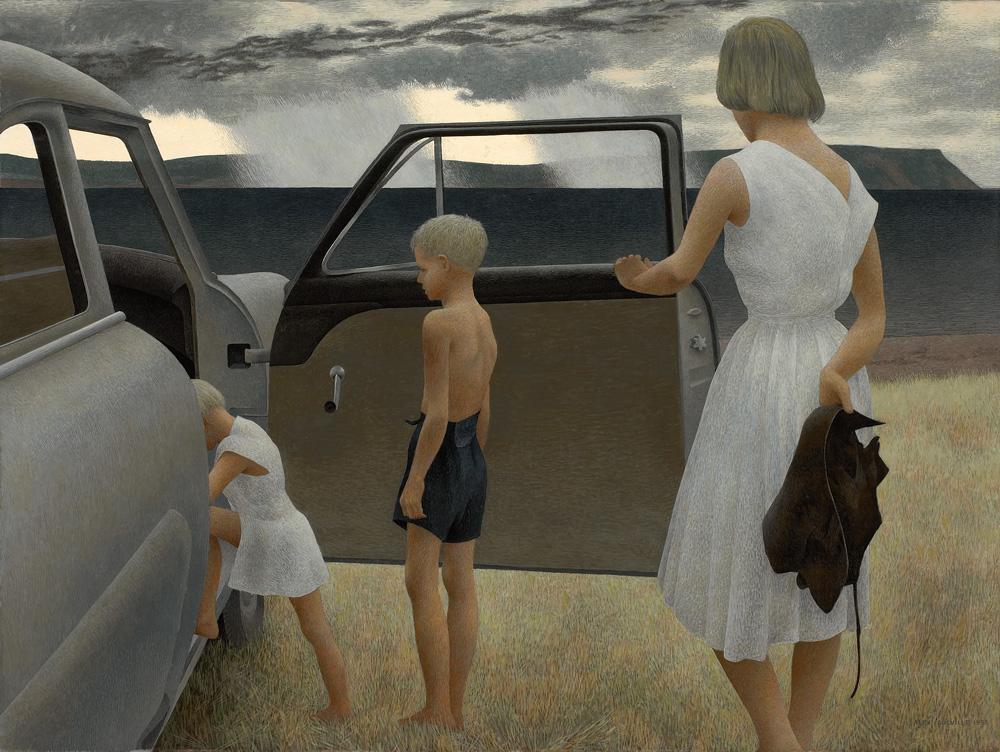
Family and Rainstorm

I'll never forget the summers of my childhood in Grand Bend, Ontario.  My Mom, my sisters (and later my brother) and I would spend the day at the beach.  Sometimes, in late afternoon, dark clouds would blow in and before we knew it, a thunderstorm would hit.  We would pack up our towels and head for cover. We would sit in our mobile home and watch the fireworks display.  There's nothing like a thunderstorm on the lake.  It was more magnificent than anything you would witness on land.

Alex Colville's Family and Rainstorm reminds me of those thunderstorms, only this time set in Nova Scotia rather than Southern Ontario.  Dark clouds hovering over the water threaten to burst open at any moment.  A mother holds the car door open for her son and daughter as they climb inside.   The children, likely drained from a day of sun and sand, are ready to collapse.  The mother is likely dreaming of a warm bath to clean off the sand that clings to her body.  I see visions of the car, only minutes later, driving down the road, its wipers working full speed, its occupants relieved to be inside.


Thursday, 8 June 2017

Milk Truck

"Toronto passed a law in the 1950's banning milk delivery before 7 am to prevent the disturbance of Torontonian's sleep."


Alex Colville's painting Milk Truck, circa 1959, is a tribute to the small town Maritimes.  A Mercury truck filled with crates of milk (and a dog) and with a boy hanging off of it ready to deliver the goods, drives down the main street of a small town.  In the background is a Simpsons Catalogue Store (a small town wouldn't have merited a full department store).  At the end of the street and the edge of the picture is the water, presumably the Atlantic.

But the milk truck wasn't just a part of Maritime history, but Canadian history.  I remember the milk truck that came down our street every day in Hamilton, Ontario.  I remember the milk box that was built into the side of our bungalow.  I remember the plastic jugs that the milk came in. Our neighbour, Mrs. Pellizari, still ordered her milk in glass bottles.

The milk truck was not always the mode of transportation for milkmen in Canada.  According to The Globe and Mail, "Most Canadians had milk, cream, butter, eggs, bread and even meat delivered -- and all by horse drawn wagon, a vehicle that some Toronto milkmen used until the late 1950's." https://www.theglobeandmail.com/news/toronto/when-the-milkman-still-rode-down-torontos-streets/article16073542/.  My Mom, who grew up in Dunbarton, 18 miles east of Toronto, remembers the horse drawn milk carts.  The horses knew the routes so well that they could continue without instruction; at a dead end street they could be counted on to turn around.

By the early 1960's, electric trucks had replaced horsedrawn wagons, but they came with their own set of problems.  They struggled in the cold and needed a pick up truck to climb steep hills.  The vehicle's rooftop refrigeration system often leaked, raining down on the driver.  Its small oil stove did little to keep the milkman warm.

Modern gas trucks soon followed with a proper refrigeration unit.  You would think that the motorized trucks would be much louder than the wagons.  However, it wasn't the rumbling of the truck motor that got the milkmen into trouble but the clinking of the milk bottles.  Toronto passed a law in the 1950's banning milk delivery before 7 am to prevent the disturbance of Torontonian's sleep.  In 1944, Ella Mae Morse had a top ten hit titled Milkman, Keep Those Bottles Quiet.

The death of the milkman and the milk truck came with the advent of modern refrigerators and the proliference of automobiles.  People could keep their milk fresh much longer at home.  They could drive themselves to the store to buy more.  The milk truck, as its predecessor the horse, was put out to pasture.