Monday, 3 April 2017

Keep America Beautiful


Keep America Beautiful ad circa 1970 courtesy https://www.flickr.com/photos/29069717@N02/23111986642.


I assumed that the Keep America Beautiful moniker came from Lady Bird Johnson, who championed the cause to clean up, first Washington D.C., and later other American cities.  However, today I discovered that the group was started in 1953 by some American businessmen.  "Keep America Beautiful is the largest community improvement organization with over 560 affiliates."  The strongest supporters of the Keep America Beautiful campaign are Coke, Pepsi and National Soft Drink Association.  In 1965, when the First Lady took up the cause of conservation, Keep America Beautiful came into the limelight.  In 1971, with the debut of Earth Day, the cause was furthered again.  In the 1980's with the advent of blue boxes, the campaign broke new ground.

According to Wikipedia circa 2004, Keep America Beautiful was responsible for (https://www.learningtogive.org/resources/keep-america-beautiful):

CLEAN UPS

  • litter and debris collected:  150 million pounds
  • roads, streets and highways cleaned:  97,000 miles
  • railroad tracks cleaned:  900 miles
  • areas of parks cleaned:  32, 300 acres
  • hiking/biking/nature trails cleaned:  2,000 miles
  • playgrounds and community recreation areas cleaned/restored/constructed:  4,000
  • rivers, lakes, shorelines cleaned:  6,500 miles
  • underwater cleanups:  80
  • wetlands restored:  8,200 acres
  • illegal dumpsites cleaned:  2,600
  • junk cars removed:  7,200
REDUCE/REUSE/RECYCLE

  • clothing collected for reuse:  5,800,000 pounds
  • bags of aluminum/steel recycled:  645,000
  • bags of newspaper recycled:  691,000
  • tires collected for recycling:  1,220,000
  • batteries collected for recycling:  21,000
BEAUTIFICATION:

  • trees planted:  131,000
  • flowers & bulbs planted:  5 million
  • homes & commercial buildings painted:  1,300
  • graffiti sites abated:  6,000


Keep America Beautiful billboard courtesy 


Sunday, 2 April 2017

Lady Bird Johnson's Highway Beautification Project

"The biggest decision of all concerns our highways, the greatest public works program of any civilization... our challenge is to see that these highways are not only superbly functional, but also in harmony with our landscape and a pleasant asset to our lives.  After all, this is a civilization where our favorite recreation is driving for pleasure." (Lady Bird Johnson)


With the construction of the Interstate Highway system overseen by President Eisenhower came the growth of the billboard industry, a force more powerful in the United States than any other save the Rifle Association.  The highways had become peppered with junkyards and billboards to the detriment of nature. Lady Bird Johnson, who accompanied her husband President Johnson on road trips from their Texas ranch to the White House, was tired of seeing the endless ads on the nation's highways.  President Johnson explained:  "We have placed a wall of civilization between us and the beauty of our countryside."

She mounted a campaign to curb the billboards amid fierce opposition.  Senator Robert Dole sarcastically called it "Lady Bird's Bill" and motioned that the word "Secretary of Commerce" be replaced in the Act with "Lady Bird", a motion that lost by only one voice vote.  But President Johnson would not be deterred, telling his staff:  "You know I love that woman and she wants that Beautification Act...and by God we're going to get it for her."  The act finally passed, after much debate, on October 22 at 1 am.

Decades later, there are mixed emotions about the Lady Bird's Bill.  Some say that while the goal of eliminating junkyards along the highways was achieved, the goal of eliminating billboards failed. Today, billboards are twice as big as they were in the 1960's.  The number of billboards has increased rather than decreased (450,000 today versus 330,000 in 1965).  Seventy thousand of the "non-conforming billboards" still stand today according to the New York Times.  Some of them which were knocked down by Hurricane Katrina. The billboard industry lobbied fiercely to get them rebuilt. (http://www.nytimes.com/2007/07/20/opinion/20wright.html).  

When new billboards are built, often trees are cut down.  Twenty of the most common birds have lost half their population in the past 50 years since Lady Bird's Bill first was signed.  But the billboard industry can take nothing away from Lady Bird's initiative.  Her heart was in the right place.


image


Saturday, 1 April 2017

Lady Bird Johnson's Beautification Project

"When I go into a neighborhood, I look for the flash of color -- a geranium in a coffee can, a window box set against the scaling side of a tenement, a border of roses struggling in a tiny patch of open ground.  Where flowers bloom, so does hope -- and hope is the precious, indispensable ingredient without which the war on poverty can never be won." (Lady Bird Johnson)


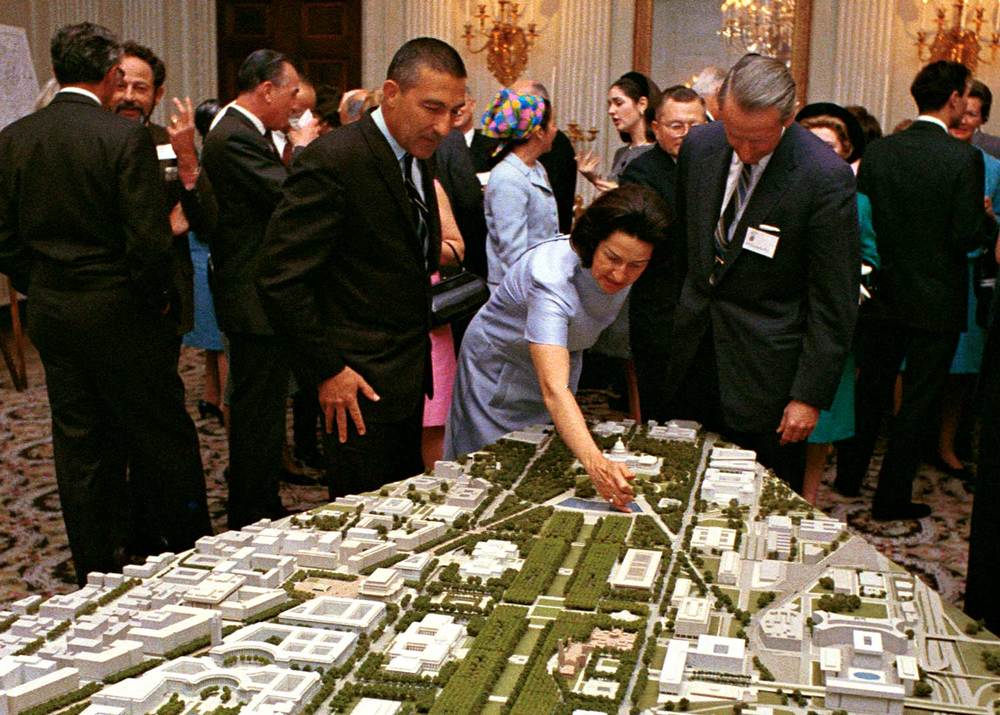
Foreground L-R: Sec. Stewart Udall, Lady Bird Johnson and Laurance Rockefeller look at an architectural model of the Washington, D.C. in 1967. LBJ Library photo by Robert Knudsen.

Lady Bird Johnson and Laurence Rockefeller study model of Washington D.C. circa 1967 courtesy http://www.ladybirdjohnson.org/biography/.


Since Earth Day falls in the month of April, I thought I would blog about Lady Bird Johnson's Beautification Project.  Mrs. Johnson first took on the role of First Lady in the 1960's at a time of urban renewal.  She pointed out that 75% of the American population lived on 1% of the land.  The nation's cities were not only crowded but also run down, particularly, Washington D.C., the nation's capital.  Lady Bird maintained that there should be a way for the natural and man-made components of the city could live in harmony.  She believed that the nation's physical beauty affected the nation's psyche.

Lady Bird started with a grassy triangle of land at the corner of 3rd and Independence Ave where she broke land and planted the first azalea in March of 1965.  The First Lady relied heavily on donations from private donors including $100,000 from the Rockefeller Foundation, 10,000 azaleas, 4,000 cherry trees along with dogwoods and daffodils.


Hains Point circa 1935 courtesy 


Lady Bird's goal was to create "functional, attractive surroundings", for a more beautiful Capital.  She took a cruise down the Potomac River to spot areas of concern.  Hains Point received attention as many cherry trees were planted there.  The First Lady took a ferry to Columbia Island, in the middle of the Potomac, for a daffodil bulb planting ceremony.  She hosted a planting at the White House for Arbor Day.


Lady Bird's efforts didn't just pertain to the flowers and trees, but also the buildings or lack thereof.  Farrell School was a drab, two story building with broken windows.  She championed an effort to get a playground for the children.  Buchanan School soon received a similar playground.

In an effort to attract more people to the downtown, the First Lady suggested that F Street be transformed into a shopping mall, one of two malls to be built.


Lady Bird focussed on Sherman Square, Farragut Square and Twining Square.  Trees were planted in Hobart Place Park and Lafayette Park.  She revitalized Pennsylvania Avenue and Rock Creek Parkway.


Washington Circle post beautification courtesy 


The First Lady was concerned about Washington's ghettos:  the urban decay, the graffiti, the garbage, the rats.  She enlisted youth to clean up the Shaw section of the capital which led to the formation of Project Pride, a group of Harvard University students and high school students to clean up other cities.

In May 1966 Lady Bird was front and centre at the White House Conference on Natural Beauty which encouraged conservation and anti litter campaigns.  Just before Lyndon Johnson left office, Columbia Island in the Potomac was renamed Lady Bird Johnson Island.  The First Lady's efforts, part of the "Keep America Beautiful" campaign, would bloom for years to come.


Lady Bird plants a cherry tree courtesy http://davesgarden.com/guides/articles/view/3473#b.

For more information, watch Showcase for the Nation:  The Beautification Project at https://www.youtube.com/watch?v=Cd2t2MsOMnc.


Friday, 31 March 2017

The Celtic Cross

Just as St. Patrick made the shamrock into a Christian symbol he did the same with the Celtic cross.  He took an ancient symbol of the sun and combined it with a Christian cross to form the Celtic cross.  Across Ireland, Scotland and England, one can find Celtic crosses in many cemeteries.  The Celtic cross had a practical component too; the circle strengthened the cross beams preventing breakage or destruction.

Early Celtic crosses, circa 600 AD were simply carved out of rock.  By the 8th, 9th and 10th Centuries, high crosses became common to honour famous people or places.  The Cross of the Scriptures, or King Flan's Cross, is inscribed with images of the Bible:  the Last Supper, the Crucifixion and the Guarding of the Tomb.  By the 1850's, it became common to use Celtic crosses as tombstones, a tradition continued in North America and Australia where Irish or Scottish immigrants have settled.


IMG_0902\


Thursday, 30 March 2017

William Butler Yeats Earns Nobel Prize

"'O words are lightly spoken'
Said Pearse to Connolly
'Maybe a breath of politic words
Has withered our rose tree
Or maybe but a wind that blows
Across the bitter sea.'"
(The Rose Tree, an imagined conversation between political radicals Pearse & Connolly after the Easter Rising of 1916)


William Butler Yeats was born in Ireland and educated in England.  His heart, however, always remained in Ireland where he would return each summer to live at his family's summer home in Connaught.  Yeats was active politically and considered himself an Irish Nationalist.  He was appointed a senator in the Irish Free State.  Yeats is arguably the most successful poet Ireland has ever produced, earning the Nobel Prize for Literature in 1923.

Using the symbolist style, Yeats crafted dozens of poems including:

  • Lake Isle of Innisfree (1890)
  • The Wanderings of Oisin (1889)
  • Song of the Old Mother (1899)
  • Adam's Curse (1902)
  • Easter (1916)
  • The Rose Tree (1916)
  • The Second Coming (1919)
  • A Prayer for my Daughter (1921)
  • Sailing to Byzantium (1928)
  • Remorse for Intemperate Speech (1933)


Wednesday, 29 March 2017

The River Shannon

Legend has it that Rowan trees once dropped bright red berries into a well where they were eaten by silver fish, earning them great wisdom.  Irish fishermen would catch the fish, hoping to share in this wisdom, but women were banned from the well.  One day, a rebel woman named Sionan fished in the well and caught a silver fish.  Suddenly, a great floodburst carried her west to the sea.  The body of water became known as the Shannon, after the woman.

The River Shannon, Irelands longest river, provides a natural barrier between Northern Ireland and Ireland.  The river spans 200 miles before it pours into the Atlantic Ocean.  Along its banks sit historic towns, castles and monasteries.  Key military battles have taken place along its shores.  Its floodplain contains marshy grasslands and bogs ideal for birds.

While the silver fish, or Atlantic salmon, still swim in the Shannon, attracting anglers to the area.  In the fall, the adult salmon swim upstream from the ocean into the river to spawn, capable of leaping a ten foot waterfall.  The following spring, the baby salmon are born.  As they grow older, they acquire vertical bars, silver in colour.  Some Atlantic salmon spawn for multiple years unlike the Pacific salmon which die after spawning.  Once tens of thousands of fish used to return each year, but now only a few thousand do.


Tuesday, 28 March 2017

Molly Malone Statue

"In Dublin's fair city
Where the girls are so pretty
I first set my eyes on sweet Molly Malone
As she wheeled her wheel barrow
Through streets broad and narrow
Crying "Cockles and mussels, alive, alive, oh!"


For Dublin's millennium celebration, a statue of Molly Malone, a beautiful bosomy belle, was unveiled in 1988.  The fictional character, featured in the song "Cockles and Mussels", was a fishmonger by day and a prostitute by night. Molly sold cockles and mussels out of her wheelbarrow.  Sadly, one day Molly, suffering from a high fever, succumbed to a bout of cholera and passed away.  Supposedly, her ghosts haunts the streets of Dublin now.  The song was first published in Boston, Massachusetts in 1876.  

Molly's statue, which sat at the bottom of Grafton Street, was temporarily removed to make way for a new track.  Plans are underway to return it to its original location in 2017.  It is known colloquially as "The Tart with the Cart" or "The Trollop with the Scallop(s)".  Supposedly, a Mary (for which Molly is a nickname) Malone passed away on June 13, 1699, the date designated for Molly Malone Day.


Image result for molly malone statue