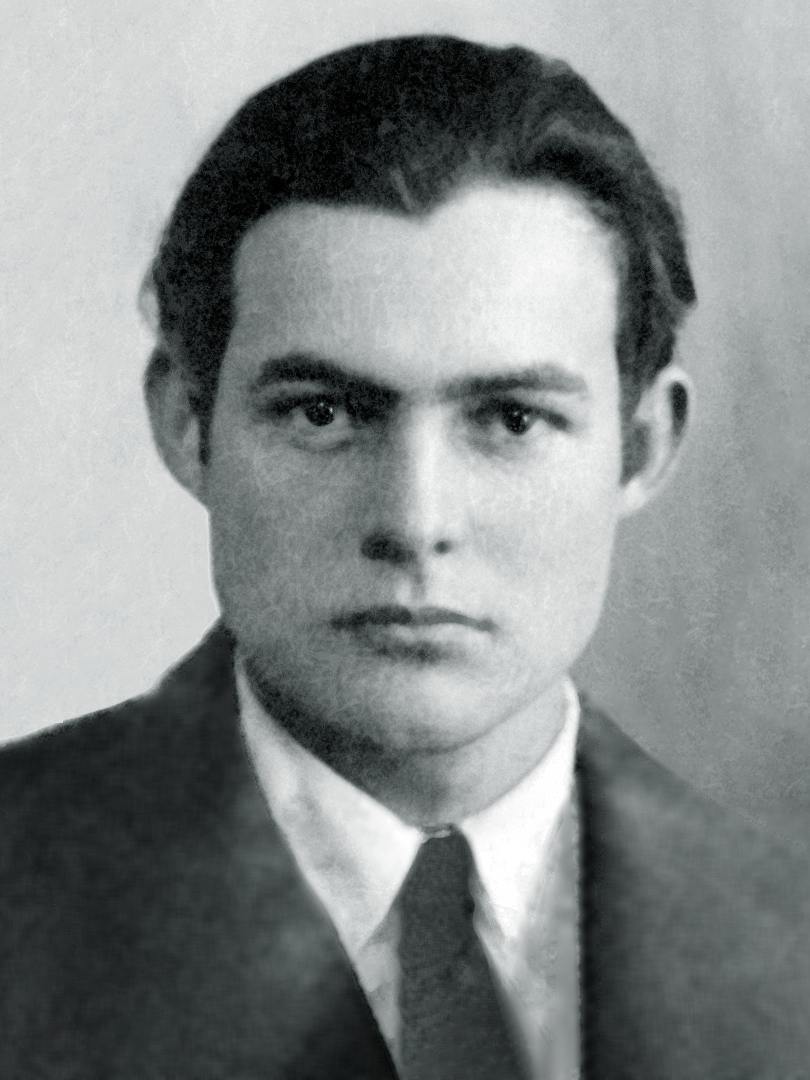
Ernest Hemingway was born in the Chicago suburb of Oak Park, Illinois in 1899 to a physician father and musician mother. Although he disliked the cello lessons that his mother made him take, he admitted later that they helped him with his writing, particularly the book
For Whom the Bell Tolls. Hemingway ended up writing dozens of articles and several books, all on the themes of war, love, loss and wilderness.
Hemingway's interest in writing started in his junior year of high school when he took a journalism course where the classroom was patterned after a newspaper office. The better writers in the class, like Hemingway, submitted their pieces to the school newspaper,
The Trapeze, including an article about the Chicago Symphony Orchestra. Hemingway wrote for the
Kansas City Star where he adopted the paper's style: "Use short sentences. Use short first paragraphs. Use vigorous English. Be positive, not negative."
At 18, Hemingway served as a Red Cross ambulance driver in Italy during the First World War. Wounded by shrapnel, he almost lost his leg and came face to face with his own mortality.
On returning to North America, he was hired by the
Toronto Star Weekly where he wrote 88 stories in the space of only 18 months, including "Tuna Fishing in Spain" and "Trout Fishing All Across Europe". He married Hadley Richardson, a reporter for
Vogue magazine. The couple moved to Paris where Hemingway hobnobbed with writers Gertrude Stein, James Joyce and Ezra Pound. He and Joyce would go on alcoholic sprees together at the Ritz Hotel. It was during this time that Hadley lost a suitcase full of his manuscripts at the Gare de Lyon while on her way to Switzerland.
Hemingway and his wife returned to Toronto where their son Jack was born. However, Hemingway missed Paris and the social set. He wanted to be an author, not a journalist. In 1926, he published
The Sun Also Rises to critical acclaim. He divorced and married Pauline Pfeiffer, also a Vogue magazine reporter.
Hemingway wrote a boxing story "Fifty Grand" followed by "Death in the Afternoon", a bullfighting story. After a 1933 safari in Africa, he wrote
The Snows of Kilimanjaro.
To Have and Have Not came in 1937. After spending time in Spain during its Civil War, Hemingway wrote
The Fifth Column the same year.
Hemingway penned
For Whom the Bell Tolls, published in 1940. Four years later he was present during the Normandy landings on a ship. The writer was also present at his beloved city of Paris during its liberation. In 1947, Hemingway was awarded the Bronze Star for bravery in World War II.
In 1946, Hemingway wrote
The Garden of Eden. In 1952, he published
The Old Man and the Sea which won the Pulitzer Prize. Two years later, he won the Nobel Prize for Literature.
In his later years, Hemingway suffered from headaches, high blood pressure, weight gain and diabetes. His alcoholism complicated these problems. He slipped into a depression and committed suicide in 1961.
Ken Burns is producing a series about Ernest Hemingway due out in 2019.