Friday, 28 October 2016

Piano Tuner

"Many [piano tuners] play octaves using the thumb and the third finger since the little finger is not strong enough to withstand the repeated stress." 
(http://www.best-norman-rockwell-art.com/1947-piano-tuner.html)


We grew up in a non-smoking household.  None of my six family members smoked.  No guests were allowed to smoke.  But there was one visitor, who came no more than once a year, who was permitted to smoke:  the piano tuner.  My dad was picky about his piano and not just anyone could touch it.
I always knew when the piano tuner had visited.  When I arrived home form school the doors and windows would be wide open and the living room would smell like smoke.

Piano tuners are a breed unto themselves.  The piano tuner would arrive with a case full of tools.  He would prop up the back of our antique grand piano, the first piece of furniture (even before a sofa) to fill my parents' living room as newlyweds over fifty-five years ago.  He would light up a cigar, stick it in between his teeth, and start tapping on the ivory keys of our Mason & Risch.

A piano tuner's work is tedious; it can't be rushed.  He pounds the notes over and over again until his fingers are numb.  "Many [piano tuners] play octaves using the thumb and the third finger since the little finger is not strong enough to withstand the repeated stress." I suppose that's why the piano tuner smoked cigars rather than cigarettes.  He knew he was in for a long day.

In Norman Rockwell's Piano Tuner, a little boy waits patiently, his hands folded behind his back, as a man tinkers at the keys of his piano.  The man is completely absorbed in his work.  He cocks his ear towards the piano, not wanting to miss a note.  A coat, umbrella and towel rest on the piano bench. Light seeps through a nearby window.  But the little boy does not go outside to play; he still waits until it his turn to sit at the piano once again.


The January 11, 1947 Saturday Evening Post cover by Norman Rockwell entitled Piano Tuner


Thursday, 27 October 2016

Man Charting War Maneuvers

"Your task will not be an easy one. Your enemy is well trained, well-equipped and battle-hardened.  He will fight savagely." (General Dwight D. Eisenhower)


A man sits at a desk, his lips holding a cigar, his ear against an old radio, his hand on the knob.  He searches for an update on the day's battles.  One station plays the strains of the Glenn Miller Orchestra.  Another plays "You Can't Do Business with Hitler".  A third plays one of President Roosevelt's fireside chats.  The man continues to turn the dial.

A map of Europe hangs on the wall.  Photographs of two American generals, Eisenhower and MacArthur, are pinned to the wall.  Three blue stars on a white flag and three small photographs of men indicate that the man has three sons in the service:  one in the Army, one in the navy and one in the Air Corps.

The man has a map opened on his lap, a newspaper curled up in his hand along with two pencils.  He follows the battles avidly.  Since he can't be there to help his sons, this is the next best thing.  An ad for war bonds comes on the radio.  He makes a mental note to contribute to the cause; anything to bring his boys home sooner.


Wednesday, 26 October 2016

Art Critic

"Art imitates life and sometimes life imitates art." (Bruce Willis)


Norman Rockwell liked to incorporate a photograph or painting into his artwork, "bringing the inner artwork to life as it were."  Art Critic features a young artist, palette in one hand, magnifying glass in the other, examining an ornately framed painting at the art gallery.  The artist is studying the locket that the lady in the painting is wearing, intent on imitating the painter's technique.

To the artist's right is a larger canvas, also surrounded by a gilded frame, this one filled with three Dutch cavaliers who are unamused that he is examining the other painting.  However, the lady in the painting is smiling, enjoying the extra attention. The young artist was modelled by Rockwell's son, Jerry, while the woman in the painting was modelled by Rockwell's wife, Mary.

Art Critic first appeared on the cover of The Saturday Evening Post on April 16, 1955.


Tuesday, 25 October 2016

Thanksgiving: Mother and Son Peeling Potatoes

"One of the most loathed duties for a soldier is kitchen patrol, KP.  Yet here is this recently discharged soldier gladly, even lovingly, peeling potatoes." (http://www.best-norman-rockwell-art.com/1945-thanksgiving-mother-and-son-peeling-potatoes.html)


Norman Rockwell's milkman had just arrived home from Europe after serving in the 9th Army Air Corps. Richard Hagelberg had survived 65 daylight bombings and fought at one of the biggest battles of all, D-Day.  Now he was back on his dairy farm in Arlington, Vermont for the first time in five years.  

Rockwell requested that he and his mother pose for his latest Thanksgiving painting.  He had already tried two sets of models, neither of whom fit the bill.  Now, he suggested to Hagelberg that he and his mother, Saara Hagelberg, pose.  Initially, the returned soldier declined.  However, after the painter offered him $15 for an hour's work, he obliged.  

The Thanksgiving scene features a mother, in a simple dress and apron, peeling potatoes in a kitchen. Her son, garbed in his military uniform, joins her in the task.  "One of the most loathed duties for a soldier is kitchen patrol, KP.  Yet here is this recently discharged soldier gladly, even lovingly, peeling potatoes."  The soldier is so relieved to be home.  We can just imagine the conversation that is taking place.  The memories must come flooding back to the soldiers of Thanksgivings past.  

No longer forced to ration, the soldier's mother prepares a Thanksgiving feast:  a pot of cranberries and a basket full of apples sit on the floor; on the red-and-white checkered tablecloth sit cabbage, collards and a large rutabaga.  An orange and a lemon peek out from behind the salt and pepper shakers.  A plump pumpkin brings colour to the scene.

Thanksgiving:  Mother and Son Peeling Potatoes graced the cover of The Saturday Evening Post on November 24, 1945.  Rockwell offered the painting to Richard Hagelberg once it was completed, as he usually did to the models in his works, but Hagelberg declined.  Perhaps it was because Rockwell had added 20 pounds and 20 years to Richard's mother.  The painting found a home in the American Legion Post in Winchendon, Massachusetts.  In the late 1970's, it was transferred to the Norman Rockwell Museum. 


Thanksgiving:  Mother and Son Peeling Potatoes circa 1945 courtesy
http://www.best-norman-rockwell-art.com/norman-rockwell-thanksgiving.html.

Monday, 24 October 2016

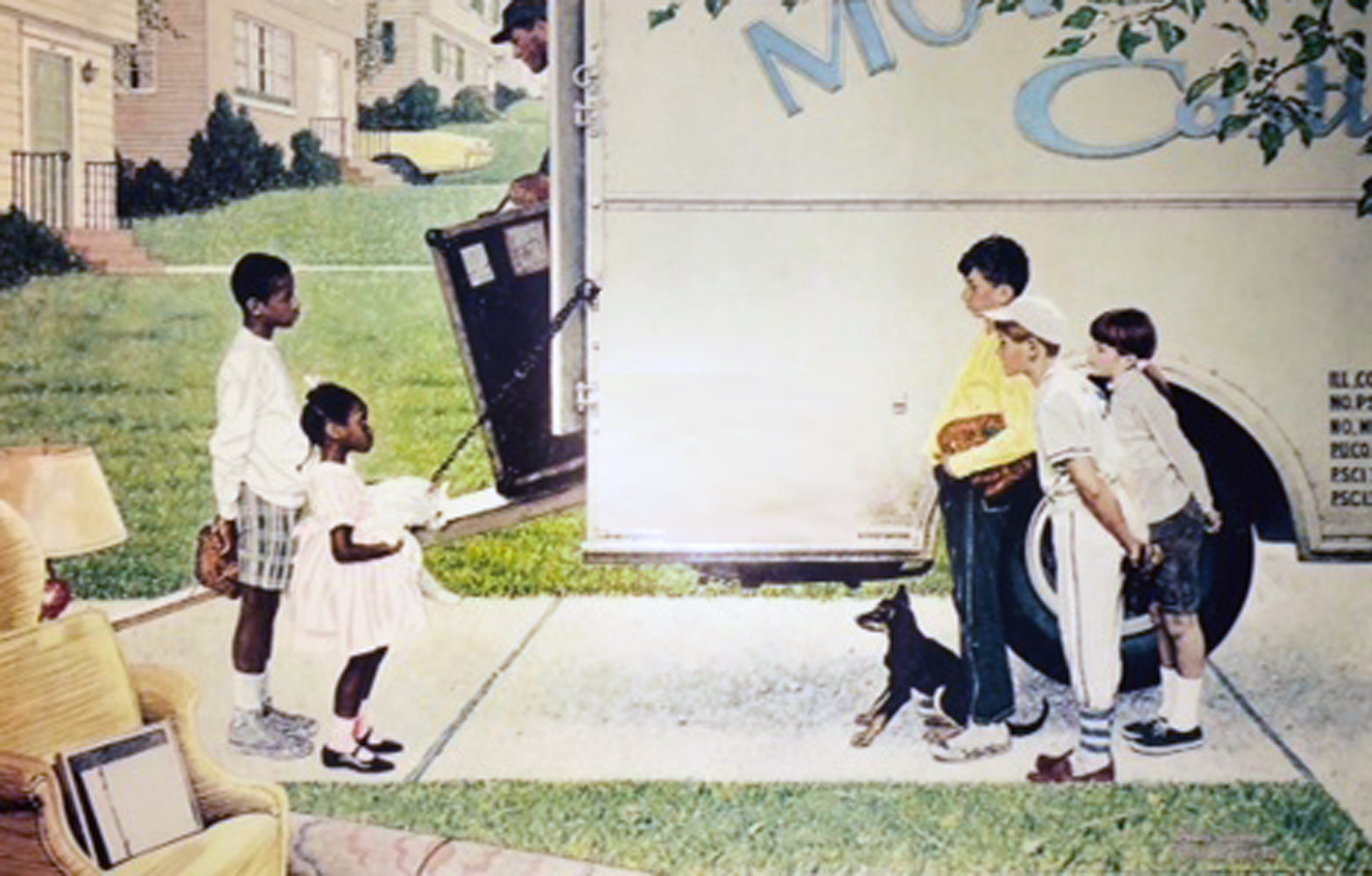
Moving Day (New Kids in the Neighborhood)

"Being a Negro in the middle of a white neighborhood is like being alone in the middle of a crowd." (Mrs. Jacqueline Robbins, Chicago suburb Park Forest)


In 1967, Look magazine interviewed Mrs. Jacqueline Robbins for an article titled Suburbia.  In 1962, the Robbins were the second black family to move into the all white Chicago suburb of Park Forest, the first having already departed.  Things did not bode well for the Robbins:  when they first arrived they discovered a newly built face, the far side painted white, the near side painted black.  It was erected by the neighbour who did not want to look at them. "Being a Negro in the middle of a white neighborhood is like being alone in the middle of a crowd," said Mrs. Robbins. (http://www.mrmosconi.com/negro.html)

Yet, blacks were leaving the ghettos of American cities at an increasing rate.  "In Chicago last year 179 families moved into white neighborhoods, more than twice as many as in the previous year, seven times as many as in 1963, and 45 times as many as in 1961 and 1962 combined." (http://www.mrmosconi.com/negro.html)

The public reaction to the integration of American cities was mixed.  Some rejected it outright.  Others applauded it on paper, but they did not react well once integration knocked on their door.  More often than not it was adults who protested integration, not children.  In fact, one Detroit neighbourhood even built a wall to prevent the white children from playing with the black children.  

Norman Rockwell painted Moving Day (The Saturday Evening Post, May 17, 1967) as a reaction to the integration of the Chicago suburb.  Two black children stand in the driveway of their new home. Three white children look at them with curiosity.  The situation looks promising if not for the adult peering from behind a window curtain.


Sunday, 23 October 2016

Marriage License

The young couple arrives at the clerk's office, full of excitement.  Today. June 30, 1955, is the most important day of their lives.  They are about to say "I do".  The groom wears a white suit, the bride, a bright yellow dress.

The clerk, however, sits in his chair, unamused.  He has seen it all before.  He seems to mimic his surroundings:  paint peels from the walls; cigarette butts sit discarded on the floor; an open map lies discarded on top of a bookshelf.  But the clerk is not all bad.  A tabby cat lingers by his chair.

After a brief ceremony, the clerk will go on with his mundane affairs.  However, the new couple will go out into the brave new world, its light emanating through the arched window.


Saturday, 22 October 2016

Window Washer

Jim Stafford took an art correspondence course with Norman Rockwell while in high school.  Five years later, while stationed at an army base in Massachusetts, he wrote a letter to the artist who invited him to his home.  When Stafford arrived, Rockwell "looked [him] up and down and said, 'You'll do.'"  Stafford wasn't sure what that meant.  It turned out Rockwell wanted him to pose as a model for his latest painting. (http://eyelevel.si.edu/2010/12/just-plain-folk-on-norman-rockwells-models.html)

Stafford would play a Manhattan window washer who comes upon an executive dictating a letter to his secretary.  The secretary looks up from her work to notice the window washer winking at her, oblivious to the executive.  Now she has likely missed a few sentences.  How will she explain to her boss what has transpired?

Rockwell paid his model $30 for three days work.  When Stafford tried to cash the pay cheque, the bank teller didn't believe it was a valid cheque, given the identity of the issuer.  Years later, he wished he had kept the cheque for posterity.

Window Washer first appeared on the cover of The Saturday Evening Post on September 17, 1960.  The original painting is now in the possession of movie maker Steven Spielberg.