Showing posts with label abolitionists. Show all posts

Sunday, 15 May 2016

Not For Ourselves Alone

"I am the better writer, she the better critic...and together we have made arguments that have stood unshaken by the storms of thirty long years; arguments that no man has answered." 
(Elizabeth Cady Stanton)


In 1851, Elizabeth Cady fell in love and married the abolitionist Henry Stanton.  The couple moved from Boston to Seneca Falls, New York.  Elizabeth Stanton missed the intellectual community in Boston and vowed to "transform women's place in society".  In 1848, she held the first Women's Rights Convention in Seneca Falls.  Susan Anthony, a teacher for ten years, joined the temperance movement, encouraging women to seek legal solutions to the poverty and violence caused by their husbands' drinking.  

Stanton and Anthony joined forces to advance the cause of women.  They complemented each other well.  As Stanton explained:  "I am the better writer, she the better critic...and together we have made arguments that have stood unshaken by the storms of thirty long years; arguments that no man has answered." Anthony was always "Pushing her [Stanton] to write one more speech, one more manifesto" (http://www.pbs.org/stantonanthony/resources/index.html).  While Stanton was married with seven children, Anthony was single and had the freedom to move about.  Anthony travelled to 54 counties in New York State delivering speeches about women's rights.  

In 1856, the women joined the American Anti-Slavery Society.  They joined forces with 5,000 women to secure 400,000 signatures supporting the 13th Amendment to free the slaves.  In 1869, the women joined the National Women's Suffrage Association. From 1868 to 1870, Stanton wrote for The Revolution, a radical women's rights newspaper.  

As part of the New Departure, Stanton and Anthony started to view the 14th and 15th Amendments as proof that all humans had the right to vote, not just males.  In 1872, they voted in the presidential election, along with 150 women, and were arrested.  Within three years, however, the Supreme Court struck down their argument.

In 1878, the women proposed their own Amendment, which would sit before Congress for 40 years.  
Stanton and Anthony merged with the American Women's Suffrage Association and The Women's Christian Temperance Union to strengthen their numbers.  And still they waited.

In 1892, Stanton retired from speaking but continued to write.  Anthony continued the cause with a campaign to acquire women's suffrage one state at a time.  Both women passed away in the early 1900's.  The 19th Amendment, granting women the right to vote, would not be passed until 1920.


Thursday, 12 May 2016

Thomas Jefferson

"I think one approaches Thomas Jefferson with the sense that he is, in a biographical sense, the Holy Grail of American History." (Ken Burns)


Thomas Jefferson, a Renaissance man, represented two polar opposite ideas.  As Ken Burn explains, "He may be the man who distilled a century of Enlightenment thought into this sentence that begins:  'all men are created equal.'  But he was also the owner of more than 200 human beings and never saw fit in his lifetime to free them..."

Jefferson believed in education:  when he lost his entire book collection to a fire at his birthplace home, he responded:  "I cannot live without my books."  He spent the next several years re-amassing his literature, which would total 6,500 titles (http://alinefromlinda.blogspot.ca/2015/10/thomas-jefferson-i-cannot-live-without.html).  When the British Army burned the White House in the War of 1812, the retired president sold his beloved collection to replenish the shelves at the Capitol.

While Jefferson was an avid reader, he was also an avid writer; his writings have been condensed into 19 volumes.  His most famous work was the Constitution of the United States, which he penned in 1787:  

"We the people of the United States, in order to form a more perfect Union, establish Justice, insure domestic Tranquility, provide for the common defence, promote the general Welfare, and secure the blessings of Liberty to ourselves and to our Posterity, do ordain and establish this constitution for the United States of America..."

As Ken Burns says, the statement "all men are created equal" is one of the most important, and revolutionary, parts of the Constitution.  However, when it came right down to it, Jefferson didn't "walk the walk".  He kept over 200 slaves, like so many other Americans.  It never occurred to him to free them, even though he pushed for equality among men.  

Even so, Burns believes that Jefferson's influence on America was more positive than negative.  As Burns explains:  While Jefferson's words "gave comfort to the secessionists and the army of Jefferson Davis.... it is more important that his words inspired Abraham Lincoln, a generation of abolitionists, and thousands of runaway slaves."


Monday, 2 March 2015

American Public's Insatiable Appetite for News: Early Abolitionists Lead the Way

"One of the peculiar traits [of the public] is the insatiable appetite which exists in all classes of people in this country for news.  It is thirst so universal that it has given rise to a general and habitual form of salutation on the meeting of friends and strangers of 'What's the news?'" 
(Nathan Hale, publisher of the Boston Daily Advertiser, 1817)


Four men in front of a tent which advertises the Boston Daily Advertiser courtesy 


Before the advent of the radio and the television and the computer, the newspaper was the public's main source for news.  Newspapers first appeared in the Thirteen Colonies in the 1700's.  However, America's population was small and it hadn't yet broken off from Britain.  

Reporters on the Eastern seaboard used to wait for ships to arrive from Britain, row out to meet them, climb aboard and record the latest news.  Then they would typeset back at the office, print it on the printing press, and share it with the locals.  The process was slow and tedious and expensive.  Only a small number of Americans subscribed to newspapers for a hefty sum. 


The telegraph was the first device to separate transport and communication courtesy http://ushistoryimages.com/images/morse-telegraph/fullsize/morse-telegraph-4.jpg.


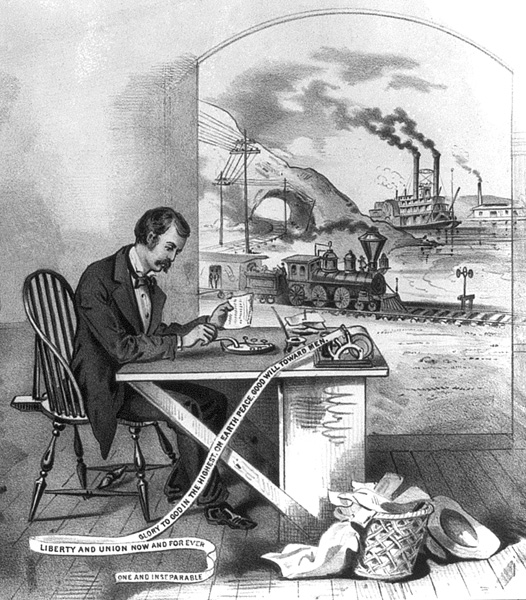
Three inventions changed the course of the newspaper:  the printing press, the telegraph and the railroad, all of which made the dissemination of news much faster and more efficient.  In the early 1800's, the United States only had 376 newspapers in distribution.  However, by 1835, that number had shot up to 1200.  

In his book Fanatics and Fire Eaters:  Newspapers and the Coming of the Civil War (http://www.amazon.com/Fanatics-Fire-eaters-Newspapers-History-Communication/dp/B005IUWPDW) Lorman Ratner calls the sudden increase in readership a "newspaper revolution" and compares it to the transportation revolution.  With printing presses becoming faster, and the population exploding, newspapers became cheaper and more readily available. 


The Liberator masthead courtesy 


Newspaper editors and reporters influenced public opinion by the images they evoked.  Abolition was one major issue that used the newspaper as its forum, driving up its sales.  The Boston paper, the Liberator, advocated the abolition of slavery.  With an ever-increasing circulation, the paper helped open the eyes of the public to the evils of slavery.  In its first issue, the editor appealed to the public, reminding them of the famous line in the Declaration of Independence that:

"'...all men are created equal, and endowed by their Creator, with certain inalienable rights -- among which are life, liberty and the pursuit of happiness.'  I shall strenuously contend for the enfranchisement of our slave population."   


When the Civil War broke out, it was the newspaper reporters who reported from the battle front.  It was the newspapers that reported on the issue of emancipation which divided the country.  The public's thirst for news was insatiable.  They wanted blow by blow accounts of the battles.  They wanted to know who was winning the war.  

Whereas in Andrew Jackson's years in the White House, only a small elite read the newspaper, by the time Abraham Lincoln took office, the lower classes were reading the paper as well.  In the end, the slavery issue was fought on the battlefield, and resolved with the ratification of the Thirteenth Amendment, thanks in part to the eye-opening headlines of the early abolitionists.