Showing posts with label 19th Amendment. Show all posts

Sunday, 22 May 2016

Prohibition

"When the mayor of Berlin, Gustav Boess, visited New York City in the fall of 1929, one of the questions he had for his host Mayor James J. Walker, was when Prohibition was to go into effect.  The problem was that Prohibition had already been the law of the United States for nearly a decade.  That Boess had to ask tells you plenty about how well it was working." (Michael Lerner)


The Alcoholic Republic talks about the great alcoholic binge that took place in America from 1790 to 1830.   Wives were worried about their husbands drinking away their pay cheques, about them coming home and taking out their frustrations on them and their children, about the possibility of living on the streets (http://alinefromlinda.blogspot.ca/2012/01/carry-nations-hatchetations.html). The Temperance Movement, a direct response to this problem, peaked in 1850 with 238,000 women (http://www.encyclopedia.com/topic/temperance_movements.aspx).


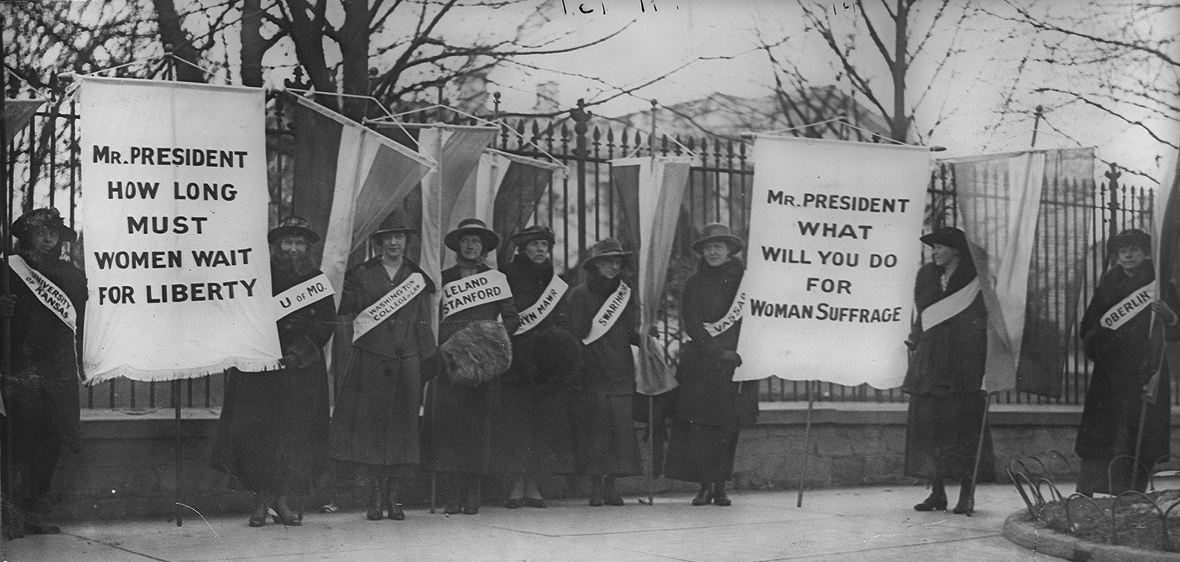
In time, the Temperance Movement's strategy changed from one of moral to legal reform.  The Prohibition Party debuted in 1869.  The Women's Christian Temperance Union emerged in 1874.  Their strategy focussed more and more on empowering women.  One way to do this was by securing the vote for women.  The W.C.T.U. joined forces with the suffragettes to make this happen.  
It is no surprise then that right on the tails of the women's right to vote (1919) came Prohibition (1920).  


Reformers were hoping that Prohibition would not only curb drinking, but also improve the quality of life in American towns and cities.  Merchants expected sales of clothing and household goods to rise. Real estate agents expected house prices to rise with the closing of saloons and the improvement of neighbourhoods.  Soft drink companies expected their profits to skyrocket.  Theatre producers expected bigger crowds as Americans looked for new outlets for entertainment.  According to historian Michael Lerner, however, this did not happen.  


Instead, the closing of breweries and saloons led to the loss of thousands of jobs.  Restaurants closed because they could no longer make a profit without a liquor licence.  Theatre revenues also declined.  On the other hand, Prohibition did lead to the rise of bootlegging, speakeasies and organized crime.  Corrupt police officers succumbed to bribes.  The number of "pharmacists" in New York tripled since a pharmacist could prescribe alcohol for many an ailment.  Enrollment at churches increased as well as the number of "self-professed" ministers who could obtain liquor through legal means.


By 1933, the 19th Amendment was repealed.  Many Americans agreed that the experiment had failed, even though Prohibitionists intentions were well-founded.

Sunday, 15 May 2016

Not For Ourselves Alone

"I am the better writer, she the better critic...and together we have made arguments that have stood unshaken by the storms of thirty long years; arguments that no man has answered." 
(Elizabeth Cady Stanton)


In 1851, Elizabeth Cady fell in love and married the abolitionist Henry Stanton.  The couple moved from Boston to Seneca Falls, New York.  Elizabeth Stanton missed the intellectual community in Boston and vowed to "transform women's place in society".  In 1848, she held the first Women's Rights Convention in Seneca Falls.  Susan Anthony, a teacher for ten years, joined the temperance movement, encouraging women to seek legal solutions to the poverty and violence caused by their husbands' drinking.  

Stanton and Anthony joined forces to advance the cause of women.  They complemented each other well.  As Stanton explained:  "I am the better writer, she the better critic...and together we have made arguments that have stood unshaken by the storms of thirty long years; arguments that no man has answered." Anthony was always "Pushing her [Stanton] to write one more speech, one more manifesto" (http://www.pbs.org/stantonanthony/resources/index.html).  While Stanton was married with seven children, Anthony was single and had the freedom to move about.  Anthony travelled to 54 counties in New York State delivering speeches about women's rights.  

In 1856, the women joined the American Anti-Slavery Society.  They joined forces with 5,000 women to secure 400,000 signatures supporting the 13th Amendment to free the slaves.  In 1869, the women joined the National Women's Suffrage Association. From 1868 to 1870, Stanton wrote for The Revolution, a radical women's rights newspaper.  

As part of the New Departure, Stanton and Anthony started to view the 14th and 15th Amendments as proof that all humans had the right to vote, not just males.  In 1872, they voted in the presidential election, along with 150 women, and were arrested.  Within three years, however, the Supreme Court struck down their argument.

In 1878, the women proposed their own Amendment, which would sit before Congress for 40 years.  
Stanton and Anthony merged with the American Women's Suffrage Association and The Women's Christian Temperance Union to strengthen their numbers.  And still they waited.

In 1892, Stanton retired from speaking but continued to write.  Anthony continued the cause with a campaign to acquire women's suffrage one state at a time.  Both women passed away in the early 1900's.  The 19th Amendment, granting women the right to vote, would not be passed until 1920.