Showing posts with label Declaration of Independence. Show all posts

Tuesday, 24 May 2016

Yosemite: A Gathering of Spirit

"I bless Yosemite for waking me up to the natural wonders but also for waking me up to my own history.  I was able to reclaim an entire trip that I had put away and lost.  I could feel my dad's hand in mine as we walked and the hike we took to the little waterfall." (Ken Burns)


Vernal Falls, Yosemite circa 1889 by Thomas Hill courtesy https://en.wikipedia.org/wiki/Yosemite_National_Park.


After three intense days of filming his documentary Yosemite:  A Gathering of Spirit, Ken Burns found himself restless and unable to sleep.  That night he had a vivid memory of visiting another National Park, Shenandoah in Virginia, with his father when his mother was dying of cancer.  The trip was a chance to realize nature's beauty, to lift his demoralized spirits.  It was also a chance to reconnect with his father.  "I bless Yosemite for waking me up to the natural wonders but also for waking me up to my own history.  I was able to reclaim an entire trip that I had put away and lost.  I could feel my dad's hand in mine as we walked and the hike we took to the little waterfall"  (http://www.usatoday.com/story/travel/2016/04/14/ken-burns-national-parks-americas-best-idea/82499256/).


Yosemite:  A Gathering of Spirit focusses on the fact that "National Parks have a way of connecting people not just to their soil, but to their soul."  While all the National Parks are beautiful, people who have visited more than one tend to have a favourite.  It's not just what people see in the Parks, but who they experience it with.  Writer Dayton Duncan, who has visited all 59 National Parks, prefers National Glacier Park, which he visited with his future wife.  
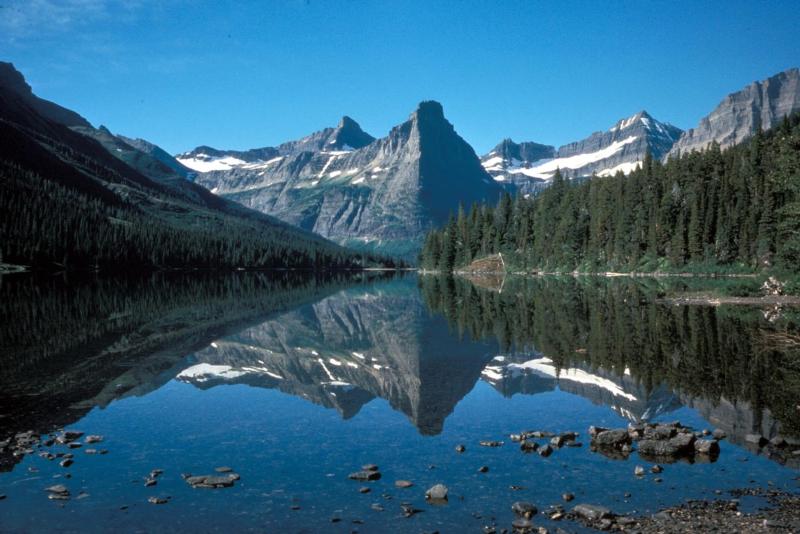

Glenns Lake

Glacier Park, Montana courtesy 


There is something revolutionary about America's National Parks.  As Duncan explains:  "National Parks are the Declaration of Independence expressed on the landscape.  We were the first nation in the history of mankind to say that the most special places should be set aside not for royalty, not for the rich, not for the well-connected, but for everyone and for all time."  

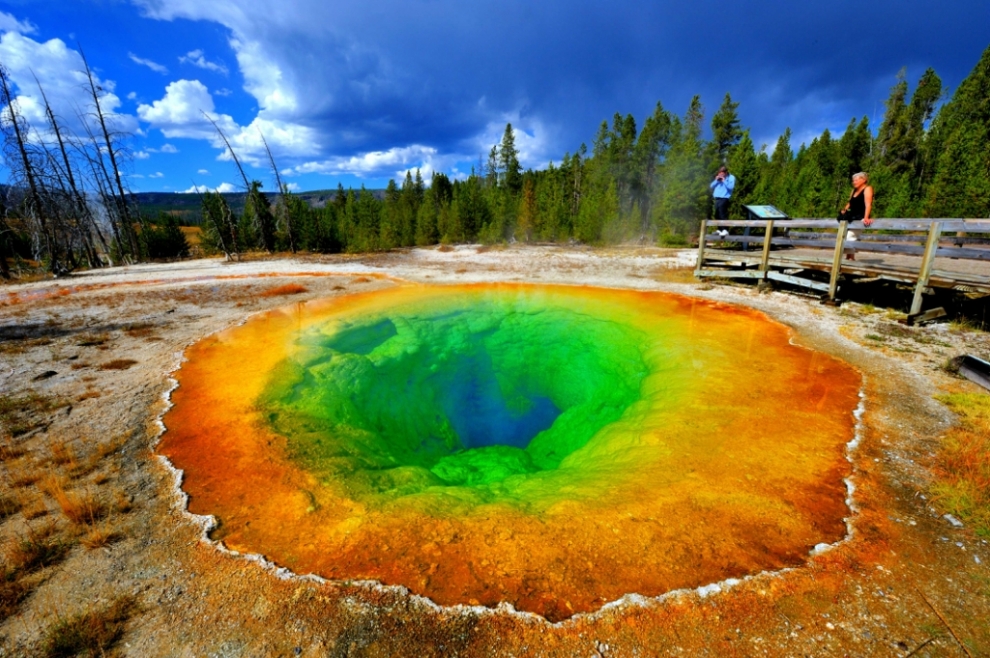
Since 1904, 13.5 billion visitors have flocked to America's National Park sites.  As of 2014, over 3.8 million people have visited Yosemite alone.  The beauty of Yosemite is its giant sequoias.  For someone who has never visited a National Park, Ken Burns recommends starting with the original one, Yellowstone, for its "geysers, thermal pools, waterfalls, and wildlife".  


However, Burns points out that Americans don't have to travel very far to find a Park:  every state has a National Park or a national monument except Delaware.  


Wednesday, 4 May 2016

The Statue of Liberty

"And in that moment, I sensed a palpable fragility in her structure, floating there above us.  But at the same time, I felt how powerful the idea she represents is -- an idea more indestructible than anything made of copper or steel, an idea as imperishable as the stars that were shining that night." 
(Ken Burns)


Lady Liberty at Paris World's Fair circa 1878 courtesy 


It was the first thing that immigrates to the New World saw when they entered New York Harbor.   For some, it represented a friendship between the donor, France, and the recipient, the United States.  For others it was much more:   a landmark of freedom.  

The concept for the Statue of Liberty was conceived in 1865 by a staunch abolitionist and supporter of the Union in the Civil War named Edouard Rene de Laboulaye.  At his home in Versailles, he broached the idea to French sculptor Frederic Auguste Bartholdi:  "If a monument should rise in the United States , as a memorial to their independence, I think it only natural if it were built by united effort." (https://en.wikipedia.org/wiki/Statue_of_Liberty).  IN 1870, Bartholdi visited New York City, sketches of Lady Liberty in hand, and fixed his eyes on Bedloe's Island as the site for the copper statue.

Designed by Frederick Auguste Bartholdi and built by Gustave Eiffel, the architect of the famous tower, the 151 foot statue was built piece by piece.  Lady Liberty's head and shoulders were exhibited at the Paris World's Fair in 1878.  Her torch was displayed at the Centennial Exposition in Philadelphia in 1876.  The full statue was shipped to the United States where it was assembled in 1886 on a pedestal built by the Americans, partly financed by public donations.  , the statue was dedicated on October 18, 1886 on Liberty Island in New York Harbor.  Lady Liberty represents Libertas, a Roman goddess, who holds a torch and a tabula ensata inscribed with the date July 4, 1776, the day the Declaration of Independence was signed.  New Yorkers celebrated the statue's completion with their first ticker tape parade, presided over by President Grover Cleveland.

Over the next several decades, from 1892 to 1954, over twelve million immigrants would feast their eyes on Lady Liberty as they entered New York Harbor.  Authors Margret and H.A. Rey, creators of Curious George, were two such immigrants, fleeing Nazi occupied Europe.  Novelist Isaac Asimov fled Communist Russia.  Dance studio legend Arthur Murray came from Poland.  For more information on Ellis Island, visit http://alinefromlinda.blogspot.ca/2013/05/may-31.html.

I would guess that some of Ken Burns' relatives sailed past the famous statue as well upon immigrating to the United States.  Ken Burns first became interested in Lady Liberty as she approached her 100th birthday.  Given permission to film night scenes on Liberty Island for his upcoming documentary, he and his crew camped out there overnight.  However, tucked into their sleeping bags under the colossal monument, they could not sleep.  Burns explained:

"And in that moment, I sensed a palpable fragility in her structure, floating there above us.  But at the same time, I felt how powerful the idea she represents is -- an idea more indestructible than anything made of copper or steel, an idea as imperishable as the stars that were shining that night." (http://www.pbs.org/kenburns/statueofliberty/about/)

Note:  For more information on the Statue of Liberty, visit http://alinefromlinda.blogspot.ca/2013/05/may-31.html.


Monday, 2 March 2015

American Public's Insatiable Appetite for News: Early Abolitionists Lead the Way

"One of the peculiar traits [of the public] is the insatiable appetite which exists in all classes of people in this country for news.  It is thirst so universal that it has given rise to a general and habitual form of salutation on the meeting of friends and strangers of 'What's the news?'" 
(Nathan Hale, publisher of the Boston Daily Advertiser, 1817)


Four men in front of a tent which advertises the Boston Daily Advertiser courtesy 


Before the advent of the radio and the television and the computer, the newspaper was the public's main source for news.  Newspapers first appeared in the Thirteen Colonies in the 1700's.  However, America's population was small and it hadn't yet broken off from Britain.  

Reporters on the Eastern seaboard used to wait for ships to arrive from Britain, row out to meet them, climb aboard and record the latest news.  Then they would typeset back at the office, print it on the printing press, and share it with the locals.  The process was slow and tedious and expensive.  Only a small number of Americans subscribed to newspapers for a hefty sum. 


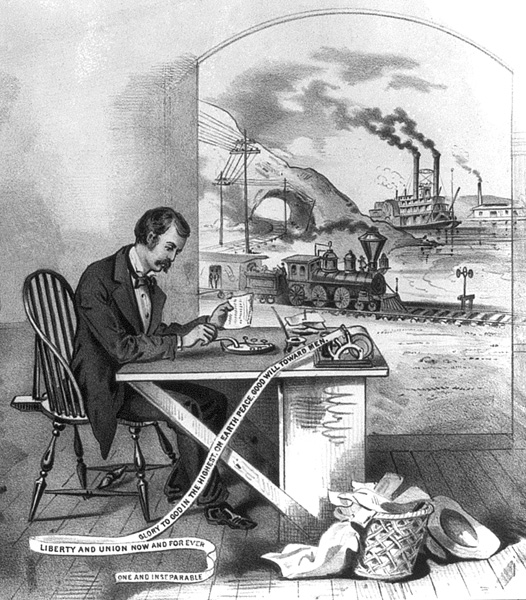
The telegraph was the first device to separate transport and communication courtesy http://ushistoryimages.com/images/morse-telegraph/fullsize/morse-telegraph-4.jpg.


Three inventions changed the course of the newspaper:  the printing press, the telegraph and the railroad, all of which made the dissemination of news much faster and more efficient.  In the early 1800's, the United States only had 376 newspapers in distribution.  However, by 1835, that number had shot up to 1200.  

In his book Fanatics and Fire Eaters:  Newspapers and the Coming of the Civil War (http://www.amazon.com/Fanatics-Fire-eaters-Newspapers-History-Communication/dp/B005IUWPDW) Lorman Ratner calls the sudden increase in readership a "newspaper revolution" and compares it to the transportation revolution.  With printing presses becoming faster, and the population exploding, newspapers became cheaper and more readily available. 


The Liberator masthead courtesy 


Newspaper editors and reporters influenced public opinion by the images they evoked.  Abolition was one major issue that used the newspaper as its forum, driving up its sales.  The Boston paper, the Liberator, advocated the abolition of slavery.  With an ever-increasing circulation, the paper helped open the eyes of the public to the evils of slavery.  In its first issue, the editor appealed to the public, reminding them of the famous line in the Declaration of Independence that:

"'...all men are created equal, and endowed by their Creator, with certain inalienable rights -- among which are life, liberty and the pursuit of happiness.'  I shall strenuously contend for the enfranchisement of our slave population."   


When the Civil War broke out, it was the newspaper reporters who reported from the battle front.  It was the newspapers that reported on the issue of emancipation which divided the country.  The public's thirst for news was insatiable.  They wanted blow by blow accounts of the battles.  They wanted to know who was winning the war.  

Whereas in Andrew Jackson's years in the White House, only a small elite read the newspaper, by the time Abraham Lincoln took office, the lower classes were reading the paper as well.  In the end, the slavery issue was fought on the battlefield, and resolved with the ratification of the Thirteenth Amendment, thanks in part to the eye-opening headlines of the early abolitionists.