Showing posts with label Eaton's Catalogue. Show all posts

Saturday, 16 January 2016

The Life of a Catalogue Fashion Illustrator

Pauline LeGoff Boutal was a French immigrant who settled in Winnipeg, Manitoba in the early 1900's.  The daughter and granddaughter of stained glass window artists, she had a flair for the arts.  She studied at both the Winnipeg Art Club and the Winnipeg School of Art.  While many artists are not able to make a living at it, such was not the case with Pauline who was hired by Bridgens of Manitoba, which had a contract with Eaton's Catalogue.  Illustrated magazines were the multimedia of the day; in fact, Bridgens employed 60 to 100 Canadian artists as well specialized artists from Chicago and New York City. 

Whereas other fashion illustrators had to work their way up at Bridgens, because of Pauline's background, she only had to apprentice for six weeks.  Pauline secured a $10 a week position with the company which would last for 23 years.  Known as Madame Boutal by her co-workers, perhaps because Paris was the fashion capital and she was French, she carved out a good living at the company.  Days lasted eight hours, although Pauline put in overtime when a catalogue was about to be launched.  While the artists at Bridgen's put in long hours, there was still time for fun.  The artists enjoyed a strong camaraderie, playing football in the hallways, playing hockey between the drafting tables and pulling practical jokes on each other. 

The work that Pauline and the other artists completed was meticulous and precise.  Pauline demonstrated an expert knowledge of ink drawings.  She created an impression of depth with her drawings of elegant silhouettes.  Rather than copying drawings, Pauline relied on her vivid imagination.  The street served as an inspiration for the young artist. 

Pauline had to be aware of current hairstyles, make up and fashion.  Her silhouettes changed over time:  in the 1920's, they were small and sculpted; in the 1930's, they had straight profiles, no wasitlines and short, wavy hair; by the 1930's, they were active and outdoors.  Each page of the catalogue was like a poster.  Pauline had to be aware of the black and white space, titles, calligraphy, prices and drawings.  Her attention to detail served her well. 

Pauline stopped working for Bridgen's in 1941.  By the 1950's, photographs seemed to replace drawings.  Pauline continued her work as a fashion illustrator. 


Pauline Boutal at work, 1947.


Friday, 15 January 2016

How Eaton's Influenced Canadian Culture


"Eaton's Department Store, Simpson's and the Hudson's Bay Company were the three major stores that represented Canadian pride, nationalism and modernity in the late nineteenth and early twentieth centuries," 
(Donica Belisle, Retail Nation:  Department Stores and the Making of Modern Canada )


Eaton's helped bring Canada into the modern age with its catalogue which reached rural places that would otherwise not have access to its products.  Selling everything from farm implements to prefabricated houses to the latest appliances, the catalogue represented modern culture at its best.  As an Eaton's advertisement from 1892 announced:  "This is emphatically an age of PROGRESS.  The golden age is before us, not behind, and those who're unwilling to keep up with the procession will have the decency to STAND ASIDE." 


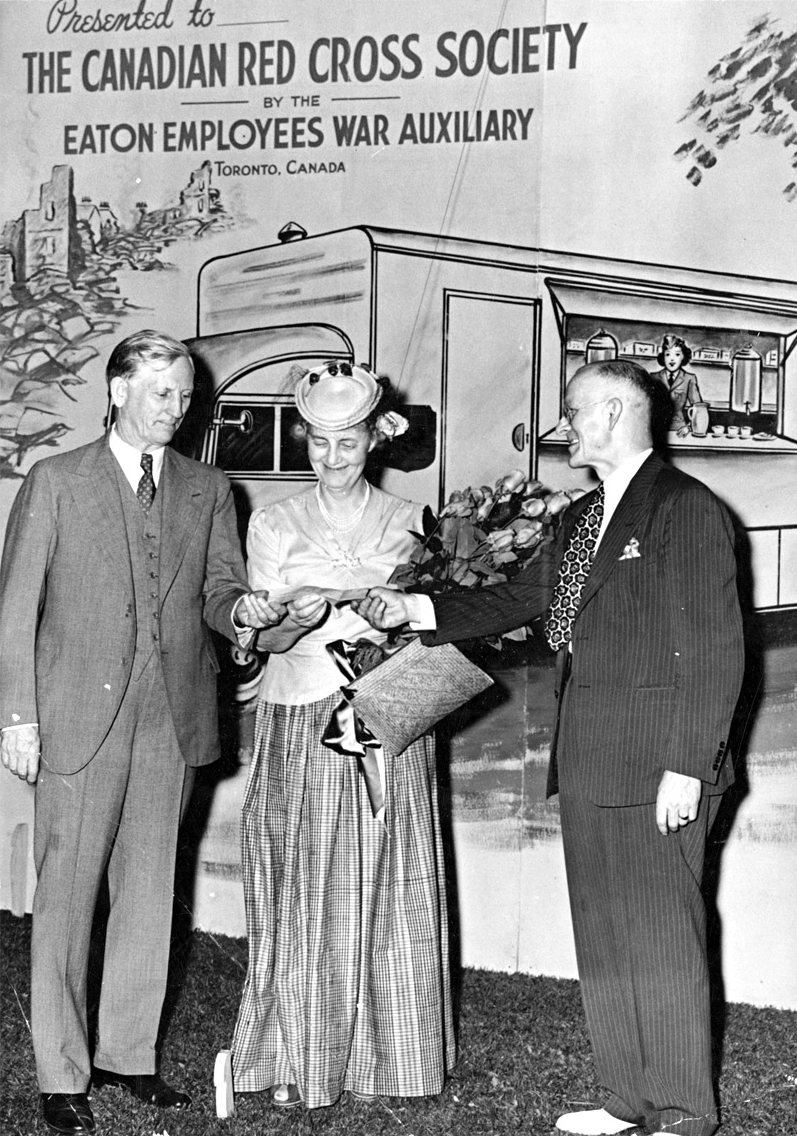
Eaton's represented Canadian nationalism and pride, particularly during the First and Second World Wars.  The Eaton's Catalogue displayed patriotic covers during the war years.  Gift baskets were sent to Canadian soldiers overseas to boost their morale.  Eaton's employees who served overseas had their jobs held for them until they returned.  Sometimes their medical expenses due to war injuries were paid by Eaton's.

Eaton's also affected popular culture.  The Santa Claus Parade, which debuted in 1905, set the tone for other major parades in North America (see http://alinefromlinda.blogspot.ca/2013/11/november-30.html).  Many Canadian children grew up watching the parade either from Toronto's Yonge Street or on their television screen.  Those children often grew up to be Eaton's customers.

Eaton's is even mentioned in Canadian literature, specifically the French Canadian folktale Le Chandail de Hockey (The Hockey Sweater) in which a young Roch Carrier asks his mother to buy him a new hockey sweater.  He is so disappointed when his mother, who writes to Monsieur Eaton, receives a Toronto Maples Leafs jersey rather than a Montreal Canadiens one.  For fear of offending Monsieur Eaton, Roch's mother insists that he wear "le chandail".  Being a Torontonian, I guess it only made sense that Monsieur Eaton would have been a Leafs fan.

Timothy Eaton has also left his mark on the world of religion.  A former Presbyterian who converted to Methodism during the tent revivals in Southern Ontario, Timothy was a devout Christian.  After his death, his widow had a church built in his memory, Timothy Eaton Memorial Methodist Church, later United, which is still in use today.


Flora Eaton, an active fundraiser for the Red Cross, allowed Eaton Hall to be used as a military hospital during the Second World War courtesy https://en.wikipedia.org/wiki/Feminism_in_Canada.


Monday, 4 January 2016

Everything From Oriental Rugs to Prefabricated Houses

"This catalogue is destined to grow wherever the maple leaf grows, throughout the vast Dominion.  We have the facilities for filling mail orders satisfactorily, no matter how far the letters have to come and the goods have to go." (Timothy Eaton, 1887)


When the Eaton's catalogue first came off the press in 1884, it was a mere 32 pages.  By the 1920's, the catalogue had grown to 500 pages.  In 1890, there were more than 100 clerks filling catalogue orders.  By 1896, Eaton's was sending out 135,000 parcels by post and 74,000 by express.  By 1903, the mail order operation was so large that it had to move to a separate building in Toronto.  Here are some of the products featured in the Eaton's catalogue over its 90 year history:


  • clothing
  • farm implements
  • silverware
  • china
  • prefabricated houses
  • jewelry
  • patterns
  • toys
  • dolls
  • books
  • windmills
  • lamps
  • hats
  • Oriental rugs
  • records
  • crystal
  • train sets
  • appliances
  • luggage
  • sporting goods
  • fishing accessories
  • hair permanent machines
  • accordions
  • pianos
  • guitars
  • phonographs
  • vacuums
  • mattresses
  • medicines
  • stationery
  • cameras
  • seeds
  • bulbs
  • baby carriages
  • women's furs
  • linens
  • drapes
  • blacksmith's tools
  • candy
  • priest's cassocks
  • Klondike miner's clothing


Eaton's Spring Summer 1913, back cover (detail).

Prefabricated Houses in Eaton's Catalogue circa 1913 courtesy http://www.historymuseum.ca/cmc/exhibitions/cpm/catalog/cat2104e.shtml#1222116.

Friday, 1 January 2016

Timothy Eaton: Department Store Genius

"There is hardly a name in Canada, with the possible exception of the Prime Minister, so well know to the people at large as that of Mr. Timothy Eaton." (The Globe, 1905)


As I research for a new picture book that I am writing about Toronto of the 1940's, I realize what an institution Eaton's was in Canada at the time.  Growing up in Toronto, my dad said that my grandma used to buy everything at Eaton's.  It seems like every Torontonian either shopped there or worked there.  I borrowed a copy of my parents' book Eatonians to delve deeper into the department store which touched Canadians for over a century and a quarter. 

First, let's examine the man who started it all, Timothy Eaton, an immigrant from Ireland who came to Canada around the mid 1800's.  He settled in Kirkton, Ontario, where he briefly ran a small business with his brother, James. 

Timothy befriended my great-great grandfather Thomas Tufts, who provided the merchant with horses to transport his goods.  Timothy and Thomas used to make runs together from Kirkton to St. Mary's where Timothy opened his second business, this one a dry goods store. 

By 1869, Timothy set out for the big city of Toronto, which at the time only had 70,000 inhabitants.  It was there that Timothy, along with a staff of four, set up a dry goods store and haberdashery at 178 Yonge Street. 

The dry goods store faired well enough that Timothy opened his first department store at 190 Yonge Street in 1883.  The three-floor store, which included 35 departments, featured a series of firsts including:  the first electric lights in a Canadian business, the first telephone in 1885 and the first elevator in 1886. 

Timothy was the first merchant to offer satisfaction guaranteed or your money refunded.  Shoppers knew that they could trust Eaton's for quality products and service.  Their workers, known as Eatonians, went out of their way to serve their customers courteously and efficiently.  Quality and service kept the customers coming back.

The Eaton's catalogue, also the brainchild of Timothy, allowed Canadians from the rural parts of the country to order goods, those who would not normally have access to an Eaton's store.  Timothy was ahead of his time with his advertising techniques used in the catalogue (http://alinefromlinda.blogspot.ca/2012/10/an-icon-of-canadian-culture.html).

Another first for Timothy was the Santa Claus Parade in 1905, well ahead of its time.  Timothy pulled out all the stops having Santa arrive by helicopter one year and by real reindeer another year. My dad remembers attending the parade every year with my granddad, followed by a visit with Santa at Eaton's Toyland.  Macy's Thanksgiving Day Parade in New York City, which didn't debut until 1925, took a page from the Toronto Eaton's Santa Claus Parade. 

In 1905, the Toronto Globe announced:  "There is hardly a name in Canada, with the possible exception of the Prime Minister, so well know to the people at large as that of Mr. Timothy Eaton." Sadly, the founder passed away in 1906.  However, his son son John Craig continued the practices started by his father and the company flourished. 

By 1911, Toronto had grown to about 250,000 inhabitants and Eaton's had 17,500 employees.  By 1919, Timothy's Queen Street store had over 60 acres of floor space.  His large plexiglass window, innovative for the time period, featured displays which attracted window shoppers from the Queen Street West pedestrian crosswalk, one of the busiest in Canada.  The window displays became even more extravagant as Timothy tried to outdo his competitor, Robert Simpson, whose department store was located across the street. 

The 1920's and 1930's saw Eaton's expand across Canada ushering in the Golden Age of the Department Store.  In Toronto, shoppers could dine in the fine restaurant on the 7th floor.  They could be entertained in the auditorium.  Or they could purchase their own entertainment by buying one of the grand pianos from the store.  My dad remembers a visit to the Queen Street Store where, at the tender age of four, he wandered off to the music department.  After several minutes, my horrified grandma discovered him there, tinkering at the keys of a baby grand.

By the 1940's, Toronto's population had risen to almost 1 million people.  The decade saw wartime shortages, but Eaton's still managed to turn a profit.  By the 1960's, Eaton's spread to the suburbs with a new store opening at Yorkdale Shopping Mall.  In the 1970's and 1980's, I remember my granddad purchasing my grandma's favourite perfume each Christmas at Eaton's.

Eaton's started to pull away from the traditions started by its founder, Timothy.  The first sign of trouble was in 1976 when Eaton's launched its last catalogue.  Six years later, the company pulled out of the Santa Claus Parade.  Finally, in 1999, the company folded. The Canadian institution that our great-great grandparents had shopped at had closed its doors.