Showing posts with label Eaton's. Show all posts

Thursday, 21 January 2016

The Department Store Candy Counter

When I entered Grade 7, my mom let me take the bus downtown with a friend.  It was a rite of passage.  We visited the department stores, including Kresge's, Woolworth's, The Right House, and Eaton's.  A highlight for me was a stop at the candy counter.  Just the aroma would put me in a good mood.  Customers could purchase anything from rosebuds to malt balls to broken O'Henry's to hard candy.  I would always choose chocolate squares which the clerk would place in a white paper bag for me to savour on the bus ride home.

While Hamilton had its fair share of chocolate, Toronto had a rich history in the candy business. The Kerr Brothers, who made hard candies and toffee, originated in St. Thomas but moved to Toronto in 1904.  Rockets were produced at the Ce De Factory on Queen Street, the same street where Eaton's was located.  Laura Secord Chocolates, owned by Toronto's Frank O'Connor opened its doors on Yonge Street in 1913.  (My Dad recently told me that Americans liked Laura Secord Chocolates so much that they sold them in the U.S. as well.  However, with bad memories of Laura Secord warning the British that The Americans were coming during the War of 1812, they sold the chocolates under a different name.)  Finally, the British Company, Cadbury, operated on Gladstone Avenue.  It was there that the Crispy Crunch was born in 1930 as a result of an employee competition.


Wednesday, 20 January 2016

The Konkle's Christmas Windows

"To peek in one of their windows, you'd think that here was a home where fairy tales come true." (Toronto Telegram, December 9, 1961)


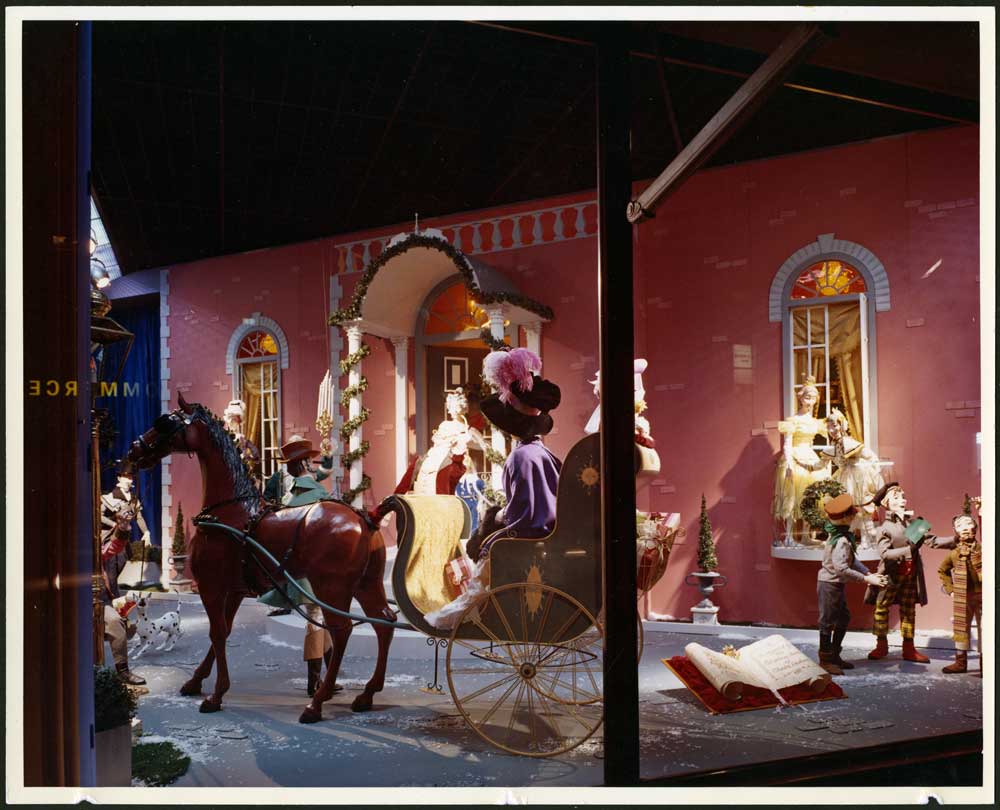
Eaton's hired Ted and Eleanor Konkle as freelancers to design the Christmas window displays in their Toronto store from 1953 to 1963.  Ted, a graduate of the Toronto School of Art, worked on sculptures for the displays.  Eleanor, a graduate of the Toronto School of Architecture, worked on costumes for the displays. 

Much of the work for the displays was performed at their home, where their two young children could be see the process.  Each Christmas display took about four months to plan and prepare.  Ted and Eleanor would do the research, make the items for the displays, and assemble them in the window. 

Each December, Torontonians would make the pilgrimage to see the fruits of their labour:  the results were nothing short of magical.  Here are some of the exhibits that the Konkle's created:


  • Santa's Toyland (1953)
  • Post Office (1955)
  • Town Square (1958)
  • The Twelve Days of Christmas (1959)
  • Renaissance Creche (1961)
  • Fantasia Animal Ballet (1962)
  • Home for the Holidays (1963)


Home for the Holidays (1961) courtesy https://pbs.twimg.com/media/CW2GNmyUAAAidX9.jpg.


Friday, 15 January 2016

How Eaton's Influenced Canadian Culture


"Eaton's Department Store, Simpson's and the Hudson's Bay Company were the three major stores that represented Canadian pride, nationalism and modernity in the late nineteenth and early twentieth centuries," 
(Donica Belisle, Retail Nation:  Department Stores and the Making of Modern Canada )


Eaton's helped bring Canada into the modern age with its catalogue which reached rural places that would otherwise not have access to its products.  Selling everything from farm implements to prefabricated houses to the latest appliances, the catalogue represented modern culture at its best.  As an Eaton's advertisement from 1892 announced:  "This is emphatically an age of PROGRESS.  The golden age is before us, not behind, and those who're unwilling to keep up with the procession will have the decency to STAND ASIDE." 


Eaton's represented Canadian nationalism and pride, particularly during the First and Second World Wars.  The Eaton's Catalogue displayed patriotic covers during the war years.  Gift baskets were sent to Canadian soldiers overseas to boost their morale.  Eaton's employees who served overseas had their jobs held for them until they returned.  Sometimes their medical expenses due to war injuries were paid by Eaton's.

Eaton's also affected popular culture.  The Santa Claus Parade, which debuted in 1905, set the tone for other major parades in North America (see http://alinefromlinda.blogspot.ca/2013/11/november-30.html).  Many Canadian children grew up watching the parade either from Toronto's Yonge Street or on their television screen.  Those children often grew up to be Eaton's customers.

Eaton's is even mentioned in Canadian literature, specifically the French Canadian folktale Le Chandail de Hockey (The Hockey Sweater) in which a young Roch Carrier asks his mother to buy him a new hockey sweater.  He is so disappointed when his mother, who writes to Monsieur Eaton, receives a Toronto Maples Leafs jersey rather than a Montreal Canadiens one.  For fear of offending Monsieur Eaton, Roch's mother insists that he wear "le chandail".  Being a Torontonian, I guess it only made sense that Monsieur Eaton would have been a Leafs fan.

Timothy Eaton has also left his mark on the world of religion.  A former Presbyterian who converted to Methodism during the tent revivals in Southern Ontario, Timothy was a devout Christian.  After his death, his widow had a church built in his memory, Timothy Eaton Memorial Methodist Church, later United, which is still in use today.


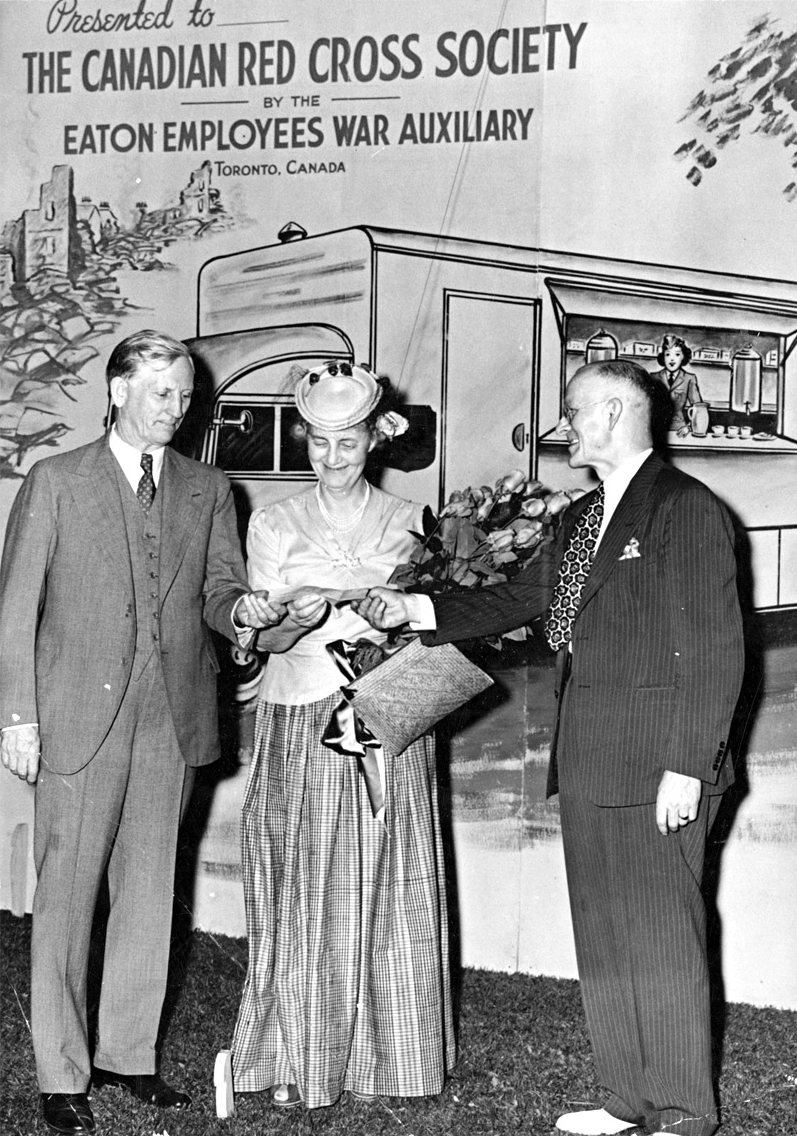

Flora Eaton, an active fundraiser for the Red Cross, allowed Eaton Hall to be used as a military hospital during the Second World War courtesy https://en.wikipedia.org/wiki/Feminism_in_Canada.


Wednesday, 13 January 2016

The Golden Age of the Department Store

"It's all a far cry from the golden age of the big department store, when it was a place you dressed up to visit, just as you did when boarding an airplane or attending an NHL game."
(Jon Wells, "The Way We Shopped:  Hamilton and the Golden Age of the Department Store")


When my dad was growing up in Toronto in the 1930's and 1940's, that was the golden age of the department store.  Eaton's was located downtown on Queen Street.  My grandma would put on her best dress, don her fur coat and hat, and climb on the streetcar to head downtown for some serious shopping.

Department stores were all about what was pleasing to the eye, "designed with Edwardian architectural touches, ornate doorways, huge display windows; and inside, Art Deco flair".  (http://www.thespec.com/news-story/5441351-the-way-we-shopped-hamilton-and-the-golden-age-of-the-department-store/). When my grandma took a trip to Eaton's, it was like a feast for the senses:  it never disappointed. 

Department stores were all about the ambience.  When my grandma opened the doors to the Eaton's store on Queen Street, she wasn't run over by a sale hungry mob.  She didn't rush down the aisles, her fur hat flying off her head, to find what she was looking for.  She didn't mutter epithets under her breath as she waited at the checkout with her purchases.  No, my grandma took her time when she shopped.  She waited patiently in line until she was served.  She thanked the salesperson properly for her service.

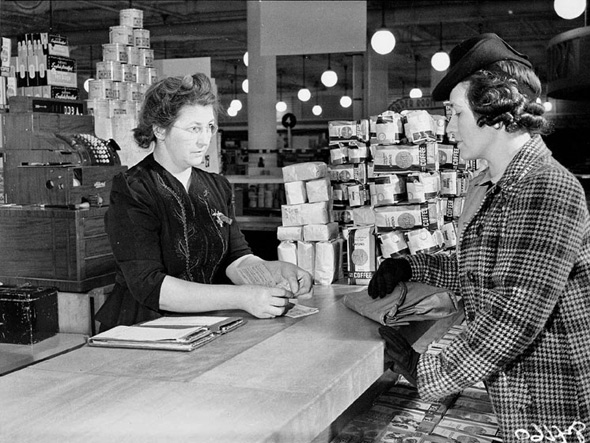
Department stores back then were all about service.  At Eaton's, she would be greeted by a polite elevator operator who would ask her what floor she wanted.  A courteous salesperson in the perfume department would greet her with samples of scents.  Another polite salesperson would help her pick out some children's clothing for my dad, maybe a pair of short pants that he hated so much.  A third courteous salesperson would help her pick out a spring hat for Easter.  In the shoe department, a sales clerk would help her try on a comfortable pair of shoes.  In the housewares department, a sales clerk would show her a selection of casserole dishes to purchase, since casseroles were her specialty.  At the candy counter, a sales clerk would fill a bag with some rosebuds which she would hand to my grandma with a smile.  The same elevator operator who brought my grandma upstairs would bring her back down, still smiling.  Grandma would exit the store, her parcels in hand, feeling quite good about the whole experience.